
Assigning Godhood
How a generation of artists make meaning in the digital abyss.
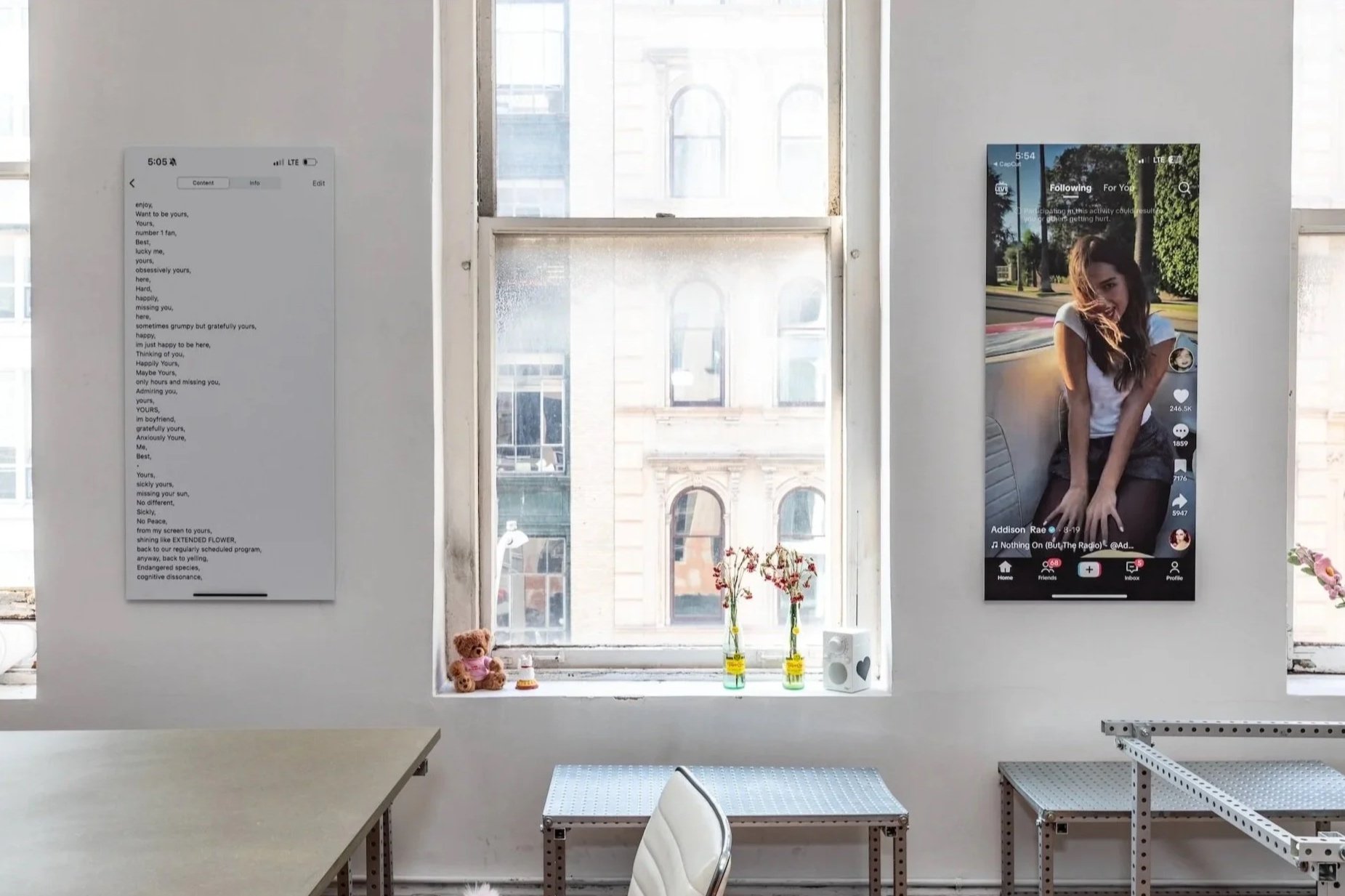
Maya Man has a screenshot framed on her wall. It’s a moment pulled from an Addison Rae TikTok, printed four feet tall, of the singer kneeling in the backseat of a moving convertible, an earnest look on her face. Superimposed over the image, semitransparent text warns: “Participating in this activity could result in you or others getting hurt.” The image is a remnant of Maya’s 2024 Sacred Screenshots exhibition, hosted at HEART, her SoHo studio-cum-gallery space, in which 26 New York artists presented a screenshot they felt resonated with them personally. Like much of Maya’s work, Sacred Screenshots reflects a preoccupation with subjective experiences of digital culture, and with navigating the muddled divide between what is denigrated as content and what is lauded as art. “I don’t think every TikTok is a work of art,” she muses. “I think a work of art becomes a work of art when an artist says it is one. It’s a very Duchampian kind of process.” Implicit in this statement, and in the decision to frame this particular show through the language of the “sacred,” is a recognition of the capacity for the mass culture of the internet to manifest intensely personal meaning, a critical site of inquiry for a number of young artists whose formative cultural experiences took place in digital spaces. Too disconnected in style, background, and philosophy to form a coherent movement, these artists nonetheless seem to reach for the same indeterminable question: How do we stay human in a world gone online?

Maya Man, (The Angels Wanna Wear My) Red Shoes #11, 2024. Image courtesy of the artist.
For Maya, a background in computer science (she received her Bachelor’s Degree in the subject from Pomona College in 2018) has driven her to explore this question via algorithmic randomness, encouraging hyperindividualized readings of her work. In (The Angels Wanna Wear My) Red Shoes, 2025, text and images from Depop listings for red ballet flats populate a screen in a random fashion, scored by algorithmically-generated sounds that correspond with each new entry. The piece loops indefinitely, allowing the code itself to enact a never-ending performance, a modernization of the fairy tale referenced in the title. “I like the idea that over the course of the piece running, the entire data set will unfold, theoretically, over time, but it’s up to the code to choose which pieces are shown in a given moment.”
Red Shoes probes the complex relationship between femininity, performance, and consumerism in the digital era, dynamics brought into contact repeatedly across Maya’s practice. Her insistence on depersonalization, on taking great lengths to remove her hand from the immediate experience of the work, allows the piece to function not as a dogmatic statement of her own conclusions but, rather, as an open-ended, mediating object through which viewers are encouraged to negotiate their own relationship to these dynamics. “It’s totally random,” she explains. “It’s not about me, it’s code. But I think that’s how a lot of the internet works. We are looking for ourselves in what we see online.” Consider the tendency to claim ownership of an algorithm, to describe a social media feed as “curated” or constructed “brick by brick.” With varying levels of legitimacy, users read the content presented to them by these algorithms as reflections of themselves. To view Red Shoes, or any of Maya’s algorithmic works, is to encounter a single permutation of an infinite many, authored largely by chance, and to search for yourself within.
“We are looking for ourselves in what we see online.”
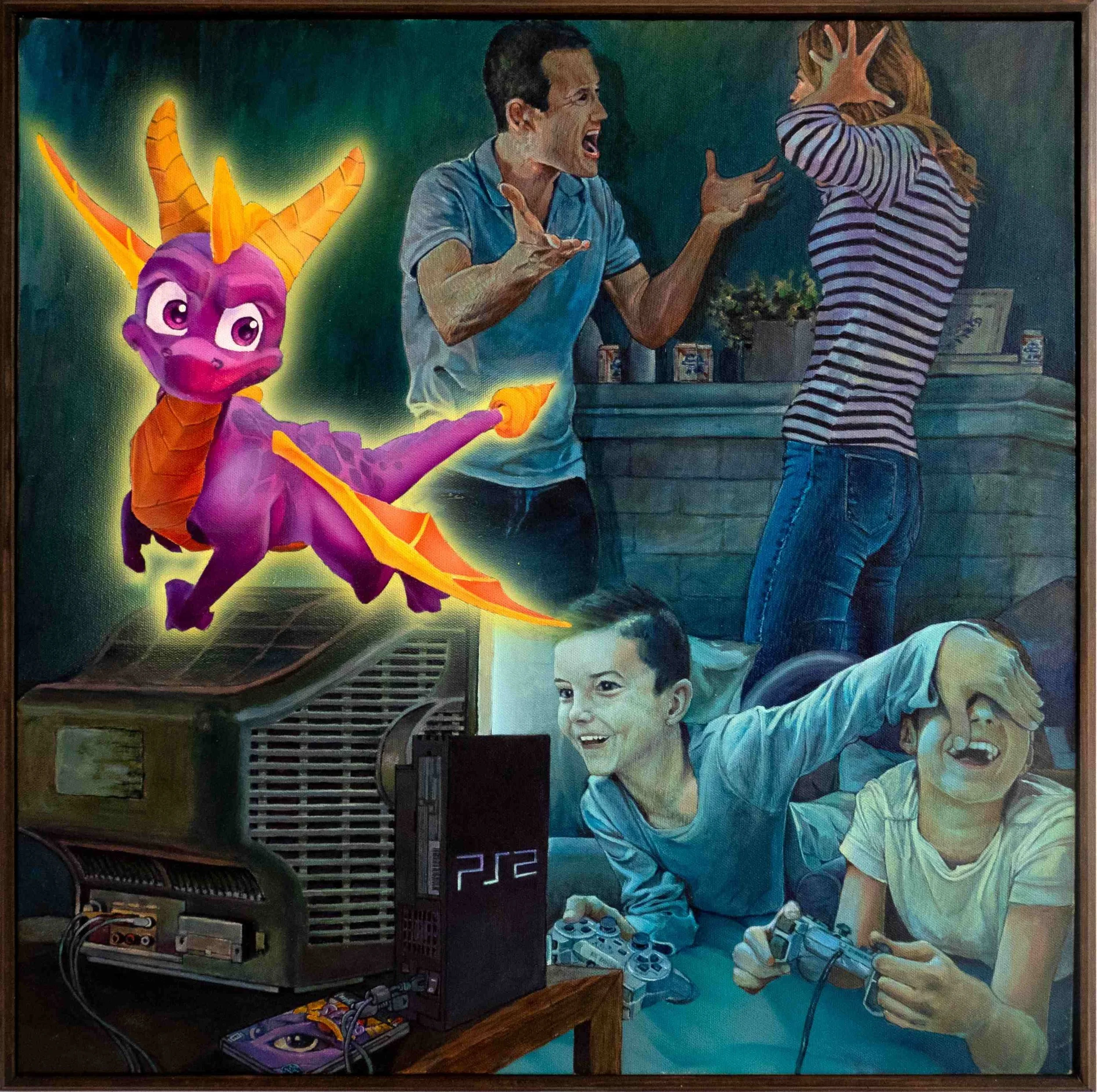
Angel Lovecraft, The best of times the worst of times. / Spyro the Dragon., 2024. Image courtesy of the artist.
Born just prior to the turn of the century, painter Angel Lovecraft’s acrylic and airbrush works forgo the individualized interpretation encouraged by algorithmic iteration, proffering nostalgia as another avenue by which representations of the digital might affirm the personal. The most potent of his works capture in profound detail the feeling of a certain era of digital childhood, little moments like sneaking a Nintendo DS Lite into a school bathroom or, as depicted in his 2024 painting The best of times the worst of times./ Spyro the Dragon., sharing a PlayStation 2 with a sibling. This painting, with its halcyon bliss set against a backdrop of marital conflict, is his favorite: “I think it hits. It’s relatable, empathetic. The whole point of art is to see reflections of yourself in other people and the things around you."
Angel situates his nostalgic scenes within the larger tradition of genre painting, in which everyday life is captured in honest relief. There’s a loneliness to many of his works, a feeling of suburban isolation rendered in their naturalistic lighting, their mundane backdrops, the way their subjects lean toward their screens, that resonates deeply with a generation of outsiders who found a sense of belonging and self-realization not in the stifling environments of their upbringing but, rather, in communities they first encountered online. “I make these paintings for myself, they’re of personal memories that I have. So I’m really shocked when I introduce them to the world and people relate to them,” he explains. “When I paint these feelings of loserdom or spending too much time on my own, I would hope that other people don’t relate to me. Or would at least, you know, put on a bluff. But I think it’s sweet that people relate to those feelings.”
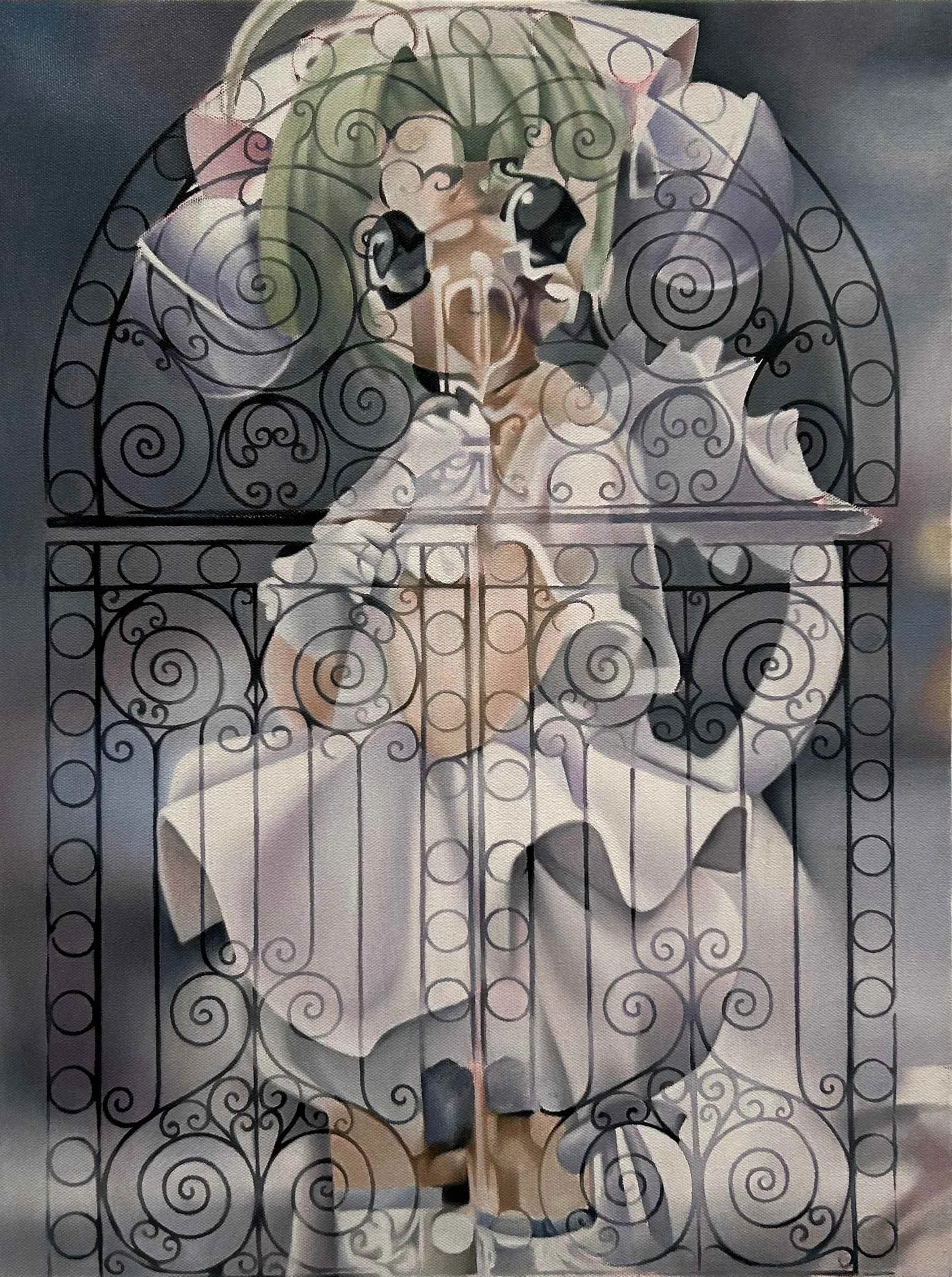
Bun, You Will Never See The Heavenly Gates, 2025. Image courtesy of the artist.
This approach has proven influential. One artist, known mononymously as Bun, cites Angel as a direct inspiration in her decision to pursue her BFA in painting from Pratt Institute, the program from which he graduated in 2022. Bun’s practice draws aesthetic language from anime and furry fandoms, two subcultures for whom online community has historically functioned as an essential foundation. Like Angel, she locates her interest in these subjects in early feelings of alienation, and in a desire to reflect back on how those feelings informed her developing understanding of self. On her childhood encounters with anime, she recalls: “Watching it at a young age very much informed how I viewed myself as a young woman. I was seeing these characters that were supposedly my age, that had slim figures and huge chests, and it made me feel like there was something wrong with me. I think that I pulled a lot of insecurity from that, not knowing that was going to inform the way I viewed myself in the future.”
Lately, her work has demonstrated an increasing interest in engaging with these characters as explicitly digital objects, and in elaborating the quasireligious treatment granted these digital objects by those who engage with them. In You Will Never See The Heavenly Gates, 2025, an angelic, anime-style character is framed behind an ornate metal gate. This configuration, characters contained within geometric structures, is typical of her recent output. “A lot of my work now is very interested in religion and how, in online spaces, we wor- ship things that will never meet us in a physical space. I wanted to create these cathedral-like structures around these fake characters that we love so much. Almost like altars to a God.” The internet, in its vast unknowability, its underlying logic known only (and often, still, incompletely) to those who design it, has long evoked this kind of spiritual reading. Considered within a religious framework, it becomes easier to locate the origins of the artistic fixation with the personal dimension of the digital. Experienced as a constant bombardment of information, the overwhelming body of all human knowledge, concentrated all in one place, the internet functions as an existential space into which artists, as well as everyday users, must project their own meaning.
“A lot of my work now is very interested in religion and how, in online spaces, we worship things that will never meet us in a physical space.”
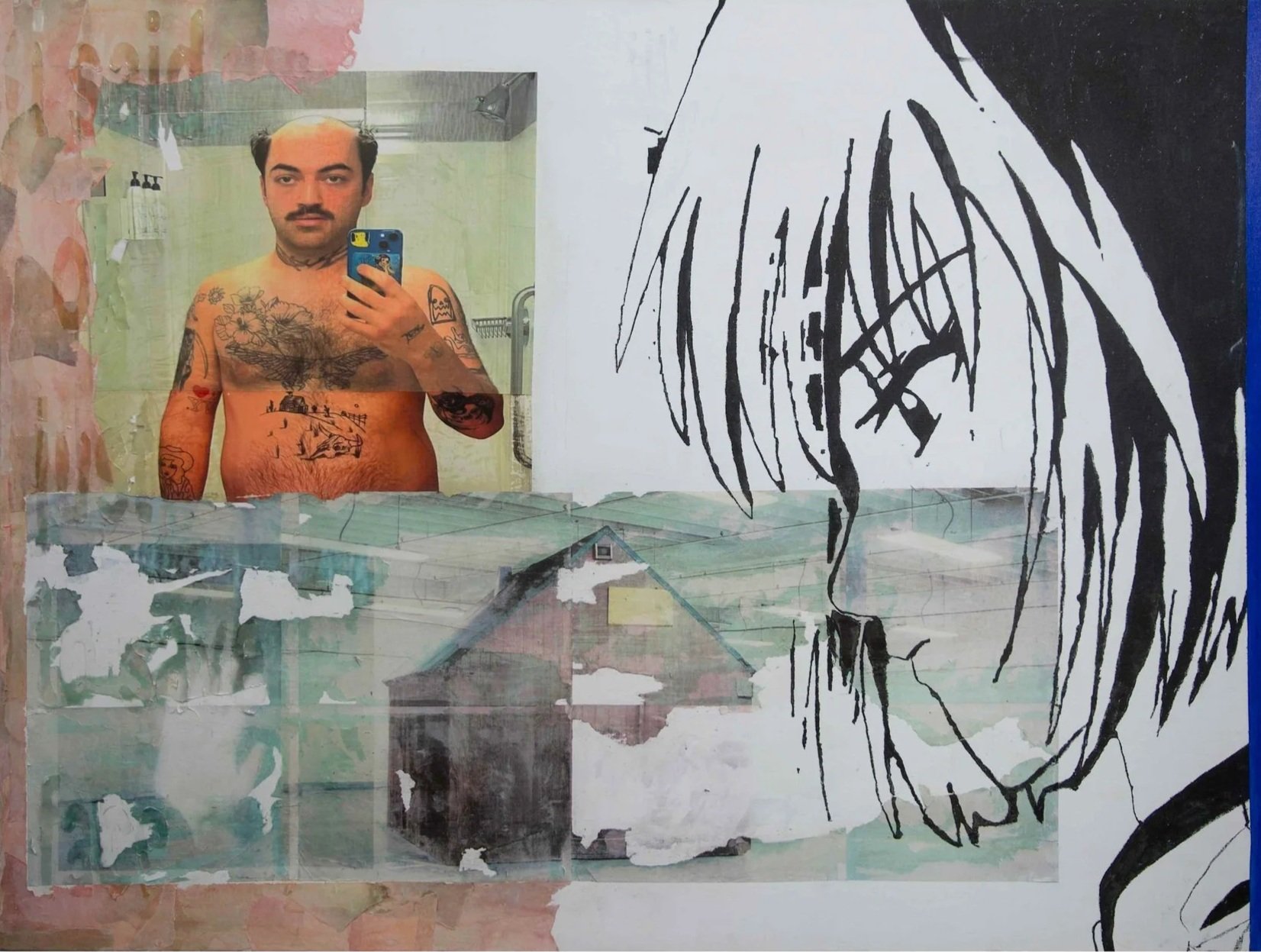
Clayton Harris, symbiopsychotaxiplasm (i said ok just to save face), 2025. Image courtesy of the artist.
In some respects, this is terrifying. “You know that meme where Shinji from Evangelion is sitting on a chair and there’s just so many words around him?” mixed-media artist Clayton Harris asks, referencing an oft-shared image of the anime character wracked with guilt, whose connotation online has gradually shifted toward the expression of a more generalized overstimulation. “That’s how I feel every day. It’s a lot all the time and I think that’s what I try to talk about in my work: a loss of identity and living in this blur.” Yet, there’s an opportunity here as well. “Images, nowadays, don’t mean anything,” he asserts. “I think they lose their original meaning and become personal really fast.” Clayton’s piece symbiopsychotaxiplasm (i said ok just to save face), 2025, incorporates three seemingly unrelated images, including a reproduction of a shirtless selfie taken by internet sensation Will Mahony, best known for his earnestly degenerate short-form social media videos. There’s no immediate statement in Clayton’s decision to include the photo, but its presence invokes a vague affiliation with Will's patent brand of dirtbag hedonism, an invocation muddled by the simultaneous inclusion of an anime character (Evangelion’s Rei Ayanami) and an image of solitary barn situated under sterile warehouse lights. The title of the piece references William Greaves’ 1968 experimental film, in which fiction and reality collapse into themselves as numerous, nested documentary crews follow the production of a film directed by Greaves himself. The disconnected images of Clayton’s work seem to update this intricate narrative structure for a digital age, reproducing his own experience online in a disparate barrage of internet-adjacent symbols which collide, lose meaning, and generate it again from within.
“Experienced as a constant bombardment of information, the overwhelming body of all human knowledge, concentrated all in one place, the internet functions as an existential space into which artists, as well as everyday users, must project their own meaning.”
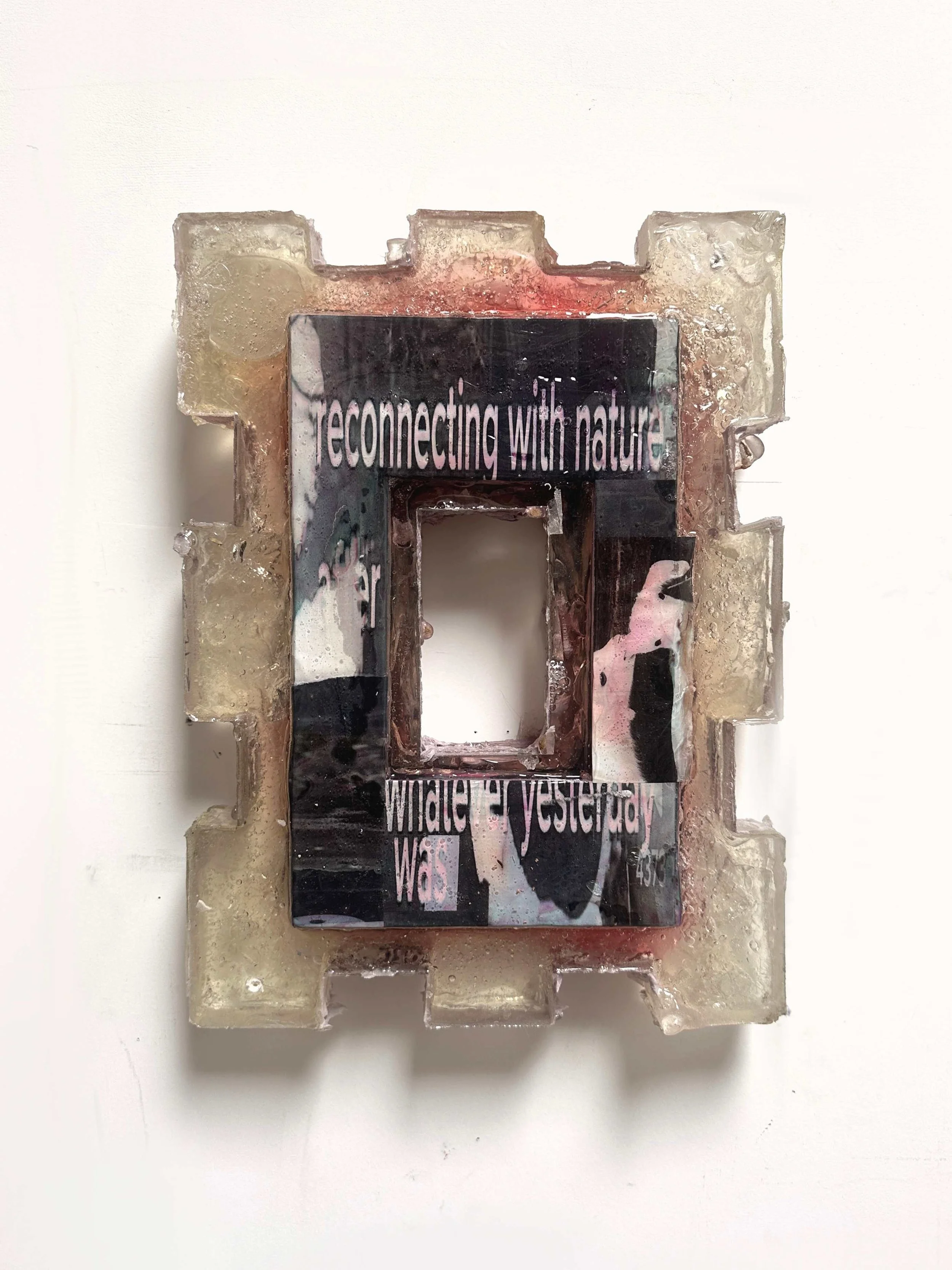
Zoe Alameda, you doing absolutely NOTHING means absolutely EVERYTHING to me, 2025. Image courtesy of the artist.
Another answer to this loss of identity, the dissociative response induced by the onslaught of digital noise, might come in reasserting the presence of the flesh. If the digital is a cerebral space, an information ecosystem divorced from any one body, multidisciplinary artist Zoe Alameda’s hybrid, sculptural works process the complex feelings provoked by its images through a practice of physical accumulation. “I find it difficult to articulate a really sensitive and vulnerable emotion,” she confesses. “But I want to do it so badly. The only way that I’ve really been able to approach that is through painting and collage and ripping and resin, because there are no words inherent in that act.” Grafted together into misshappen, Frankenstein forms, these techniques build toward capturing that indescribable sensation. Zoe expresses a fascination with “cursed images,” uncanny photographs divorced from their original context, which evoke a profound feeling that they shouldn’t exist. The tactile nature of her work, where texture is equally important, if not superior, to subject matter, might be read as a direct response to this feeling, an effort to grant the disembodied digital a new, physical context. In you doing absolutely NOTHING means absolutely EVERYTHING to me, 2025, meme-style text is swallowed by a thick, mucoid gel—as if the wry, self-mocking sentiment of the words has been overtaken by something physiological, something abstractly (yet undeniably) human. “I need to feel things tangibly,” she explains, to feel connected to them. “Memes are a mask. Humor and irony, in general, are a mask for not fully confronting the feeling that I’m feeling.”
Resistance to irony is a common sentiment among these artists. Without fail, they seem compelled by some decentralized instinct to reject the “meme art” of the previous decade, which through sardonic wit shies away from the absence of meaning threatened by the digital, refusing to face it head on. There is a yearning instead for something sincere, something grounded in authenticity. Brooklyn-based painter Pasha Smelyantsev argues that the ironic mode is, in the long-term, fundamentally incompatible with developing a craft: “That detached, overly conceptualized thing is really good fuel for commercial art. You can make 100 paintings real easy if all of them are ironic and you don’t really care, but you’re not pouring your soul into it.” Pasha’s paintings are dominated by repeated motifs: numeric symbols, curved crosses that evoke the fleur-de-lis, and five-pointed stars, among others. To the digitally-minded, their structured arrangement recalls a layered interface, with symbols and subjects operating on distinct planes.
Yet, Pasha resists a wholly digital reading of this symbology, locating them at a point of intersection between contemporary graphic design theory and illustrations found in early medieval manuscripts. Nowhere is the latter of these origins clearer than her 2025 painting, FatChance2Live., in which the arrangement of these symbols over a swirling, hellish background reveals the shape of a cross. Regardless of origin, their inclusion carries ritualistic weight. “They’re utilized as a signifier of my hand,” she clarifies. Carried over across works, these symbols become a mark of identity. “It feels like doing something instead of writing my name. I don’t like signing my work. I don’t do that, ever.” It’s a radical movement away from the commercial art arising from that ironic mode. An affirmation of selfhood and soul, over and over and over again, on her own terms.
The internet is vast. It’s empty and it’s overflowing, all at once. It demands a response. Give yourself over to the boundless expanse or demand your body with a devotional hand, the choice is yours alone.
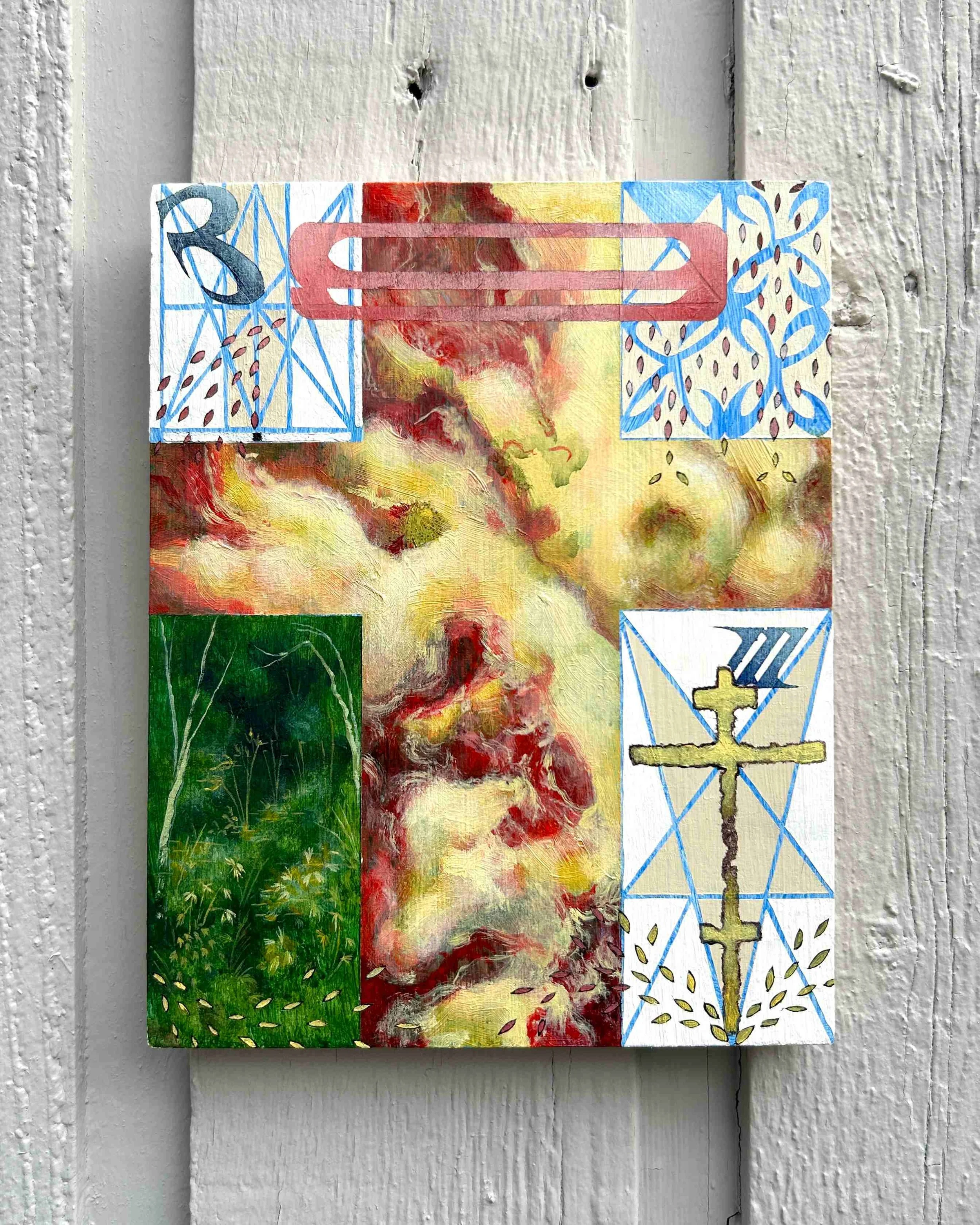
Pasha Smelyantsev, FatChance2Live, 2025. Image courtesy of the artist.
Here, in this symbolic identification, is the unifying point. Online, far more easily than in the real world, we are given a chance at self-invention, an opportunity to create ourselves in our own image. The internet is vast. It’s empty and it’s overflowing, all at once. It demands a response. Give yourself over to the boundless expanse or demand your body with a devotional hand, the choice is yours alone. It wasn’t always like this. In the late 1990s and early 2000s, the internet experienced a shift. “For a long time, for most people...the internet was more of a read-only experience,” explains Maya. “You had to be pretty technically literate to put something on the internet. You didn’t just click a button and upload something like you can on Instagram now. Increasingly, all of these different platforms have made it much easier to write to the internet, to upload content.” Critics of the hyperparticipatory, social mode of behaving online encouraged by this shift decry the narcissism of posting, its projection of self, the supposed impossibility of authentic connection via digital means. Many of these artists voice the same concerns. But they share an optimism, too. Angel tells me: “When I talk to people that are younger than me, there’s a sort of tech dystopian world view, and that is a reality, but I think there’s still a version of the internet that’s saving the world. It’s one that I think is real and genuine. I think it saves everybody every day, you know?” It’s a matter of perspective. Stare too hard at the irony and you might miss the sincerity, the earnest attempts at connection, the act of creation—the immaculate conception within.
Thus saith Bun: “We’re assigning godhood to the things that make us feel more comfortable, the things that give us that connection that we might not be able to achieve in a physical space. Because it’s hard to talk to people. Because we were all raised online.”
“We’re assigning Godhood to the things that make us feel more comfortable, the things that give us that connection that we might not be able to achieve in a physical space. Because it’s hard to talk to people. Because we were all raised online.”
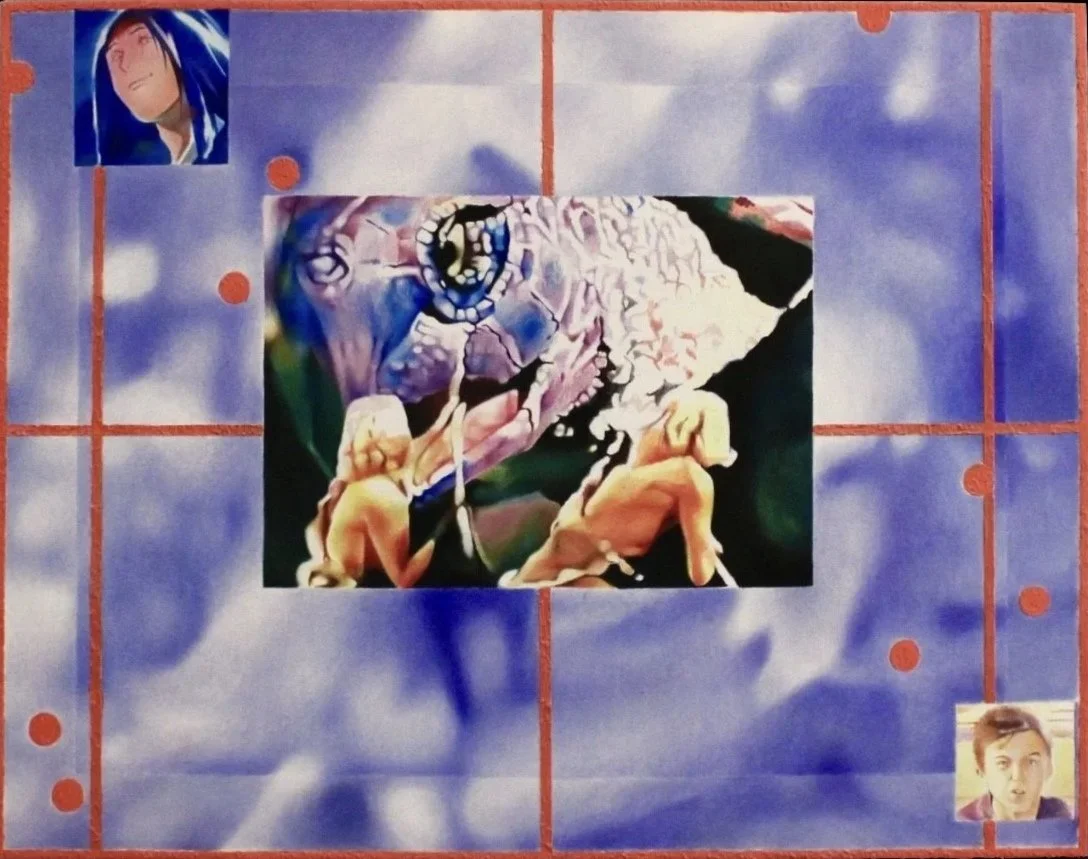
Bun, Untitled Malcom in the Middle painting, 2025. Image courtesy of the artist.
This story was first published in Issue 03: The Signature Issue in Spring 2026.