
Constellations & Root Systems
Sisters Celia and Ava Liberace dissect their shared lineage, from memories of passing drawings under the dinner table to cutting each other’s hair in the bathtub. After divergent college paths, their sisterhood has deepened in adulthood as they’ve identified their artistic practices as constellations and root systems—distinct yet parallel methods of interpreting the world. Every artwork in this story is a portrayal of one sister made by the other; a reflection of their evolving relationship that now grounds their art and transforms it into an act of listening, translation, and generational creativity.
Moderated by JANE LEWIS
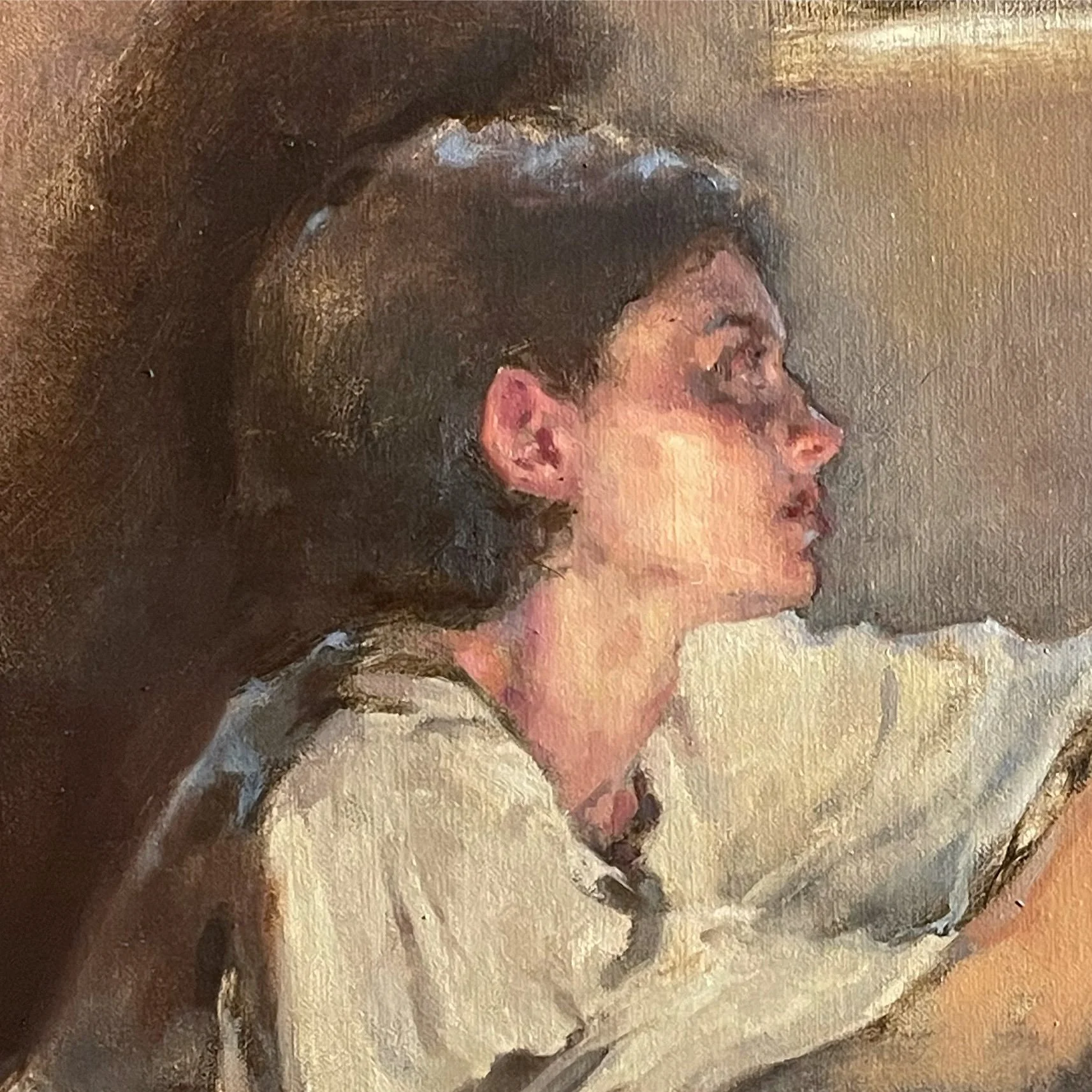
Celia Liberace, Diotama and Disciple, 2025
AVA LIBERACE: Celia and I were just in Ireland and it was incredible. We went to Mountmellick where our family lives, and it was beautiful. Everything melted away—we were playing music in the car, driving down the roads and seeing the whole landscape. It was so magical. It was the first time that we traveled there just the two of us without our family.
CELIA LIBERACE: Our grandmother grew up there. You look out the window and see the beach and a tennis court. And then probably a family member. In the mornings our cousins would just knock on the door in the morning. Not that we would know their names necessarily because they're distant, but everyone's kind of interconnected which is special. Generations of small town relationships.
JANE LEWIS: That’s beautiful. Where specifically did she grow up?
AVA: In Ballycastle, the north eastern tip of Ireland.
CELIA: You can see Scotland from beyond the ocean. It's that far north.
JANE: Did you get to travel a lot during your childhood?
AVA: Our dad is an art teacher and he would travel around and host workshops. It was only in the past six years or so that we started getting more involved in helping out. We're in Essex right now and we're helping with organization and workshop maintenance. We're taking the class alongside that: figure and portrait drawing and painting, live model sessions every day with a focus on a specific material or technique.
CELIA: This year's kind of [Ilya] Repin inspired, or John [Singer] Sargent inspired, so it’s very stylistically akin to a certain artist or a time period.
JANE: Is your dad the one who introduced you both to drawing and painting?
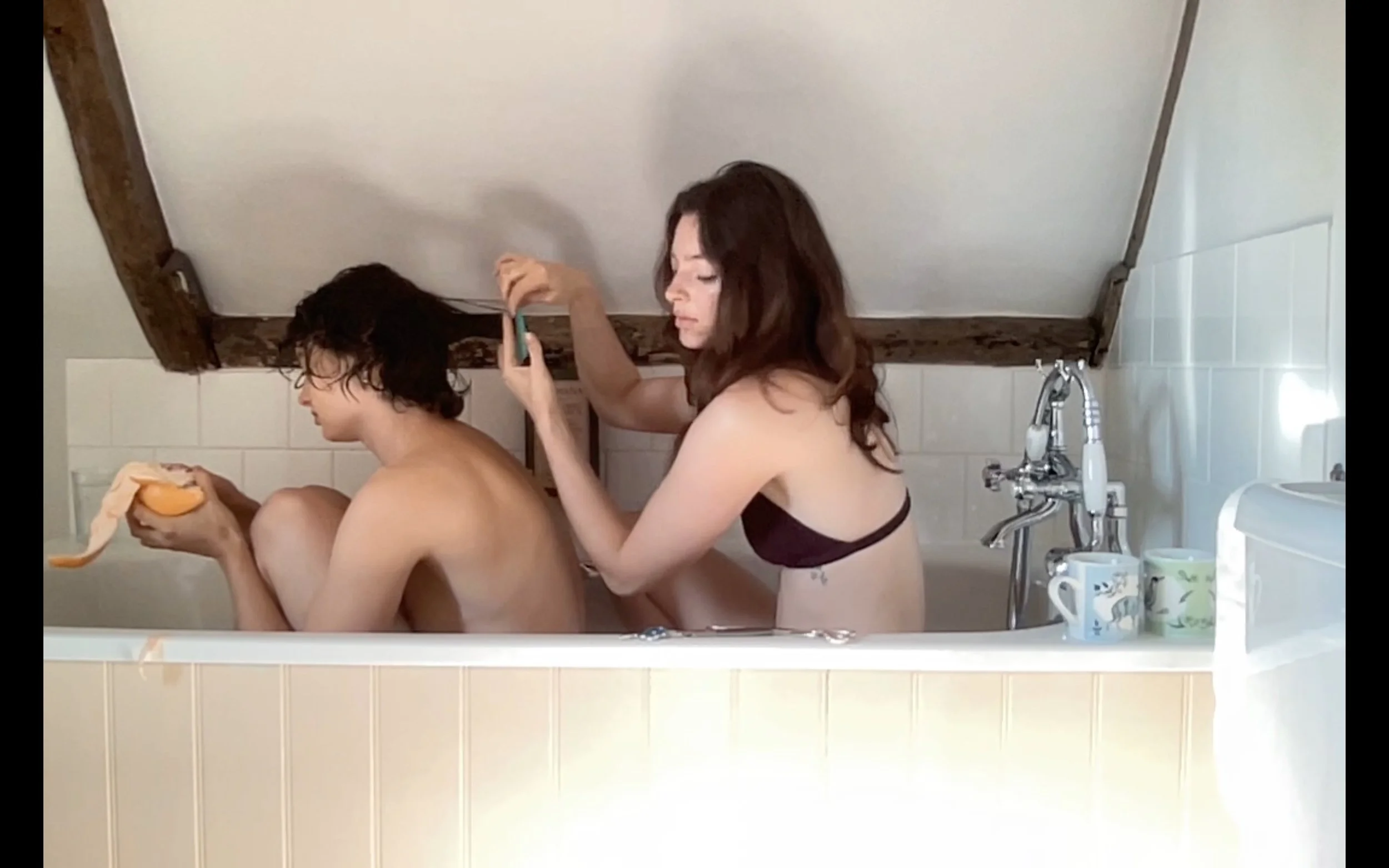
Celia and Ava Liberace, Hair cutting during family roadtrip through the Cotswalds, 2025
AVA: He never pushed it on us but we definitely were exposed to it in our childhood. We had a lot of sessions around the dinner table where we'd put a skull in the center and we—my mom, Celia, my dad and I—would all sit around the skull and just sketch. I have really strong memories of that. And traveling with my dad's class, they all became a bit of a second family. We would just sit outside a church and draw the architecture. We have a lot of photos of us when we were young drawing churches and exteriors.
CELIA: It was very intrinsic to our family culture. We bonded through art making. It was woven within our day-to-day, rather than something that was imposed on us.
AVA: Our parents taught us different things. Mom is really into leaves and picking fallen plums up off the ground or picking up cool sticks. She's very observational and very curious about her surroundings. She taught me to be observant of the natural world. My dad definitely instilled more technical points of view.
CELIA: He taught us discipline as well, and to be curious about how to navigate a three-dimensional world—interrogating the systems that are all around us to find what's actually fruitful and truthful versus what's illusory. It was intrinsic, also, to art lessons. What’s important when you're looking at a figure and what's an optical illusion?
AVA: It sounds kind of like a mind game. It's funny, we’re all bonding over mind games.
CELIA: That’s what art is, dude.
JANE: Art is a mind game, I love that. What are some of the systems that you two feel inform your work?
AVA: You know, I was thinking about this recently because Celia just taught a class in Sweden and it was the first time that I understood your system.
CELIA: Oh really? Interesting.
AVA: What I learned from you throughout these years is how you symbolize features, or symbolize what you see. You have a certain type of mark making. I want to hear what you think your system is, but I feel like it’s this general interpretation. You take key points and then you symbolize them through a shape, and then you connect them through a web and so it becomes a web of symbols.
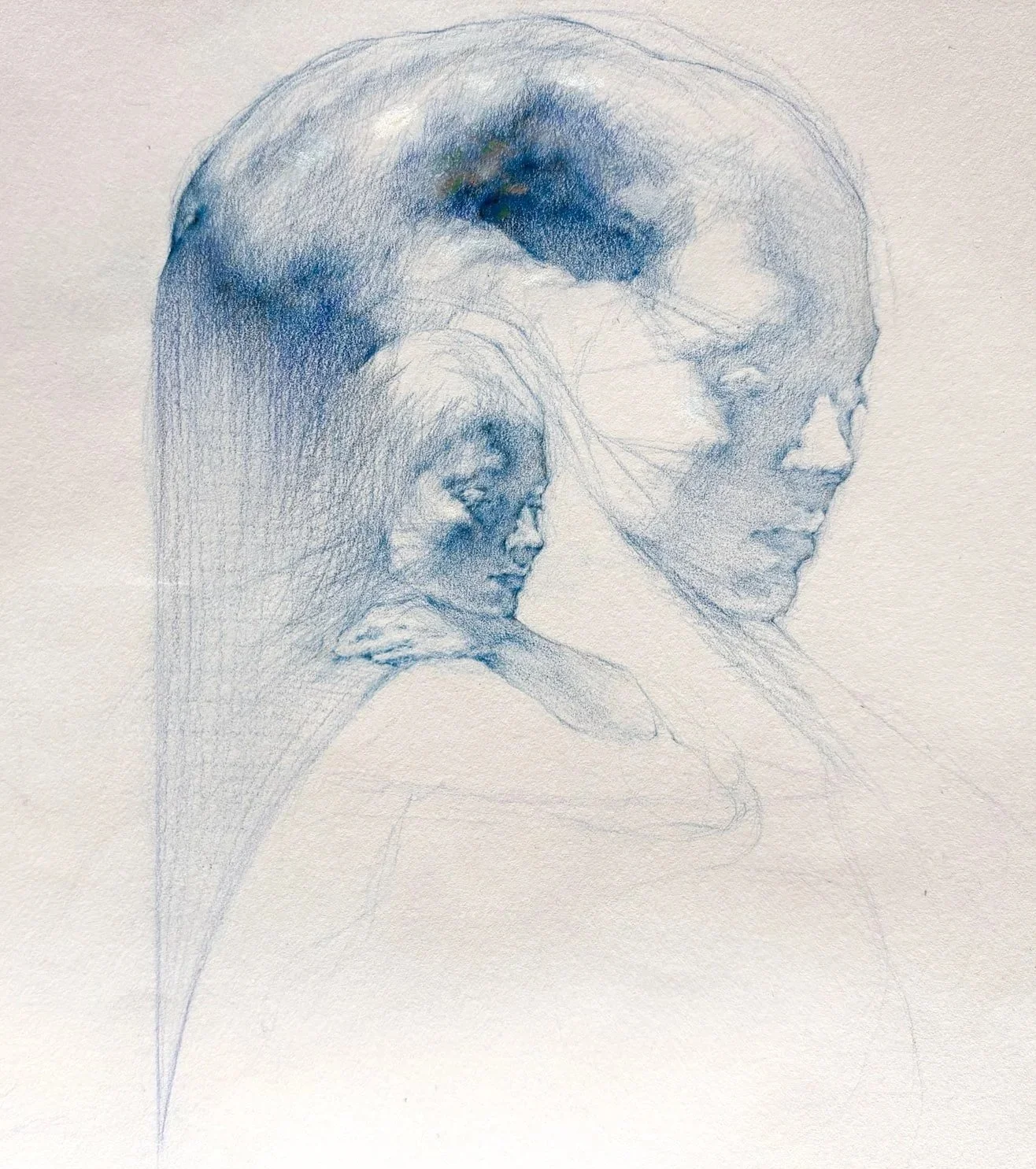
Ava Liberace, Seal's World, 2025
CELIA: That's so Gemini! I'm a Gemini. That's what a Gemini's brain is like. Some people have described my style—or mark making—as constellation points, which really resonates with me. It made sense that I'm feeling out a form in an energetic way. I think that it's an energetic translation when I'm trying to transcribe or interpret something that I find beautiful or compelling. It's like a dance where you're feeling into something and touching it, feeling the contours, and pulling out a certain energetic concentration. Maybe your model is older and they have a lot of lines concentrated in their forehead. You know, that's a memory, an accumulation of experiences and you naturally feel into that. It's an energetic exercise for me more so than a technical or mathematical one.
Your practice, Ava, I feel is very much based on root systems. Trees, micro-rhizome systems within the ground. They’re breathing and intertwining with one another beneath the surface. You feel into it, breathe into it. It's very intuitive in that way. I think really good artists that I follow, no matter what medium they use, have this sense of listening and breathing into something and then conveying their message through that interpretation.
JANE: Do you think listening is as important as seeing in art?
CELIA: Yes. Totally.
JANE: Do both of your references come from these constellation points and root systems, or do you also have artists that you look to?
AVA: My dad, he had his teachers, but he's pretty self-taught in the way that he never went to an academy. So he learned by copying these artists, these master portrait painters, like Sargent, [Antonio] Mancini, [Pietro] Faccini—those are the main three whose techniques he borrowed and then instilled in us. Even if I’m just drawing a shadow, he's like, "Oh, that's super [Andrea] Fortini of you." All different techniques and styles that inform how you interpret your translation, so we had a balance of all these references. And that, for me, is a constellation point in another way.
“Drawing is like a dance.”
CELIA: Music is a reference, too. There's a lot of musical references to how artists tell a story through a tone. How can you find, maintain, or develop a tone within your piece that resonates with you and is tied to a certain message? Not that I’m very message oriented, but I think music and sound and auditory landscapes are a breath of fresh air outside visual language. When I grew up with these references handed to me, I needed to ask myself, “Well, is this really me? Or is it more tied to my family lineage?” So it was really important for both of us to step away from art as our main source of inspiration as a whole. Both of us got really into music, tones, and sounds. It's a different way of translating a story because it's within a brief period of time whereas a visual piece of art is eternal in some ways; there's no beginning and end, it's just there. You receive the information all at once for the most part.
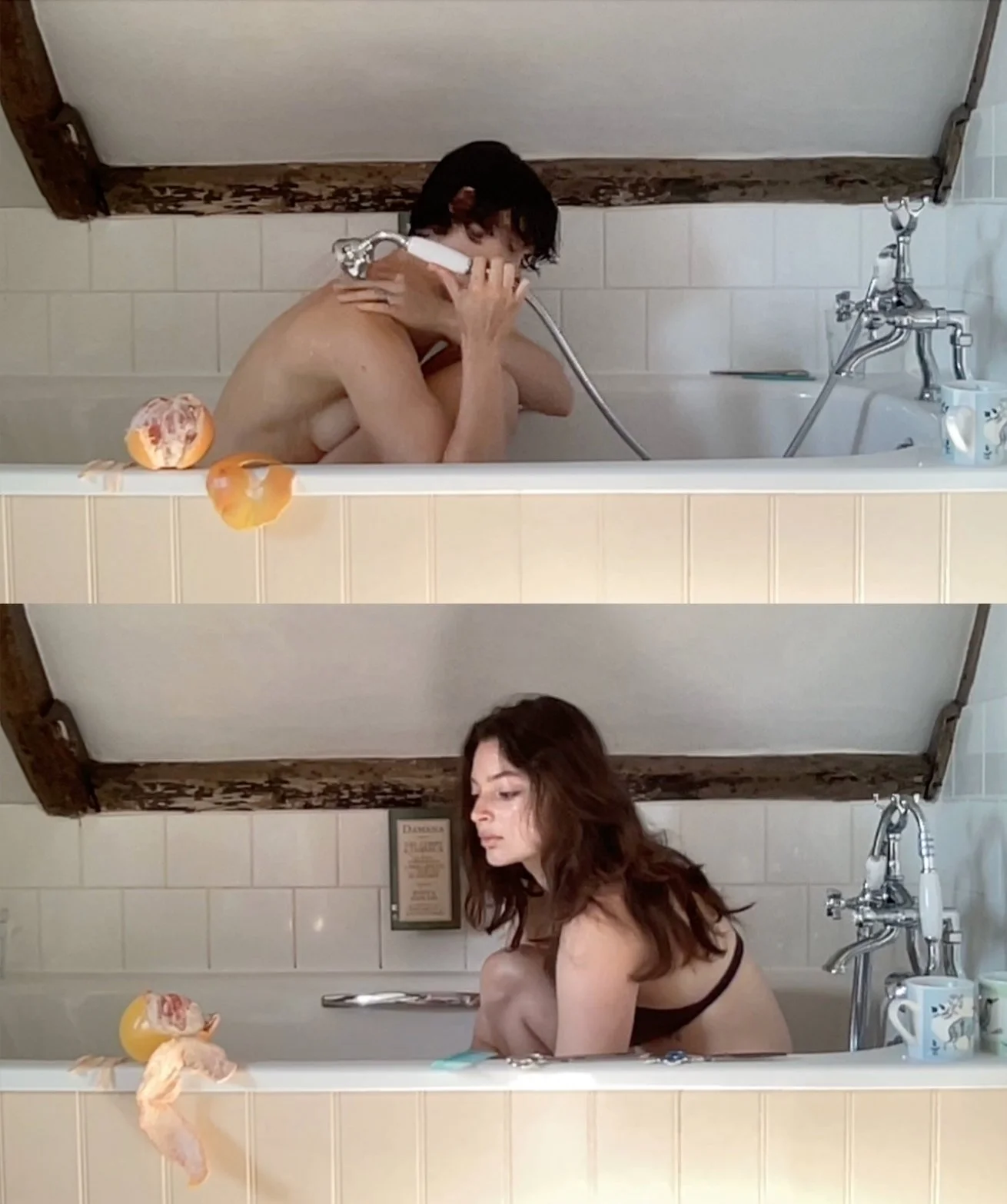
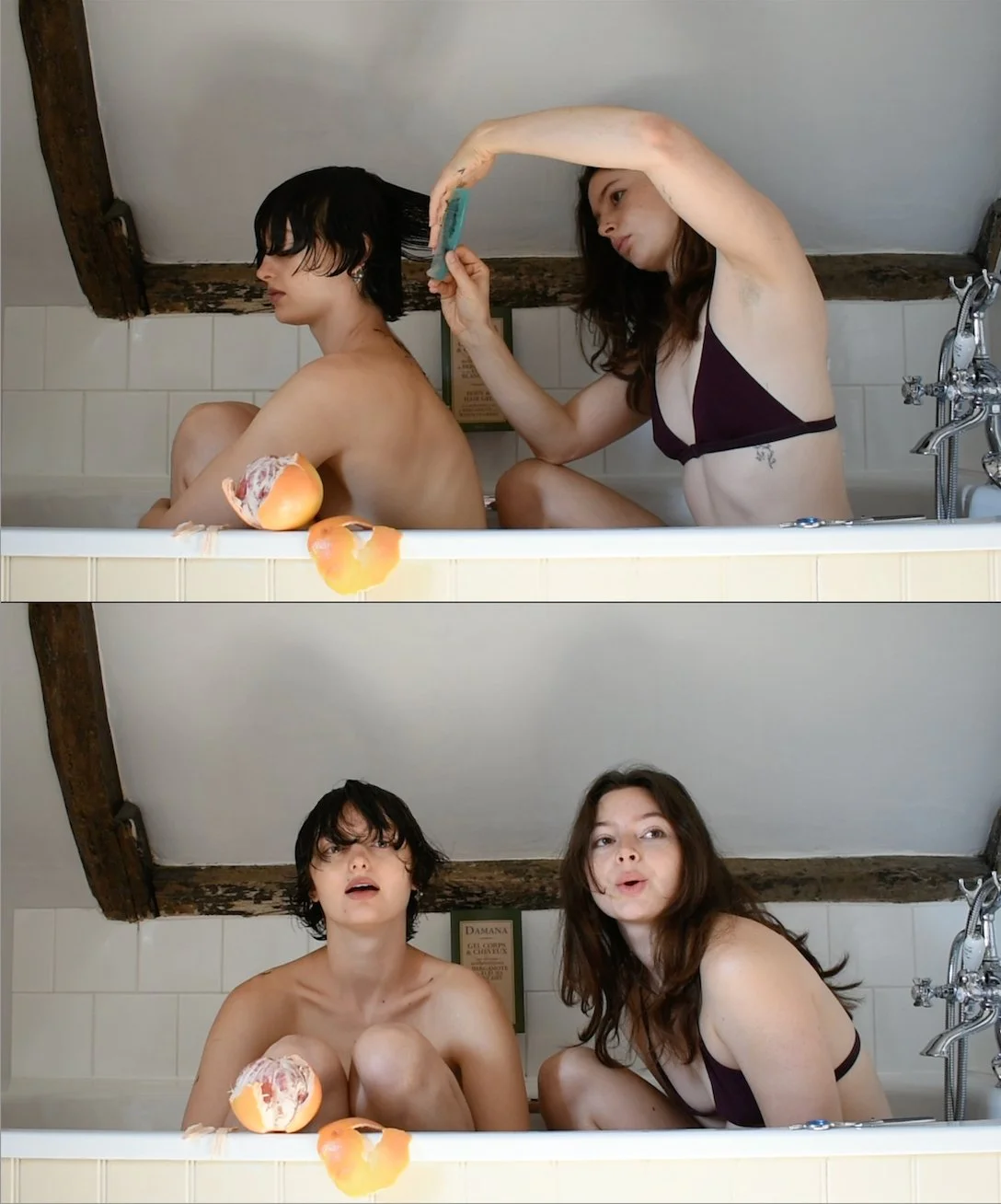
AVA: I like the idea of translation. Especially as we’ve gotten closer, I feel like our music tastes have started to blend. We started talking and listening to each other more. Our communication got so much stronger with the addition of music and other mediums that didn’t necessarily come from our parents. I feel like the bathroom is a core place of connection for us, too. When we had these big arguments, we’d go to the bathroom, specifically the bathtub, and just talk about it. Listen to each other, try to understand where the other’s coming from and how we were translating each other’s words. Then we would come to a resolution. We kept returning to the bathroom. And now we cut each other's hair in the bathtub. It's so cute.
JANE: What other memories do you have growing up with each other?
AVA: We didn't really get along. I remember watching Frozen (2013) and Anna was shut out by her sister Elsa. I was like, “That's us!” because we didn’t talk that much. We didn’t bond! We lived very separate lives, but we shared a room.
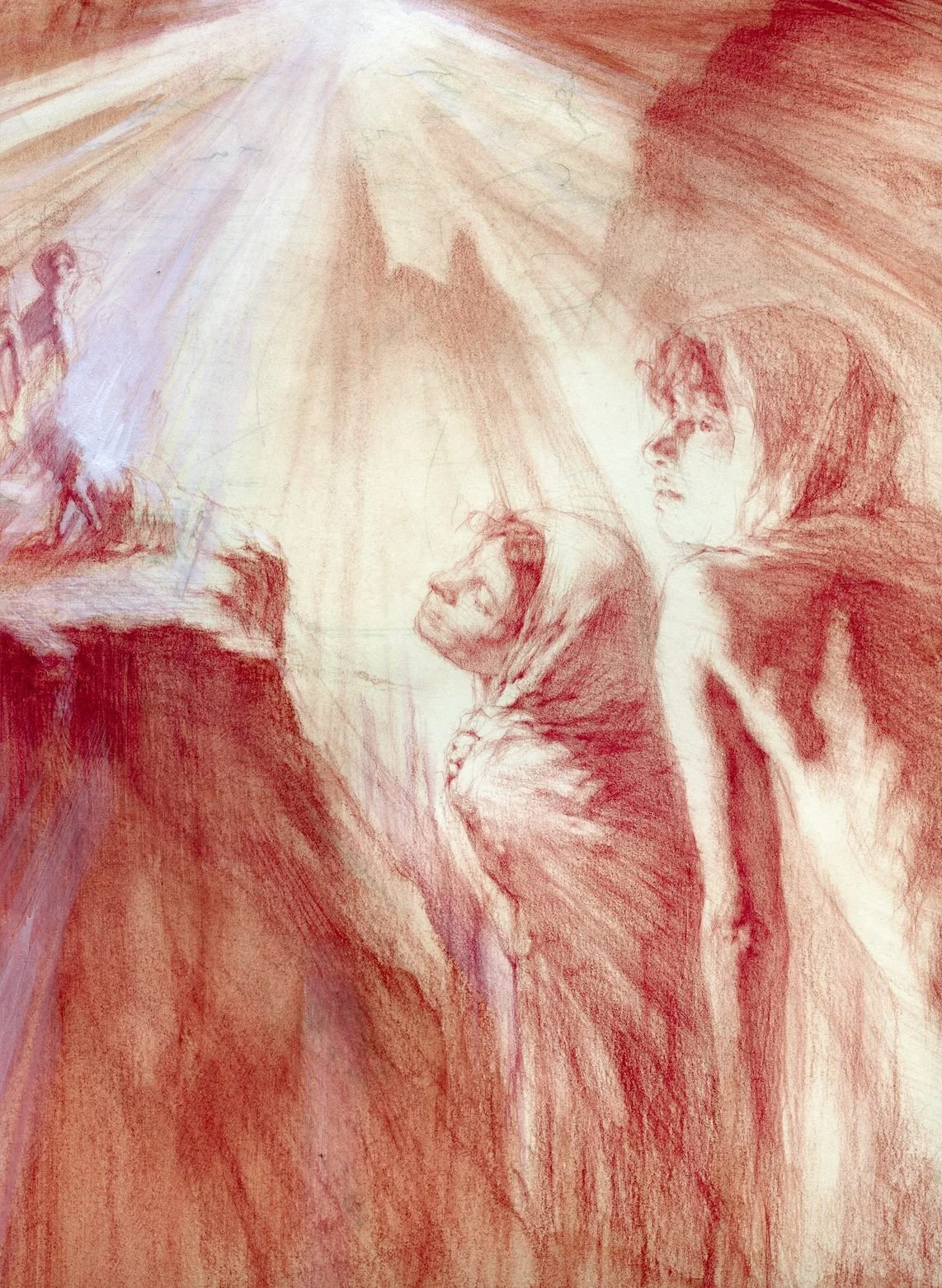
Ava Liberace, Pinnacles, 2025.
CELIA: Yes. By sharing a room we knew each other's tendencies, but we weren’t close.
AVA: I don't remember a lot of bonding moments when we were really young except for playing a Rembrandt memory card game during Christmas time. Or if we were at a big family dinner, Celia and I would pass drawings back and forth kind of like pictionary, growing the drawing. All silent ways of bonding with each other.
CELIA: I do think we bonded very silently. We were just very different. Our personalities were so different as kids and I think I experienced some resentment and a little bit of confusion.
JANE: How would you describe both your personalities when you were young?
AVA: More generally, Celia was a bit more reserved and I had sporadic energy.
CELIA: Ava was really good with people and getting the best out of everyone. You talked to everyone on the street and I was terrified of talking to people and sharing myself. You were very passionate about living in general, and exploring. At least that's how I interpreted you. I think I resented that. How do you have so much fun all the time?
AVA: That's so interesting. I've never heard that from you before. I always thought that you had a beautiful way of translating the world, just silently. You always had a notebook with gorgeous sketches. Art became a medium for you earlier on in life than it did for me. You absorbed the world in such a beautiful way.
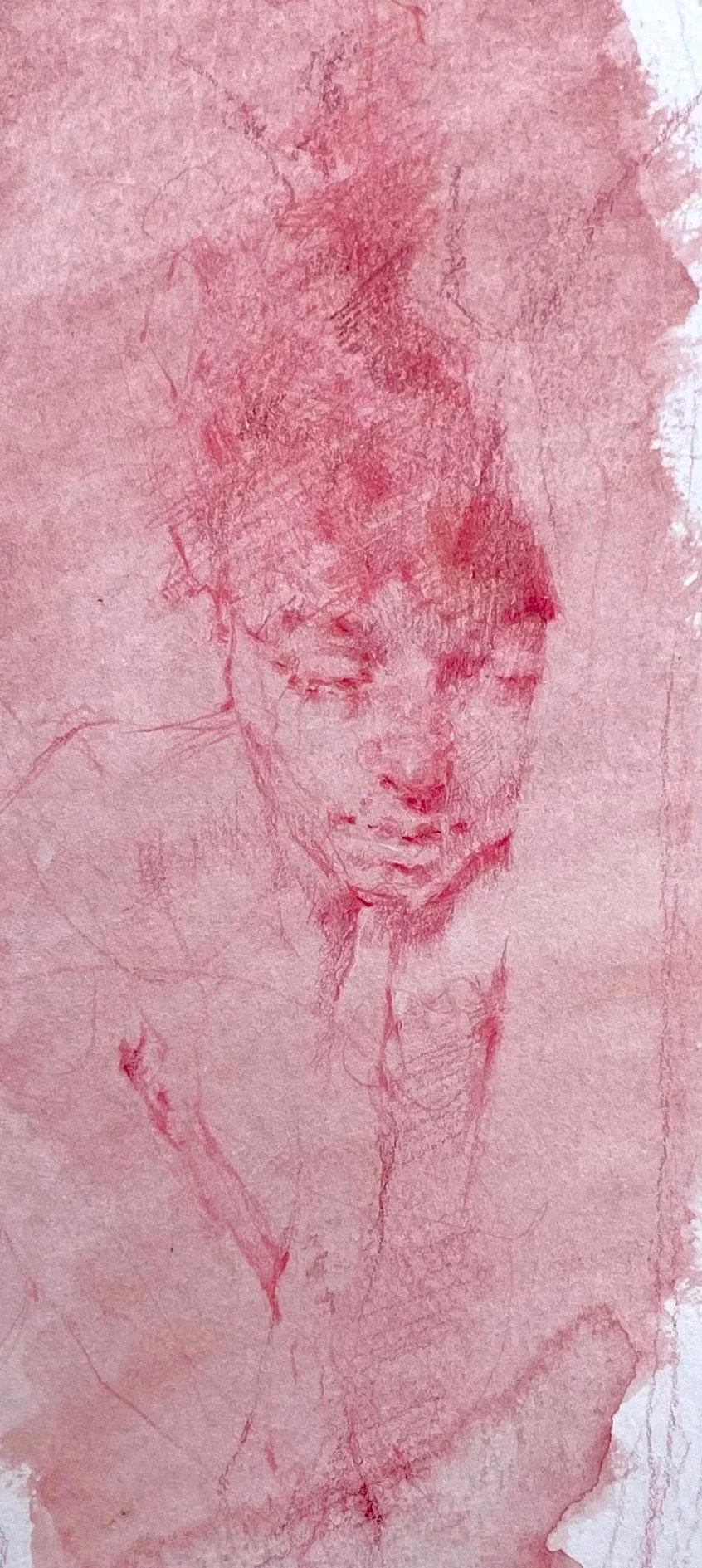
Celia Liberace, Aves in 71 beadle, 2025
CELIA: When I went to college I started to realize we're actually living such parallel lives and I had never noticed that before. You’re going through exactly what I went through two years ago. Like, verbatim: every step, every little nook and cranny of the relationship with my mother and my father, or my own relationship to art. I can see myself in her and that was a turning point in our relationship. It's so crazy how I had so much resentment before. I just wasn't looking closely enough.
JANE: How did going to college inform your relationship to each other and your relationship to art?
AVA: It was the first time that I had my own room and that totally changed my relationship with myself, but especially with art. I became more explorative with my alone time, spending so much intimate time with myself through drawing. I move a lot when I draw and I think it’s really important for me to crawl and stretch and run, and then draw. I can only really do that when I'm alone and feel most comfortable. There's something so special about being alone with yourself and feeling comfort in your own presence. I think the separation between us was good in every realm of my life. But how was it for you, going to college?
CELIA: I had my own room in college too. I went to Cooper Union. It was bizarre. Everyone who goes there is a little bit of a tortured soul. You get all of these people who are reserved, a little scared, but also really creative, all in one small space in the middle of Manhattan. It's just a weird energy, very surreal. I definitely learned a lot. College definitely transformed me as a human being, but it feels so far away from me now.
JANE: You’re living in London now?
CELIA: Yes. We've been traveling across Europe a lot recently. It has an innate romance to it and everything's just so beautiful. Formal harmony is treasured here so things are naturally beautiful and magical: the architecture and the streets and the cobblestones. I'm really glad to be here. It's a little challenging in London.
JANE: How so?
CELIA: It’s similar to New York in that it's so human centric. It's a bit severed from the natural world in its philosophy as a whole. There is just a little bit of a disconnection with nature. But within the grooves, you can find a rich, creative world. It's so special because the creative worlds of New York, Paris, and Prague are all connected. The major cities all communicate with one another, so being in one of those creative hubs is a magical experience.
I found this art collective in London called 858. Maybe 20 to 30 people go and they're all creating art for fun and creating art with one another, talking about art, and presenting their art with everyone else. It immediately felt like a family which is something I never really experienced in New York. Even at Cooper, everyone was a little scared of one another and scared of themselves.
JANE: Ava, listening to Celia describe her school experience, how do you think about your own?
AVA: We had fairly different experiences. What was socially important at Wesleyan [University] was more centered around music, fashion, and disciplines outside of mental creativity. I had friends in different scenes, people who were more interested in sports or art or biology. They were so manically creative at Wesleyan; the idea of people collaborating across disciplines like engineering and art is insane. I knew one guy who started a club where he upcycled old technology and e-waste to create musical instruments. There's so much drive to create and collaborate among different majors. When I visited the Cooper Union I saw the studios and felt that same frenzy which I loved.
“I see myself in her.”
CELIA: I think it was more of an isolated frenzy—or a bunch of isolated frenzies. Whereas at Wesleyan it felt more community oriented. That’s also because of the campus. It has a natural feeling of, “Oh, this is a home.” This is where you guys belong. You had a really beautiful library, these communal spaces where everyone could go.
JANE: My twin sister and I are so similar to you in that she chose a more community and campus-oriented school while I gravitated towards the city. How do you feel your sisterhood has informed your art?
AVA: Celia, you're constantly teaching me how to embody the world, to document and take notes on my environment, and how to be present with it. Whenever we travel, you always bring your sketchbook and you always write the date and then some sort of abstract doodle that's an interpretation or translation of what you're seeing. I like that you take photographs because you’re really good at capturing moments in that medium, too. I learn every day how to ground myself in what I'm experiencing just through documentation and that's something that we can do together, so it heightens the experience. We can use our sketchbooks, and the way that you teach me feels like a generational translation of how mom and dad teach. It's a deeper way to experience life and yourself and art.
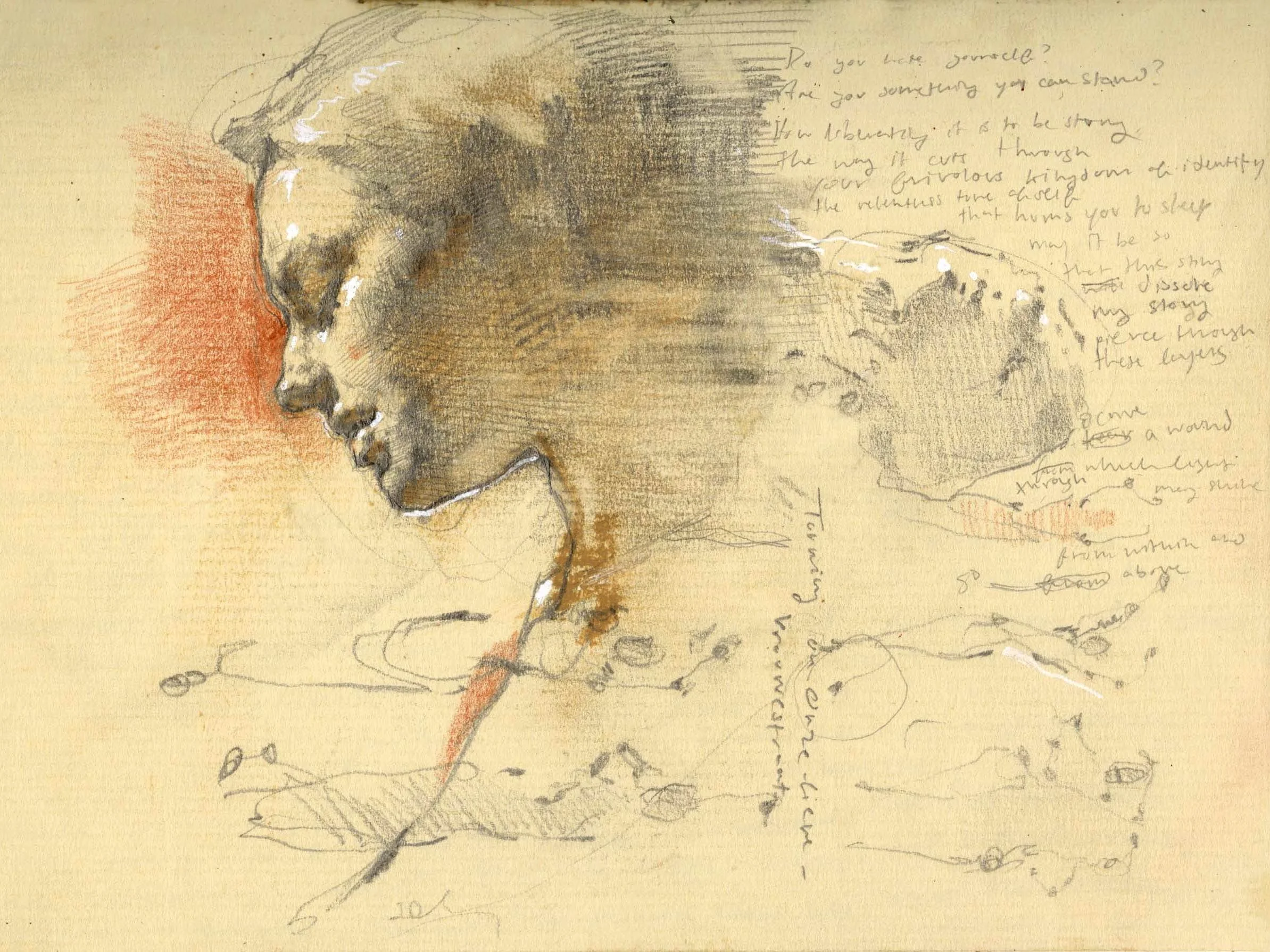
Celia Liberace, Kingdom of Self: Collected Shards Series, 2023
CELIA: It's really amazing to actively create our own worlds together knowing that we are part of the same lineage. We have all of that embedded within us. So there is this sort of heightened resonance that we tune into when we're in close proximity and creating together.
Ava as a child versus Ava now—you have these moments of intense passion and drive and inspiration where you're looking at the world and you're filled from head to toe with this excitement. “I'm ready to embrace the world and give love and receive love!” That's such a gift to be around. Especially within these past five years of becoming so close, even in some of the darkest or lowest moments I've had, I would never, ever switch this experience out to be in another body or another entity. I have Ava. She's a grounding force. She ties so many of my life experiences together in one central being and that informs my art consistently.
AVA: Whenever I feel in that state of, “I'm just so excited to document,” I understand how to receive and how to listen, from you. It’s cyclical. You don't realize how much you taught me because it's something that was so indirect. It was just how you experienced the world. I looked up to you so much. I still do. As your little sister, everything that you did I wanted to do, everything you wore I wanted to wear, and how you saw life and took it in, I wanted to do that too.