
Breast Milk
Still waiting patiently for puberty.
What happened is that someone had forgotten to tell Dante that we had an egg donor so by the time we were standing in the kitchen listening to Mom recount her 23-and-Me findings, my little brother was extremely confused. The map showed a smattering of percentages spanning across Western Europe as well as a small stray percentage in South East Asia.
“I’m four percent Indian. Isn’t that incredible?”
By incredible she meant regrettably colonial. My brother was intrigued. He chimed in.
“Can you believe we’re two percent Indian?”
Mom and I hesitated and looked at him.
“You know that we had an egg donor, right?”
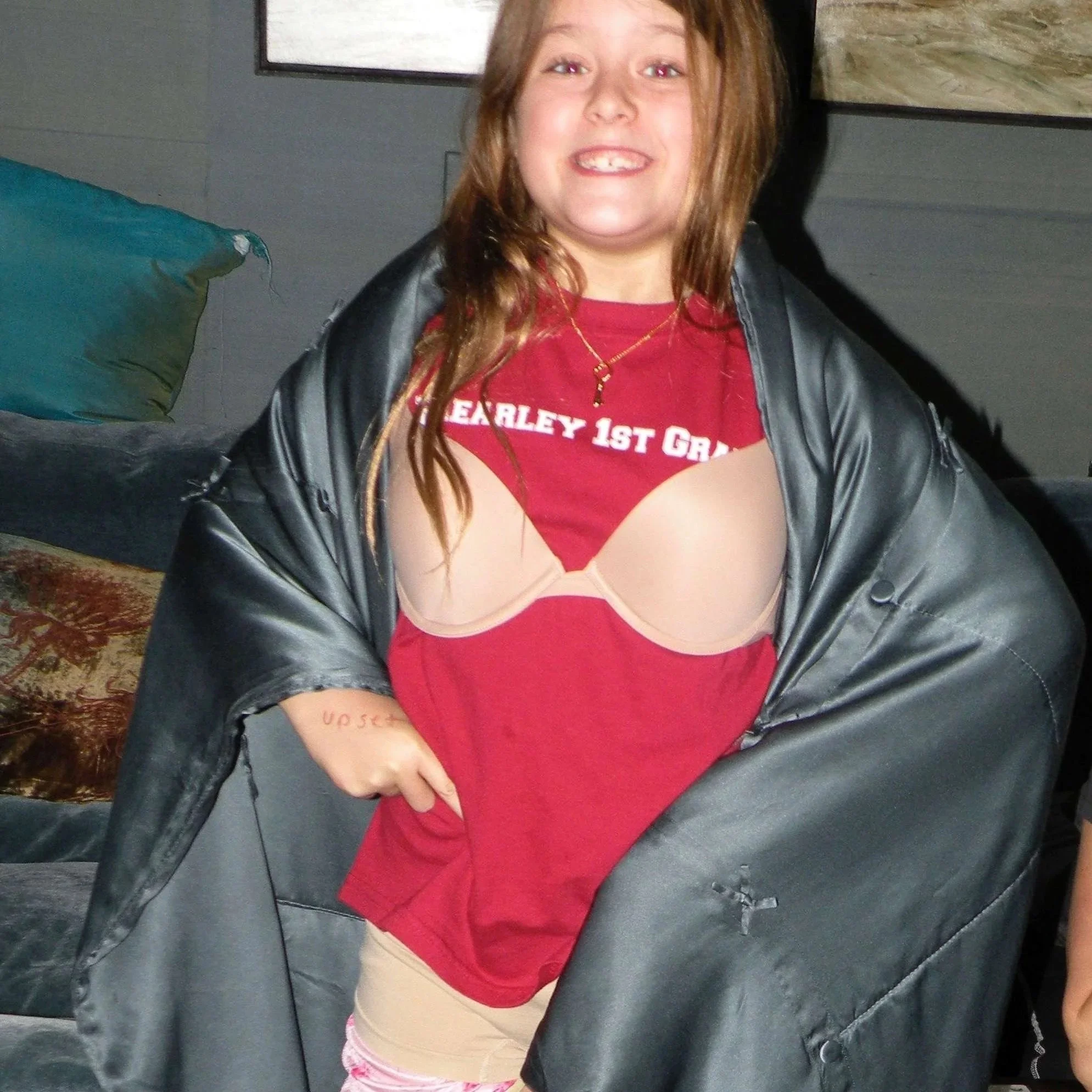
“Yeah, like we weren’t in Mom’s stomach. We were in Lisa’s stomach, right?”
Dante had a slender grasp on science and an even slenderer grasp on women’s reproductive health. It seemed nit picky at that moment to explain to him that we’d never really been in anyone’s stomach at all. Mom had a hysterectomy at 23: the nuclear solution to her endometriosis. It was the mid '80s and it seemed that her doctor also had a slender grasp on women’s reproductive health.
Years later, when it came time to have kids, Mom had had no choice but to outsource the operation. A friend of a friend had met a woman named Lisa who lived in LA and was open to the idea. CBS had recently run a program about surrogacy, so it was already in the cultural consciousness—chic in a sci-fi, start of the millennium sort of way.
My Mom popped the question and Lisa agreed. Shortly thereafter I was made in a lab, mixed in a dish. Then put to incubate in the empty uterus Lisa so graciously offered up. Nine months later I came out: perfect, bald, bright eyes, and fully baked.
My parents took me back to New York but Lisa kept in touch. She sent breast milk on ice and well wishes on all the big milestones. Three years later, she did the same for Dante. By then she was older and he was slightly more difficult, so Dante was fed formula. Then we moved. That’s when Mom came across a lactating neighbor. It wasn’t long before Dante was spending afternoons suckling on the nipple of a stranger.
Somewhere along the way, someone had forgotten to explain to Dante how an egg donor was different from a surrogate. Mom began to clarify–
“Lisa carried you guys but we got your eggs from—"
“Wait hold on Jordan is calling me—Yo.”
Dante put his AirPods in and went to his room. He left me alone in the kitchen in the company of our Mom, her ancestral chart, and the looming question I’d never asked.
“So where did you get the eggs?”
“A friend gave them to us.”
“A friend?”
“Erin. I don’t think you’d remember her. She was an old friend.”
“Oh... cool.”
“Maybe you should reach out.”
The origin of the egg never really interested me except for a brief moment when I was becoming literate. I was maybe 8, right when one graduates from reading elementary practice booklets to real world short form. We were in the nail salon, my Mom and I. She’d gotten a French manicure and, with a fair amount of convincing, I’d gotten a pedicure. I was hesitant at first, as I was a rough and tumble tomboy and I wasn’t sure that glitter toes would compliment my low rise cargo shorts. I would later learn that this was just called being bisexual.
There I was, under the dryer with my purple painted toes, staring down at the gossip rag sitting beside me. On the front was my new favorite celebrity, Megan Fox. In the weeks since I’d seen Transformers (2007), I’d been oscillating between wanting to be her or kiss her. I would later learn that this was also just called being bisexual. I had no choice but to read the magazine out loud cover to cover.
The article—or whatever the industry term is for a few bolded quotes that overlay half naked photos—revealed that Megan Fox was not always good looking. “Nobody would believe me, but I was actually not a very cute kid,” she confessed earnestly to the interviewer of US Weekly. It was at that moment that I became immediately alerted to the fact that one day I might look different. That my empty tooth sockets weren’t forever. And that, though hotness was of no use presently, it could someday be something that was very important to me. I needed some indication of the direction in which I was going.
If I was going to stay ugly, it was best that I found out early. I was already clever, curious, and clearly literate beyond my years. Maybe I’d work on cultivating talents that were less forward facing like practicing piano or being just like so super funny. On the other hand, if I was going to be hot, I needed to know now, so that I could start preparing for puberty—purchasing bras with oversized cups and teeny tiny bands or practicing for the day I might find myself in a mini- skirt, bent over the open hood of a beat up car. If only I knew where my egg came from I might have some indication as to the likelihood of a Megan Fox-esque genetic predisposition. It haunted me until my toes dried. Then I got distracted and never thought about it again.
By the time I was standing in the kitchen with my Mom and her 23andMe, I was 22. Although I didn’t look like Megan Fox, with the help of a boob job, some lip liner and generous hair extensions, I could be well on my way. What Erin had to offer I didn’t really know. At the very least she’d be an older version of myself: someone I could look at and gauge what age I might need to start investing in under eye cream or botox.
I flew to LA, pretended I was there on other business, and texted Erin something casual while I was sitting on the tarmac:
“Hey, Mom told me that you’re my egg donor. Maybe we could get brunch?”
“Hi love, let’s do Cecconi’s in West Hollywood. 11ish?”
“Perfect!”
That night I took exactly two hits of a joint and watched The Substance (2024). I was fine and then I started to spiral. Pacing, plotting, playing out every scenario so that I might get ahead of the problem. My concerns were purely practical, irrational but existential, all in the vein of sci-fi. Suddenly, I imagined us not as individuals, but as two parts of one monstrous whole—one having emerged from the other, now with a completely agentic consciousness.
There were questions about where I would run and what weapon I might use—if and when the encounter turned violent. If, in fact, we should come face to face and jump, morbidly admiring the other: the body from which we split. There was a chance the intrigue would turn into a knock out fight, pulling hair and breaking glass over which one of us was responsible for our collective vanity.
So I stayed up and ate cereal until the paranoia wore off. When there was only milk left, I was overcome by a far greater fear. Maybe the meeting wouldn’t be violent. Maybe it would be emotional.
My insomnia worsened. Around 4:15a.m. I had the epiphany that she’d likely designed her life around the void that was my lack of presence in it. I imagined her diary filled with entries on or related to me: fantasizing about where I was, what I might be wearing, or who I might be. Cursive sprawl in gel pen tallying the number of days it had been since the egg harvest. She’d spent 22 years yearning, wishing on birthday candles and stray eyelashes that we might one day cross paths. And it was finally here.
At 5:40a.m. it occurred to me that maybe the void was undetected, that the missing me was subconscious. Maybe she had lived a full life, with good company and enjoyable experiences. Maybe she had loved and been loved. Maybe she hadn’t thought too much about me. Or maybe she wasn’t the reflecting type. Or so she thought. This would likely change when she saw me across the brunch table. Reality would set it and she would realize what she had been hiding all these years—a palpable ache, a repressed pining, a void so profound it could not be named. Upon seeing me, she would be overcome not by sadness, nor joy, but melancholy: the gratitude of knowing me now, inextricable from the deep regret of not having known me sooner.
I tossed and turned a few more hours on the eve of the most important day of my egg donor’s life. I prepared for the possibility of her radical reflection right there in West Hollywood on the corner of Melrose and North Robertson. A corner on which few grown women had reckoned before.
I would blowdry my hair. I would do my makeup. I would wear a brunch-appropriate blouse and well fitting pants. Being both beautiful and well dressed, I believed would, in some primitive way, bring her peace. At 8 a.m. I began to primp. A few hours later, I arrived at Cecconi's with caked concealer cracking in the pockets of my under eye bags. I was early, underslept, and overdolled. I ordered a mimosa and waited for an older version of myself to walk through the double glass doors.
But then she walked in, a petite blonde with a blow out and an off the shoulder blouse. We hugged. She sat down. We made chit chat as I studied her face and she studied mine, attempting to lay claim to any features we might recognize. They were few and far between. An arched eyebrow here, a curl of the lip there, but by and large any visual similarities felt like a stretch. They required a creative reimagining of what might have been there before. Before the rhinoplasty frenzy of the early '90s. Before cosmetic amendments had softened her more distinctive features.
Our similarities were revealed in conversation. Our tendency towards working out. Our preference for tortilla chips. Our habit of staying too long at the party. A slightly lazy left eye that drifted when we drank.
I asked how she knew Mom.
“Well let's see, I guess she was dating Anne and I was dating Jules at the time, and then Judy and Donna got married and Jules and I split up, but we just all stayed friends.”
“Wait, my Mom was a lesbian?”
“Sort of.”
“And so are you?”
“Mostly.”
A smile spread across my face. I’d go home and call my ex-girlfriend and tell her that she was wrong and I was right. Explain that I was bred from a cohort of iconic lesbians. That I hadn’t broken up with her because I was straight, like she insisted, but because I just didn’t love her. That when it came down to the pure science of things—genetics, I mean, environmental and deterministic—I was and had always been half gay on my mother’s side.
The waiter cleared our plates. He left us there as the conversation lulled. Erin reached across the empty table and sighed like it was time to get serious. So here it was. We’d come to the confessional. I’d foreseen the reckoning and I’d prepared. I adjusted the straps of my too- loose-in-the-bust blouse.
She was on the cusp of being earnest. I was scared but I was ready.
I looked at my egg donor, this woman who I now loved but I had never really known. She took my hands in hers, looked down at my nice brunch top and then back at my face and said:
“Sophia, I don’t want you to be under any illusions...I’ve had a breast augmentation.”
This story was first published in print for Bias Cut 03: The Signature Issue.