
Artist India Sachi divulges the performances and processes through which her metamorphic paintings take shape.
By BELLA BUTLER
Photographer FRANCESCA HSU
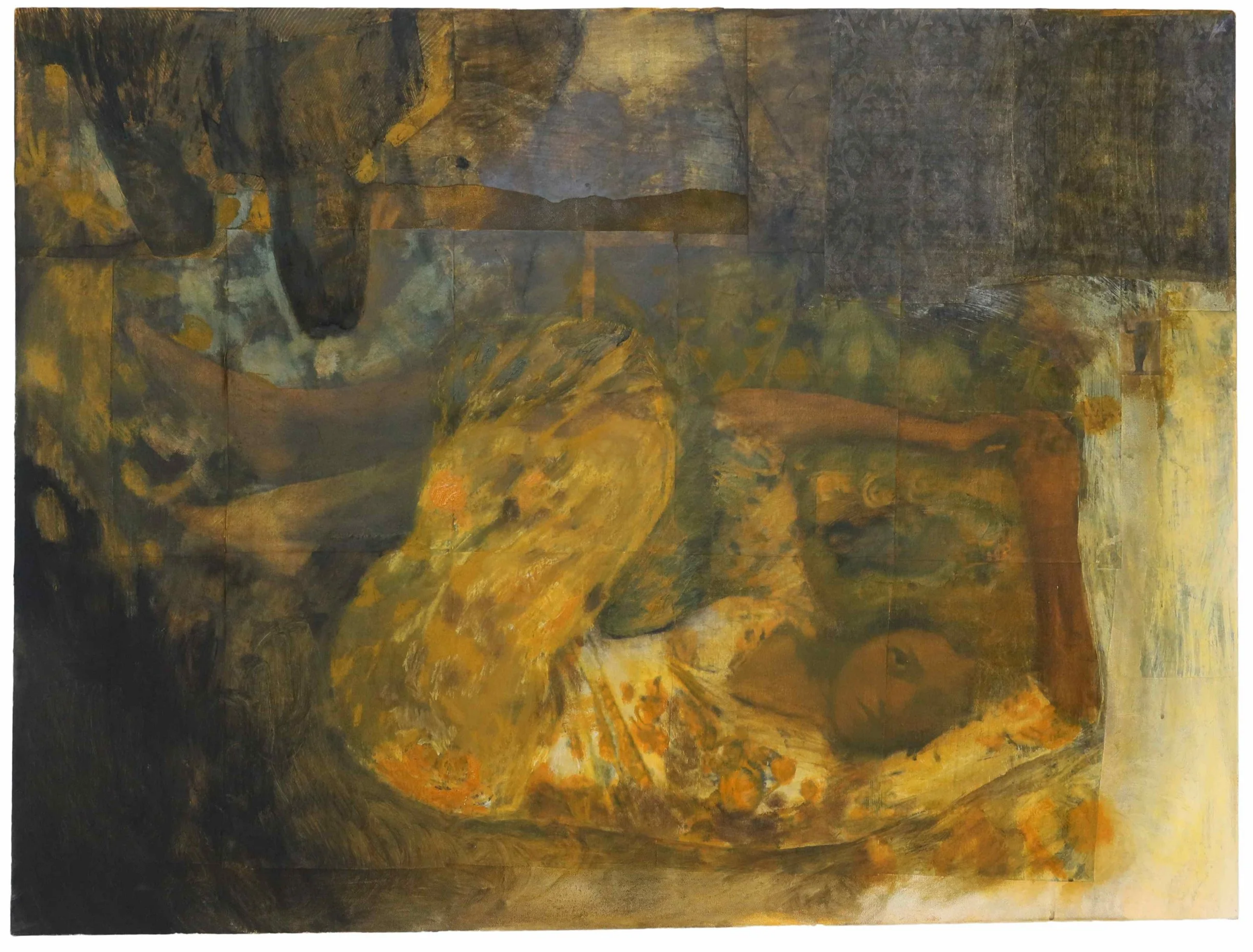
India Sachi, Indian yellow, 2025. Image courtesy of the artist.
A woman in yellow reclines, falling into an indeterminate space. It is a space that is neither interior nor exterior, but an in-betweenness. A bright white spills upwards from the ground as a darkness descends from above. Two nondescript figures hang from the sky. The position of the woman's body recalls the foundational styles of Romanticism, but her stare pierces ahead, reminding the viewer that she exists closer to a “now” than to a “then.” The surface of the canvas feels alive, activated by smudged and blurred brushstrokes interacting—but not competing—with what appears to be a faint grid, the composition broken up into subtle rectangles. It is a strong composition, and yet, it is unstable. It rejects a total grasping of its nature, a total grasping of its content. Like a jigsaw puzzle precariously laid out on the kitchen table, it threatens its own material disruption, or, perhaps more generatively put: it proposes its own “I love chaotic interactions.” rearrangement and consequently new ways of seeing. It is a space where many things are true at once. This is Indian yellow, 2025, a work by 26-year old New York-based painter India Sachi.
Slightly winded from the four-story climb in an industrial building in Ridgewood, Queens, I enter India’s studio. She meets me with a warm smile and welcomes me into the high-ceilinged room. The studio reminds me of a glass shard; wide and flat at the door with walls that gradually slant inward until they meet at a point. There is a wooden table where she pulls up a second chair for me opposite a quaint daybed, apologizing for the lack of visible paintings in the room. She has just returned from a one-month artist’s residency at Maison Monna in Upstate New York, and her new work leans against the wall, still wrapped.
“It’s a circular practice.”
Born in New York City and raised in the Hudson Valley, India is soft spoken in cadence, yet assertive and bold in her beliefs. In her paintings, soft and ethereal brushstrokes depict figures and scenes with an eerie depth. Her predominantly female figures, sometimes surrounded by animals, furniture, or other bodies, are placed in settings that are ambiguous yet undoubtedly grounded in hints of space. Her works exist in muted and pastel tones. Myth, particularly Ovid's "Metamorphoses," is an important influence in her practice. The occasional inclusion of creatures, namely snakes and fish, illustrate her continued interest in metamorphosis.
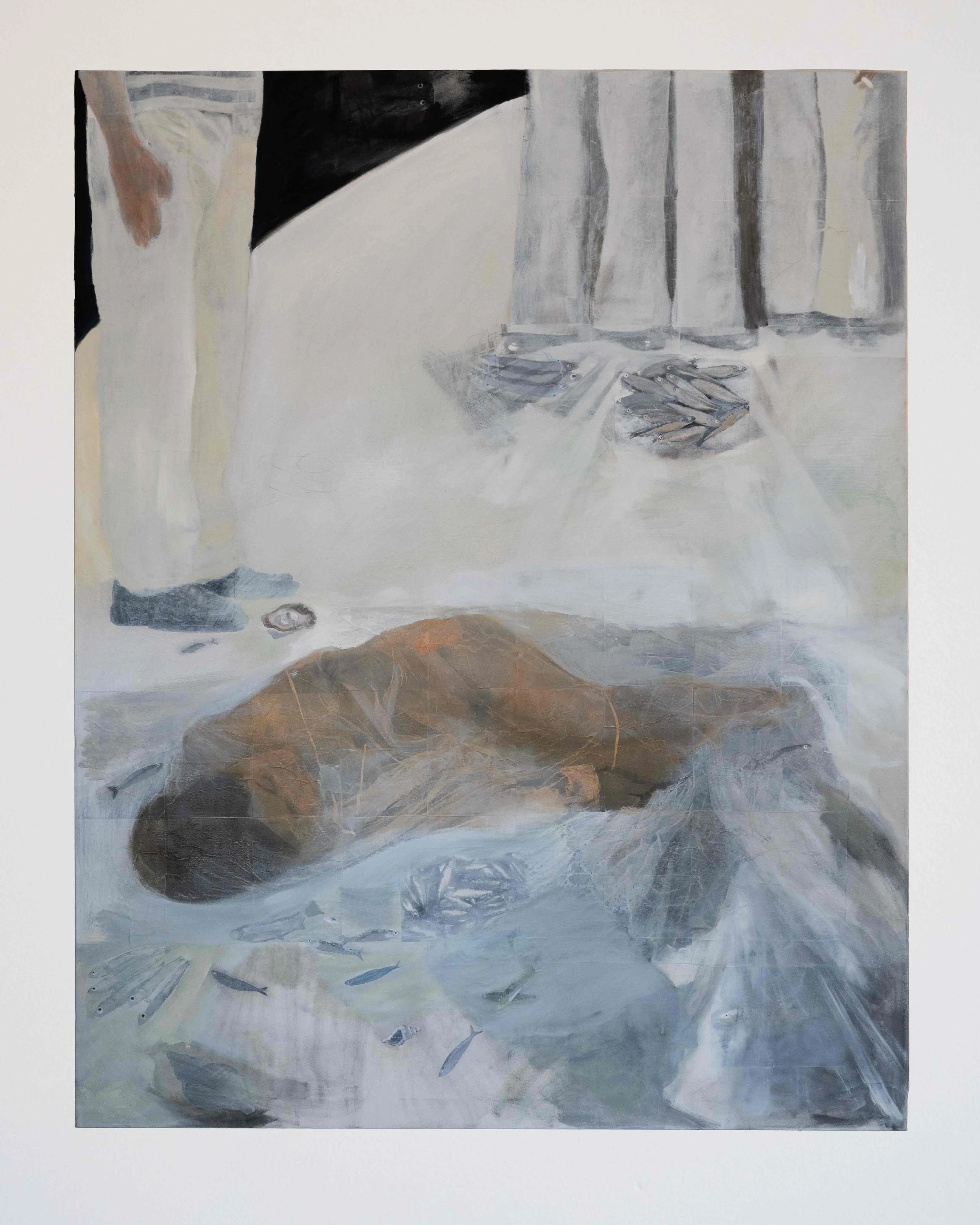
India Sachi, Sardine, 2025. Image courtesy of the artist.
To characterize India as a painter would be reductive. It is clear that she sees art as a way of life, a way of moving through seconds, minutes and hours, a way of forging vital connections in and to the world. Before delving into her paintings, she lets me in on her ten year plan: to start a commune with fellow artists where they can live and create in community. “We found a Masonic Lodge for sale upstate that my friends and I wish we could buy,” she tells me. “It's huge. The entire top is wooden and the space is cavernous with a gallery at the bottom and an apartment in the middle.”
In other words, India is not interested in working in a vacuum, nor is she interested in feeding her work onto the conveyor belts of capitalist production. I tell her I’ll happily join the commune, and she responds wisely: “I think that's the desire of every artist—to support each other because it's already so hard to support yourself. The last few decades have felt too individual. You can see that in the way people are making things. It’s scary to take risks because you are your own support. But if everybody was living together and helping each other work, you could experiment more."
It’s in India’s nature to take risks. She reacts quickly and with intention to her environment and experiences with an innate artistic impulse, whether she is responding to a dream by making a giant papier-mâché bear costume (with real deer teeth) while confined in a house in remote New Hampshire, or developing the unique multimedia practice she uses today to create her paintings. The latter emerged from a catalytic event during her undergraduate years at the Rhode Island School of Design, from which she graduated in 2022.
One day she was in her apartment in Providence, Rhode Island, when she caught a man peering through her window as she was lying alone on her bed. As disturbed as she was, she also felt invigorated to make a very specific painting to “cure [her] anger.” She tells me that “it ended up looking exactly like Paul Gauguin's Spirit of the Dead Watching, 1892. The composition was exactly the same as the painting.”
“The last few decades have felt too individual. You can see that in the way people are making things.”
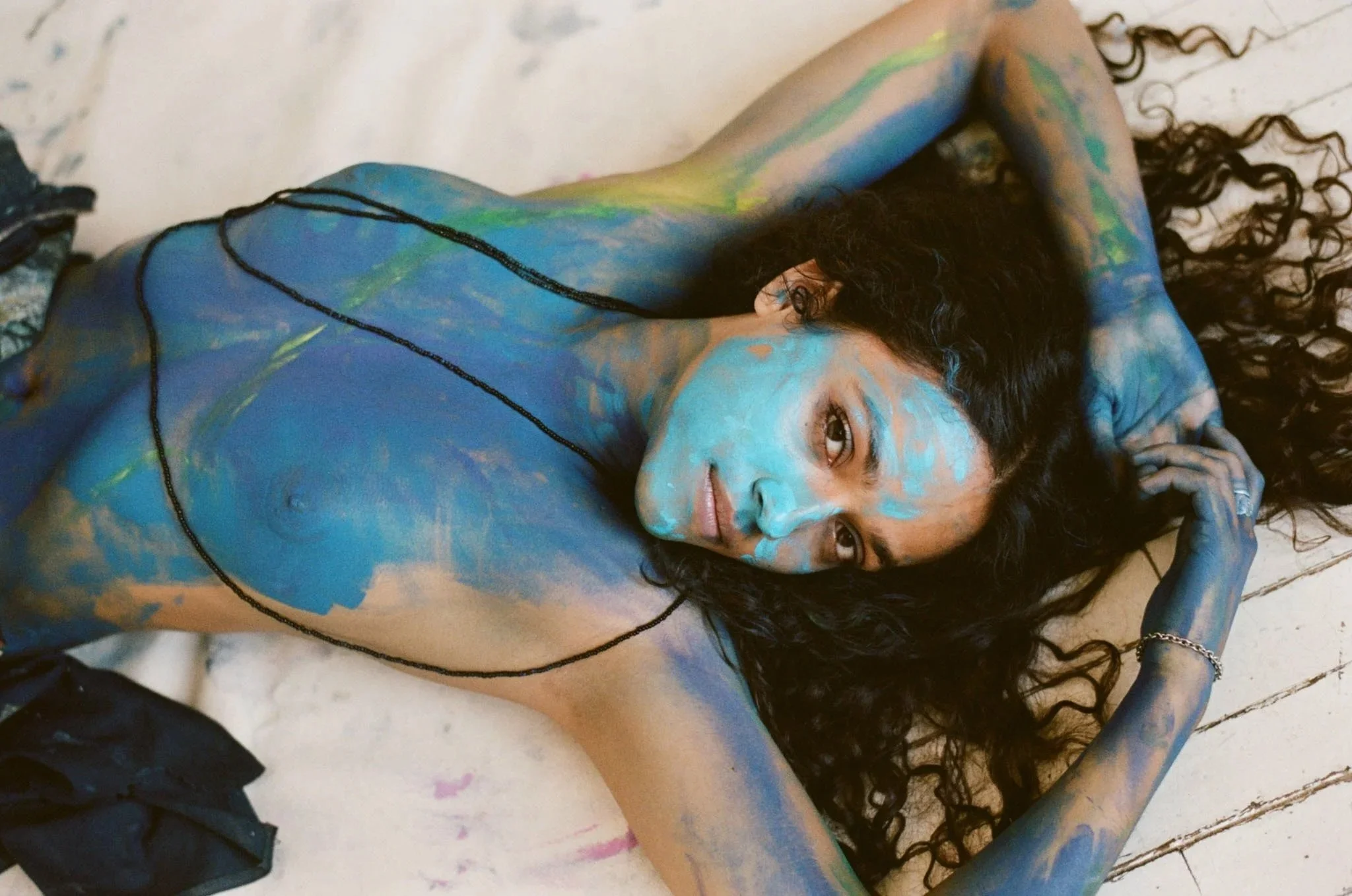
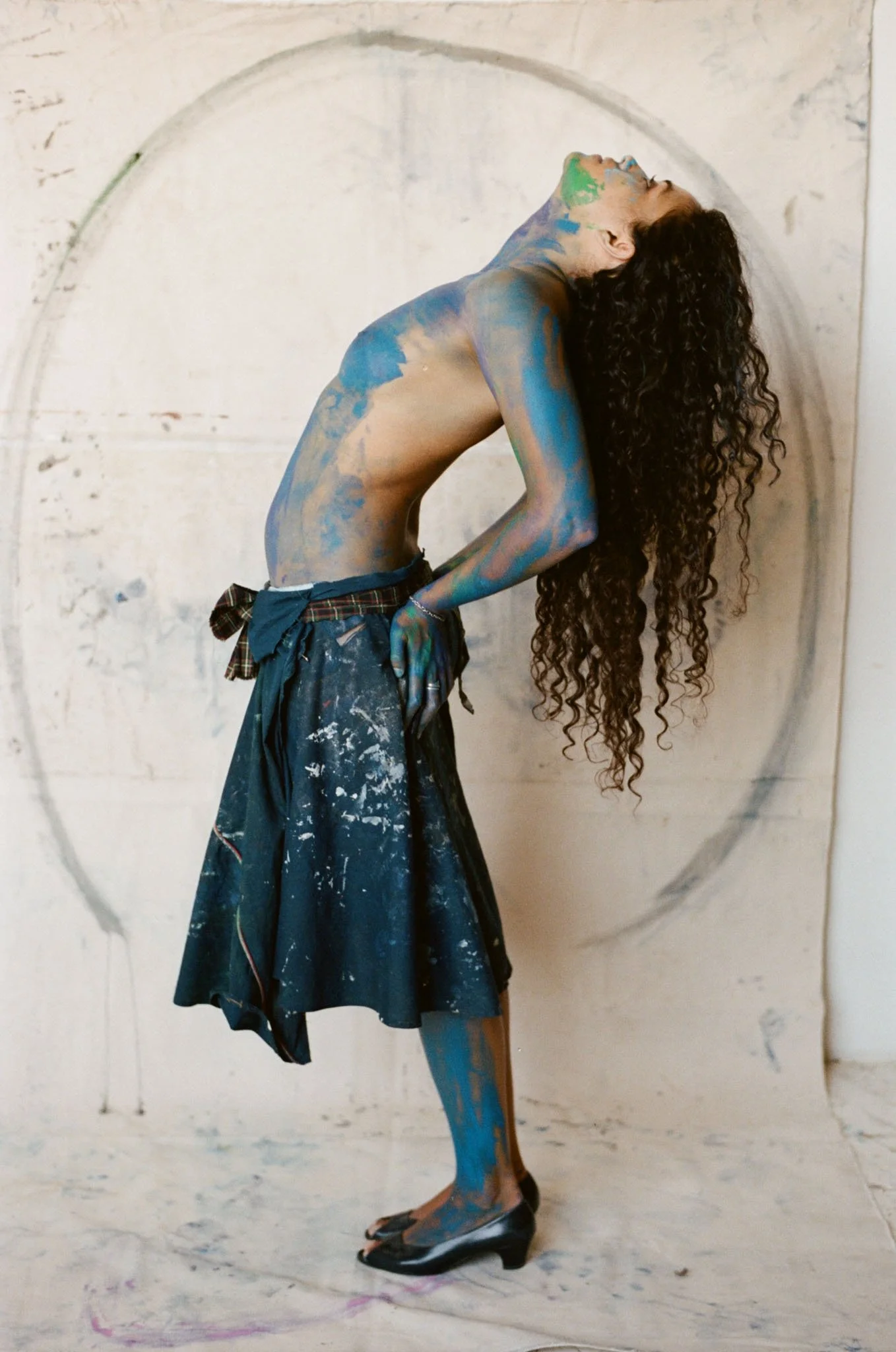
Her three-step process includes a session of photographic self-portraiture, a photographic transfer that functions as an under layer on the canvas, and a final layer of paint. Once printed, the self-portraits are transferred onto the canvas using a mixture of glue, water, and the pulp of the paper, which integrate and dry into the weave of the canvas. Only after this does she add the paint. “I see the oil as a kind of skin that goes on over the photograph, like a metamorphosis or a camouflage or an adornment,” she notes. In addition to the bodies depicted on the canvas, the canvas itself is a body. The transfer process includes an impression of energy, of bodily force, not purely of pulp and ink.
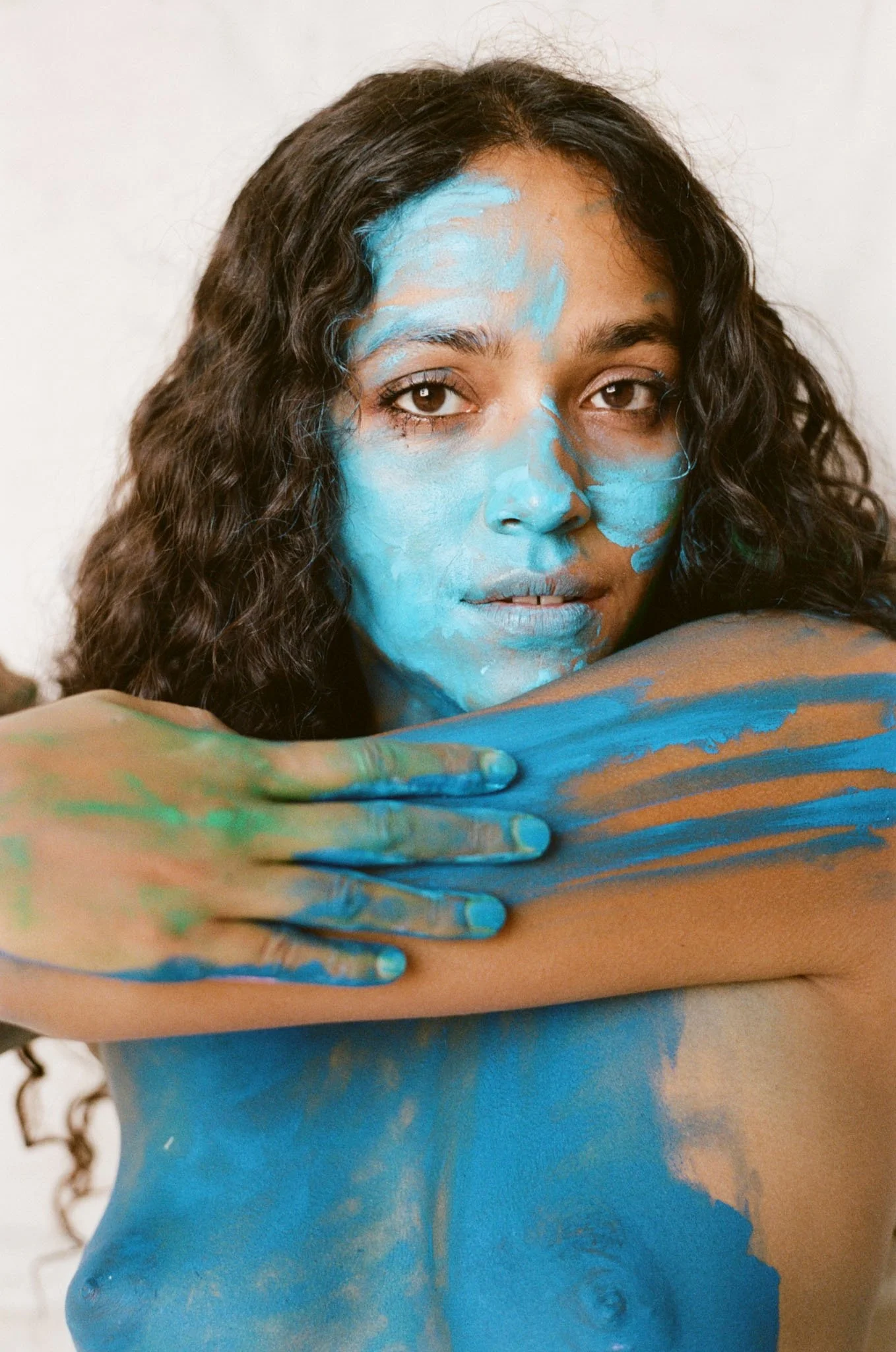
To begin the formative painting mentioned above—which eventually became Big pink room, 2022—she took a photo of herself in the original position she had been in when she caught the man looking through her window to use as a reference. This quickly gave way to the discovery that she could use the physical photograph itself, as opposed to using it merely as a reference from which to paint. She printed the self portrait into gridded sections to prepare them for the canvas. India describes how she “performed the whole composition” exactly how she wanted it. The agency in her tone is palpable. It was as if she had plucked out the peeping Tom’s eyes and taken his gaze, rendering him blind, stripping him of his once objectifying power. She had reclaimed her image and performed it play-by-play in front of the camera, from no one’s script but her own. “This has been my process for a long time,” she tells me, “It's a circular practice. You think of things in your head, and then ask: how am I going to make that? If I act it out myself, I can do it precisely.” There is an uncomplicated desire for total control within her practice.
While the performance element is integral to her process, India makes clear that her paintings are not self-portraits. She takes videos of herself in which she holds several positions, then screenshots the compositions that intrigue her the most. It feels playful to her. Recently, she has been using these videos to conceive compositions with multiple people. “I love chaotic interactions,” she tells me. “I use a wide angle and walk around the room posing, walking to different places in the room to act out what the other person would be doing, imagining the whole scene in my head.”
India’s material process is not merely additive. Subtraction and omission play an inevitable role in the chain of events. In order for the paint to be applied, the photograph tiles must dry on the canvas. Except, not all of them cooperate. “Everything has to be secure,” India explains, “but sometimes when I make a painting I have to rip off some of the remaining pieces of paper that aren’t sticking. I rub my hands all over it and stick my fingers between the canvas and the paper to remove it. And when I just rip it off, I lose 25 percent of the image, so I'm working with a kind of abstract body.”
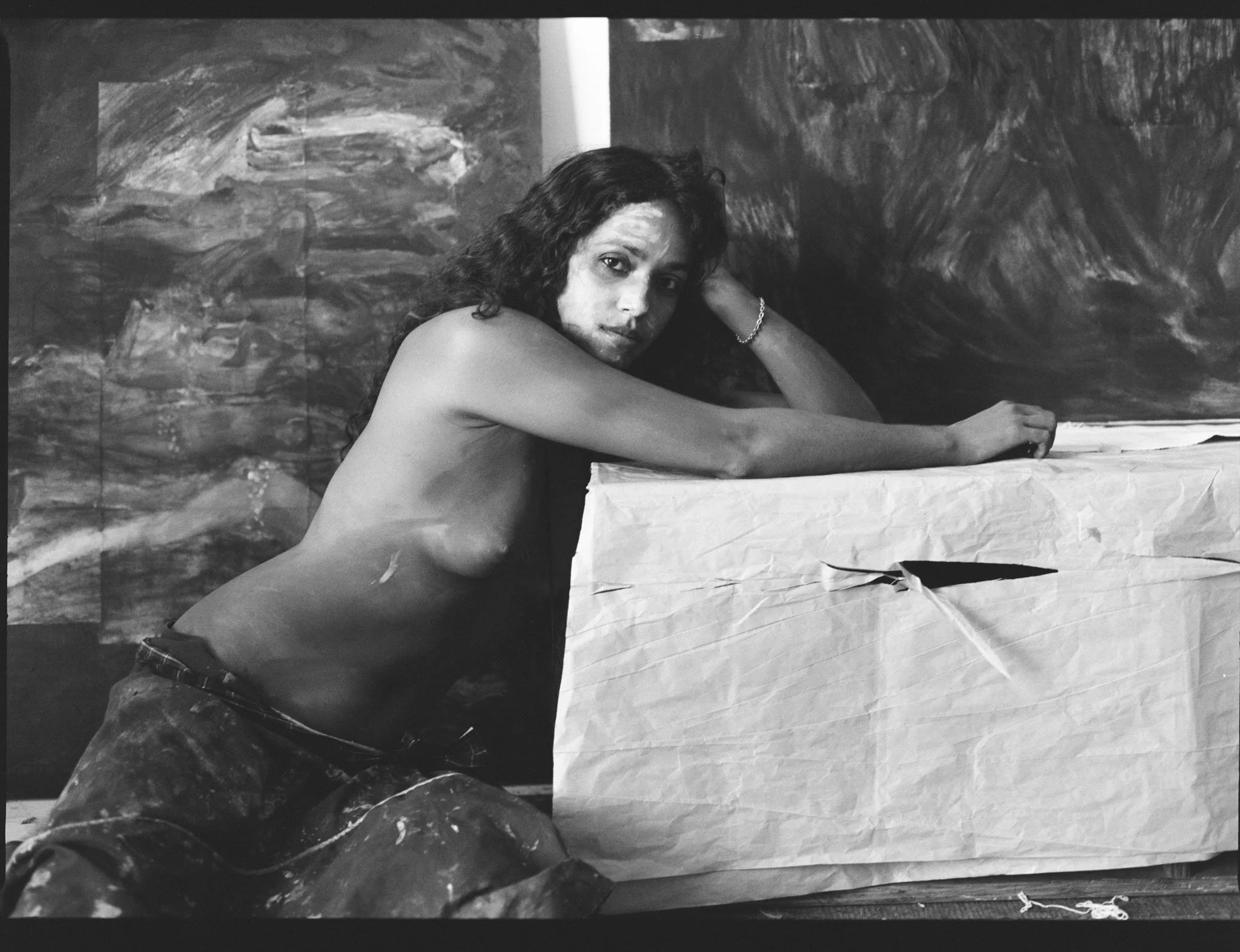
The abstract bodies that present themselves to India—with conceptual as well as physical holes and gaps—are one of the generative “dilemmas” in both her process and product. With these “holes,” as she calls them, she is faced with the question of whether to “let them be open” or make “a prosthetic to the body.” She tells me it can take her weeks to decide.
These gaps in visual information are what allow the emotional interiority of the body/canvas and of the depicted figure to shine through. India makes the observation that “it’s similar to how the outside of your body is very defined to other people, but in reality, you know how undefined the self really is. You can't see the inside of your body. It’s abstract in this way. You can feel what's going on in there, but that’s different than knowing or being able to define it.” India tells me that some viewers have called her work “unfinished,” due to the gaps and her resistance to draw figures in full detail, but she pushes against that. “I get so frustrated by painting something that's tight,” she explains. “You're searching for more definition, and I'm searching for less definition, so we're working against each other.” She uses active verbs in her statements, pointing to the productive instability I perceived when I first saw her work. India’s paintings make observers out of us rather than passive spectators.
She is not interested in states of stagnation or stability, whether it be in narrative or in bodies. There is both beauty and safety in metamorphosis and the ability to camouflage, to change one’s form, to exist in flux, especially for women. Her paintings undergo changes in material and psychic states—fluctuations in visibility, through material layers and transfers of corporeal energy—both during the process and in the finished work. Paradoxically, this state of formal instability is the very thing that stabilizes the bodies of her canvas, the humanity of her subjects
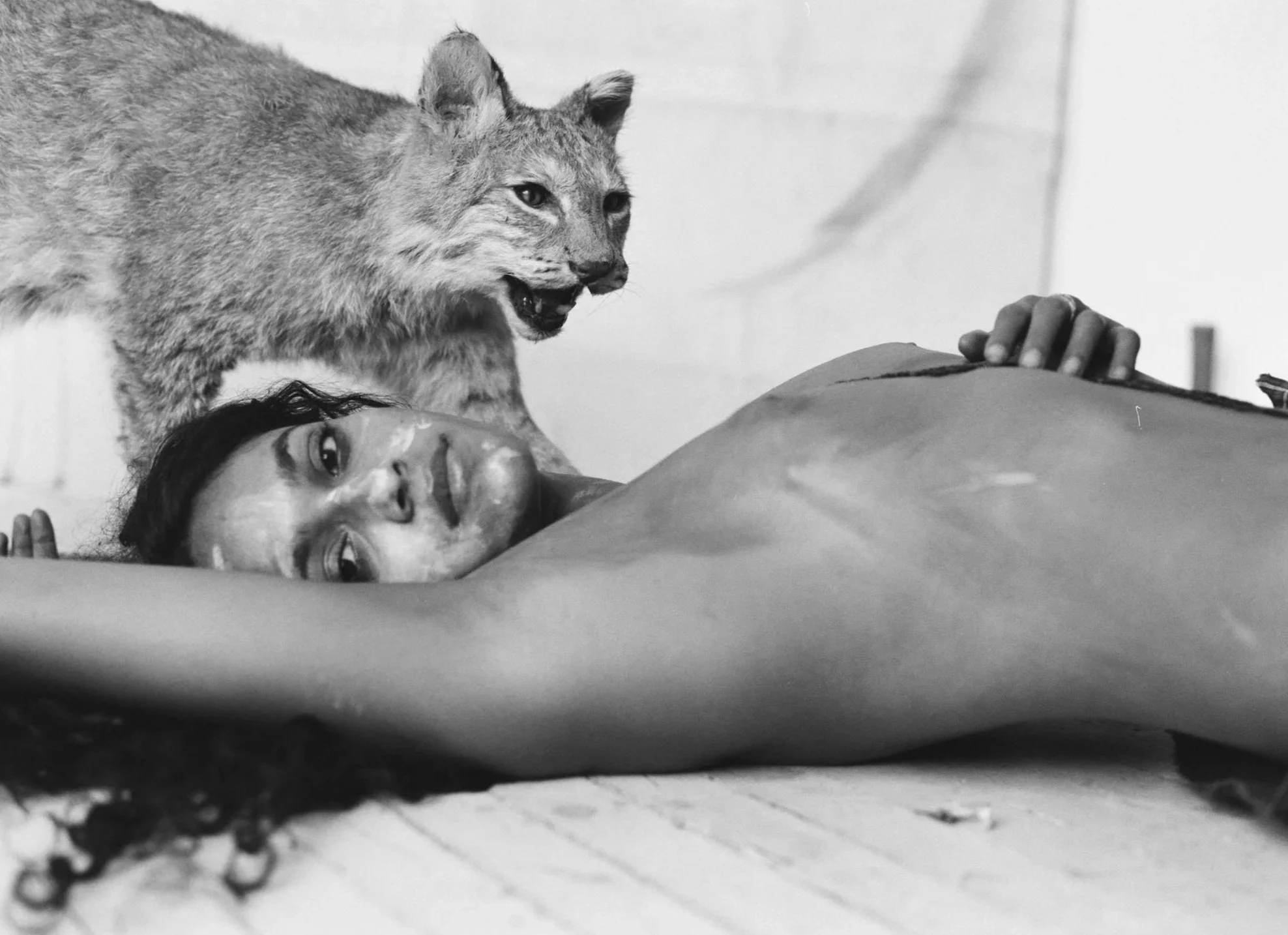
This story was first published in print for Bias Cut 04: The Body Issue.