
Infinite Rendition
Sculptor César E. López delves into the nuance of his seemingly harsh and industrial sculptures, revealing their biometric qualities and relation to his experience as a Guatemalan immigrant in the United States.
By BELLA BUTLER
Photographer MORGAN MABEN
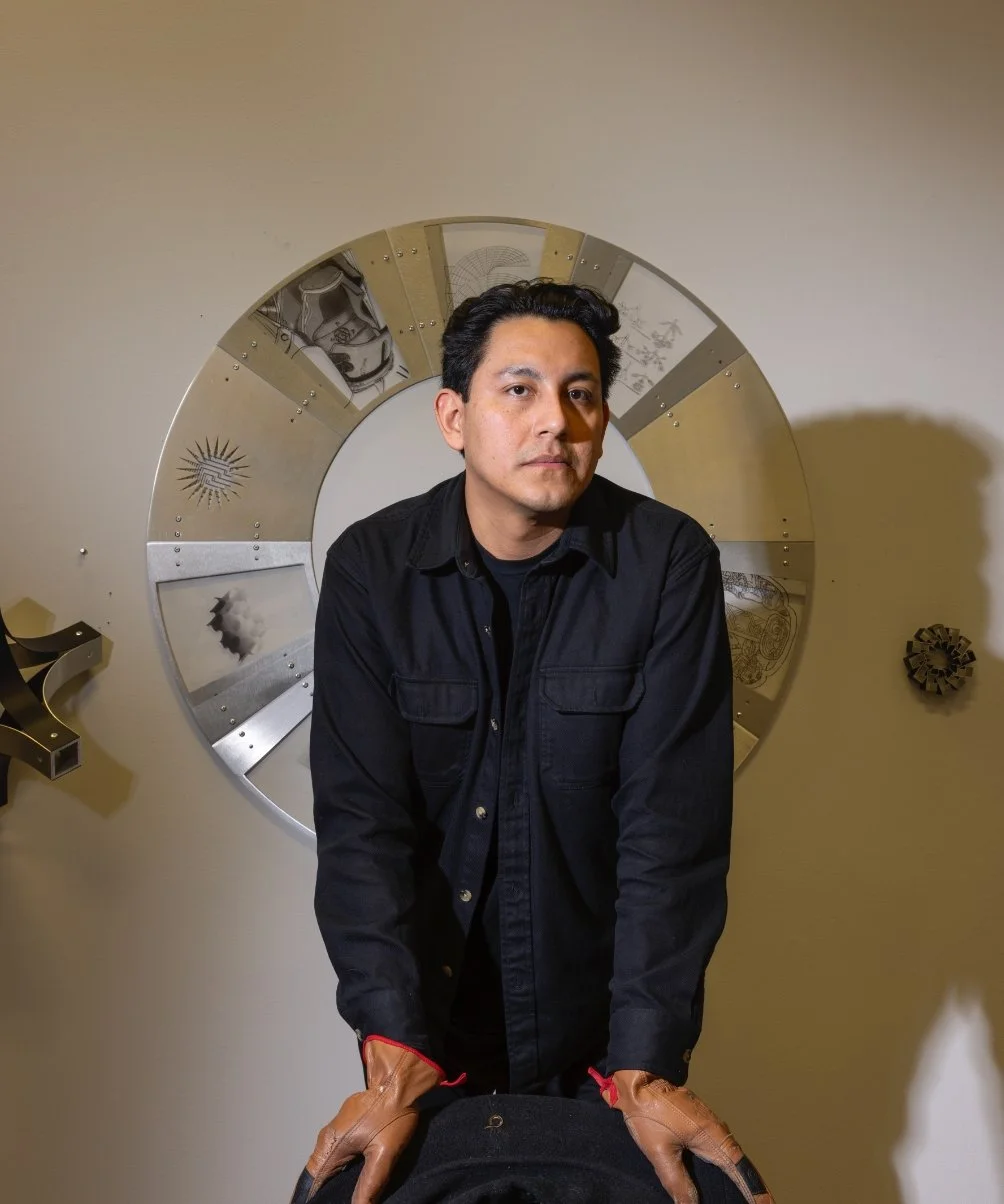
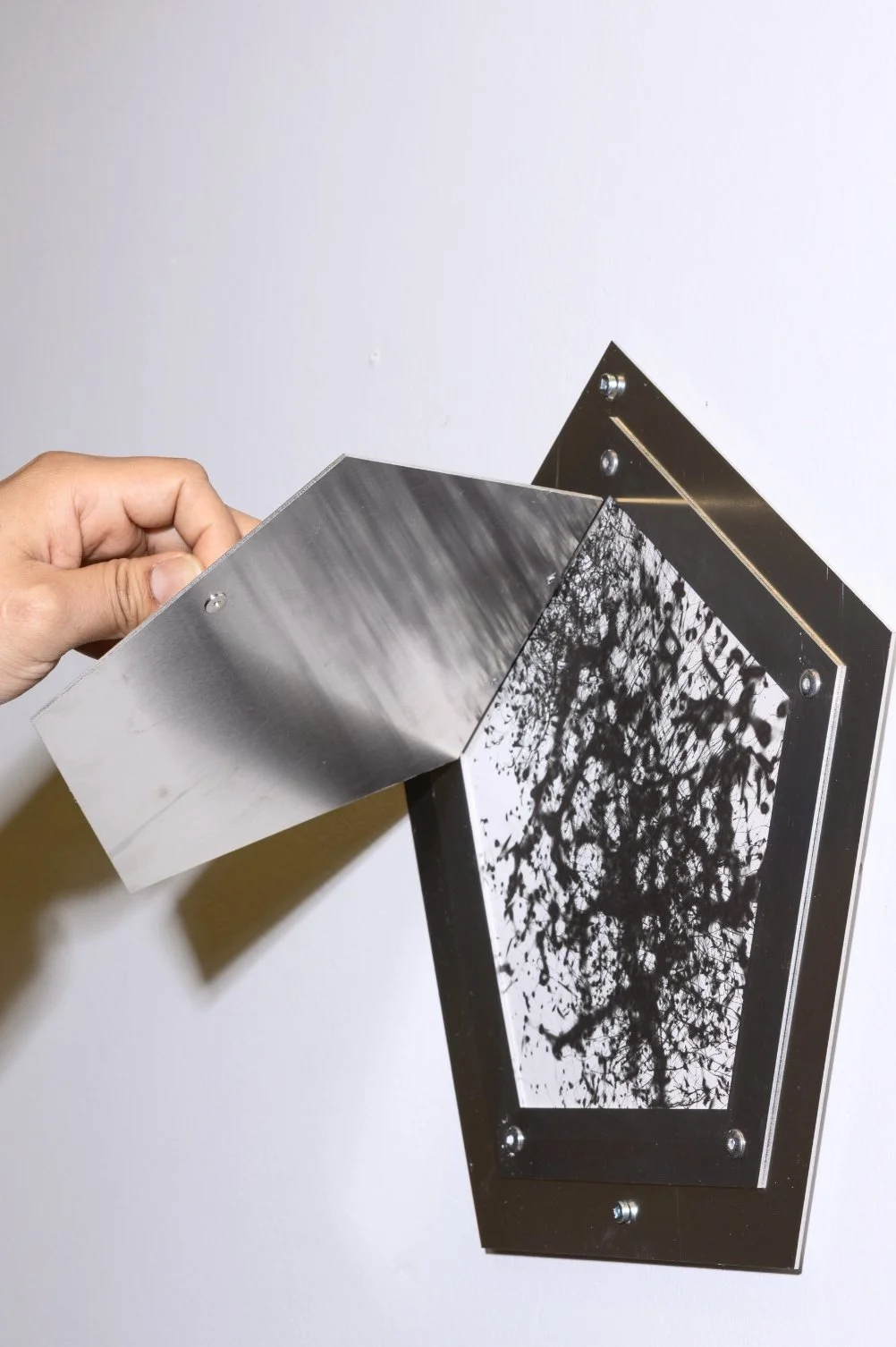
When I step into César E. López's concrete, high-ceilinged studio, I am met by a sea of metal sculptures—some the size of my hand and others towering feet above me. The sculptures extend into the space, mounted on walls, covering the ground and reaching off tables. They are forceful and industrial, and yet there is something living about them, as if they’re as aware of my presence as I am of theirs.
César, born in Quetzaltenango, Guatemala, immigrated to the states in 2001 with his brother and mother, eventually going on to complete his BFA in 2019 at the Kansas City Art Institute. With a well established track record—having had two solo shows and features in almost twenty group exhibitions—he is treating his MFA at Yale School of Art as an opportunity to experiment and expand his practice within a supportive institution. His studio, bursting at the seams with metals, plastics, miscellaneous objects, and industrial tools, more than reflects this.
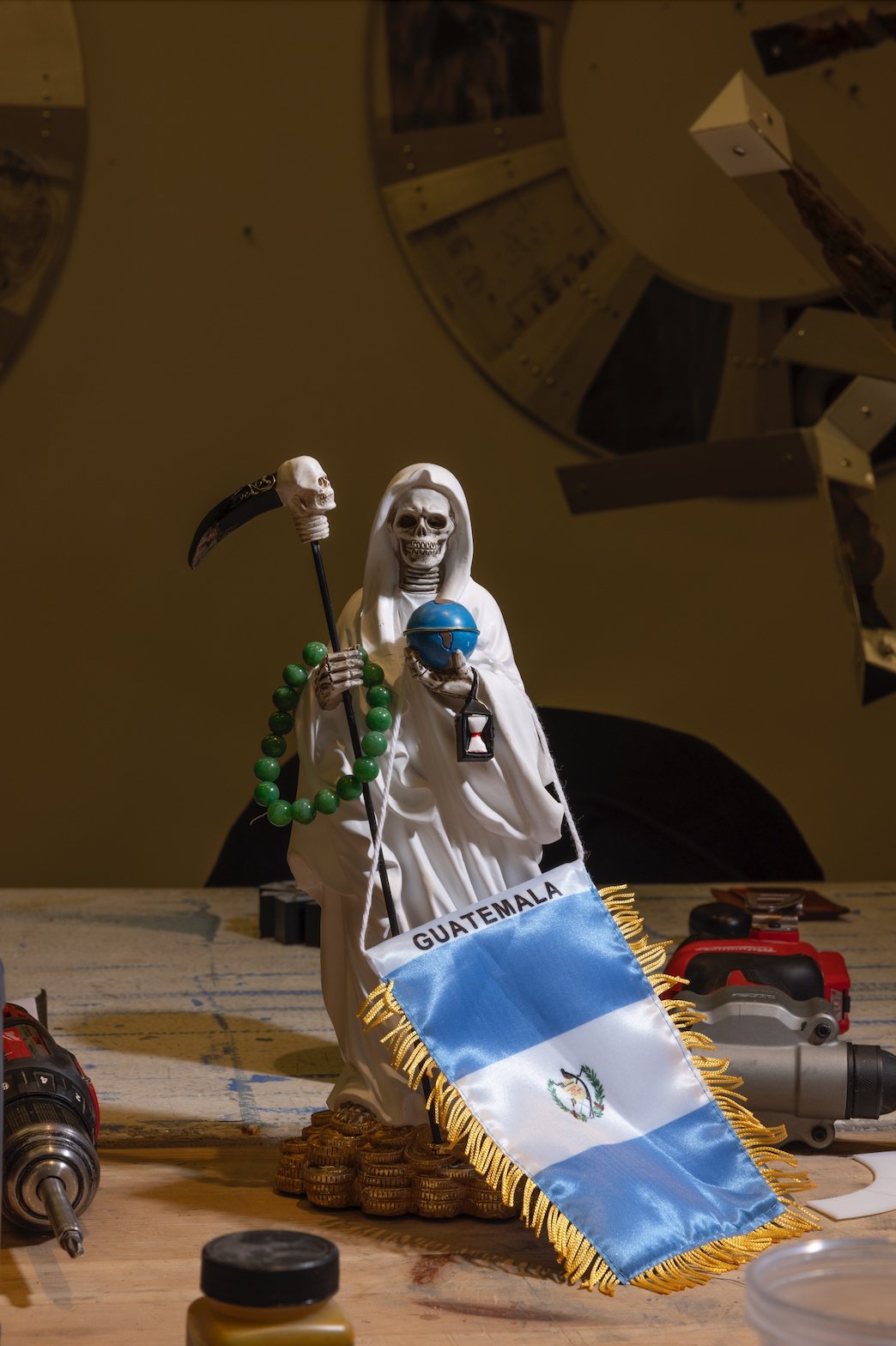
We sit on stools but he can hardly stay still, jumping up every few minutes to fetch small works, materials, and tools so I can hold and touch them. Constructing aluminum structures has in part necessitated (and preceded by) an in-depth knowledge of material composition and properties. In my lap he places small cuts of metal, old iPods, and sample sheets of colored aluminum. His modular sculptures range in tones of greys and blacks. As César explains his process, his eyes light up. He explains that, in order to alter the tones of his metal, they must go through an electromechanical process called anodizing. This process entails submerging the metal (anode) into an acidic bath through which an electric current is passed, forming a thick, porous oxide layer that can be dyed and then sealed. “Essentially what you're doing is controlling rust at a microscopic level.” I feel like I can see some sort of life humming imperceptibly within the metal. This apparent relationship between material and temporality exposes a cascade of nuances and insightful contradictions within César’s work. His art is nothing if not deeply contemporary.
Despite what one may expect look ing at the artist’s seemingly cold, metallic sculptures, César began as a painter. Utilizing predominantly bright, warm colors applied to canvases in flat layers, he worked with forms found in flags, grids and globes as a way of exploring mapping. César traces his journey from painting to sculpture, attributing its roots to his waning desire to create works specifically about himself. “Painting was taught to me as a human-centric thing. It's your own personal mark on the surface that could only be made by you.” However, he thoughtfully articulates that as an immigrant in the United States, drawing attention to oneself is not typically encouraged, considering the political dangers it can pose. Sculpture allows him an escape from the attention he speaks of. He wants a medium where he can avoid easily legible identity markers. His works, mostly made from mechanically cut pieces of aluminum, create the effect of distance through impenetrable industrial structures, far from the fleshy forms of the human body. Unlike painting, “my hand doesn't touch it,” he explains. Instead, he uses CAD (computer-aided design) for every element of the sculpture and segments them with a laser cutter
As our conversation progresses, we arrive back at one of my initial thoughts: that Cesar’s works are not so mechanically inhuman after all, but rather that they might intrinsically relate to the corporeal.
He walks me through the steps integral to creating each sculpture, revealing that each measurement for the pieces of metal is determined by those of his body. He explains, “I was thinking about biometrics, where, while someone is immigrating to America, they take all your measurements. There are machines that photograph you, not just your height and your face, but your fingerprint too. They measure your hand. That is another way in which they can tell you're you.” I laugh when he says “that's probably a knuckle,” while I examine an extra small segment of aluminum.
In keeping with his desire to create distance between himself and the art, biometrics allow César to depersonalize the work by reducing the individual into mere numerical values. But only to an extent. The image of a human body still seeps through: deriving structural elements from self-taken biometrics inescapably tethers the sculpture to the body that made it, even if the identity of that body remains invisible. It undoubtedly becomes indexical work—human work.
“Material immortality is really valuable as someone who has immigrated to this country. We don’t need to look very far in the news to understand why someone would want that.”
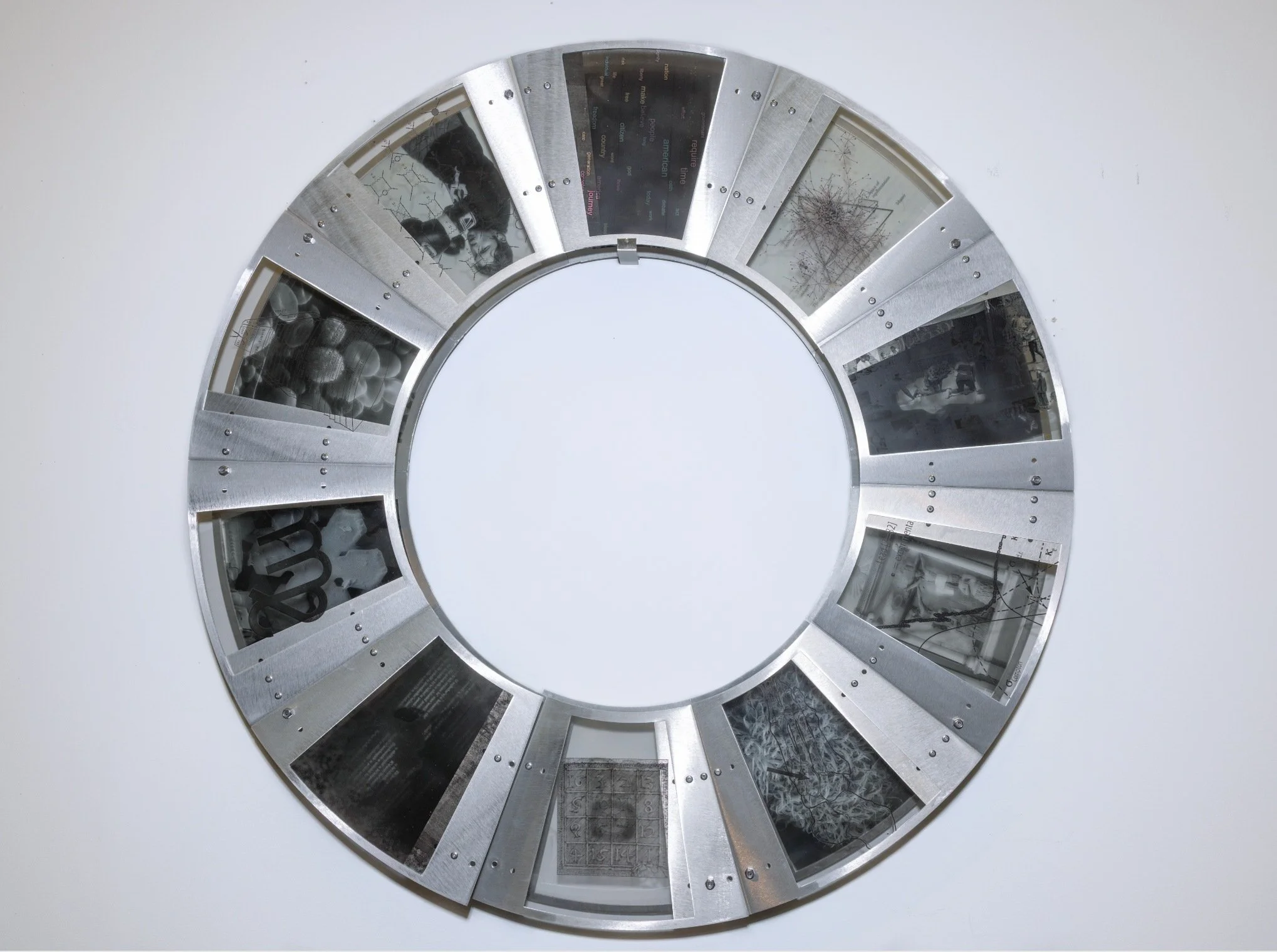
I confess to him that from the get-go I had detected something living emanating from his sculptures. He concedes and explains this indexical quality is a mode of taking personal experience and imbuing it in sculptural forms and objects; it allows a human transfer, a projection of self, without having to be representational and risk losing anonymity. The meticulously designed metal forms, that “something else,” are proof of a transformation taking place within the art, and maybe within the self.
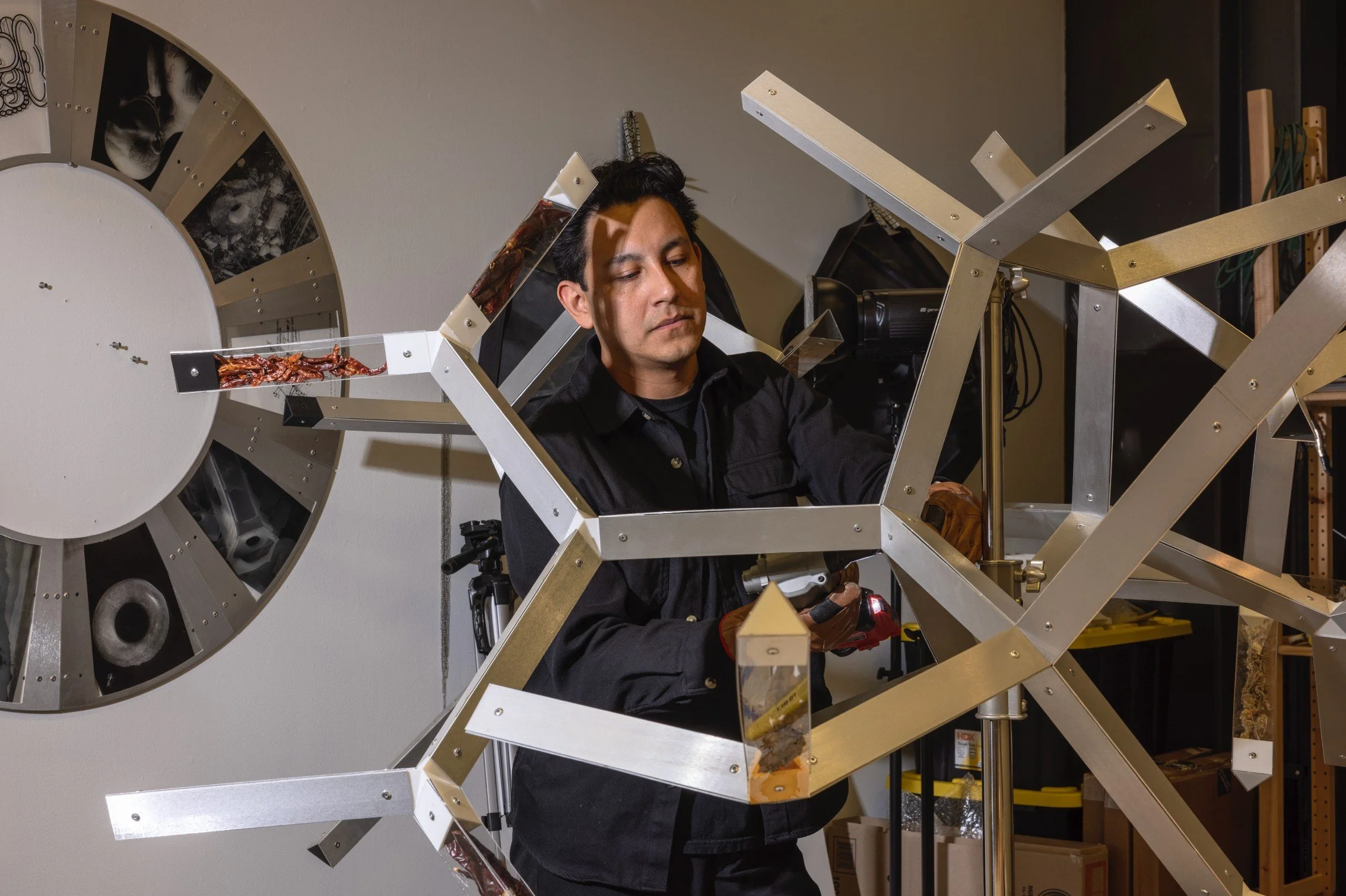
With a closer look, there is a small detail that exposes a new vital element in his sculptures: the rivets (small industrial bolts). In other words, these metal bodies do not make and hold themselves. César reveals that his manual effort is needed for assembly, that “someone has to do it by hand” because it’s the one thing that can't be done by machine. This mode of structural cohesion is dependent “on the singular point or punctuation of a person.” He hands me the rivet gun and a piece of scrap metal. “You wanna shoot it? It’s very haptic feedback.” I say sure and I do. The power from inserting the rivet shoots back into me, buzzing through my veins.
As I consider the modularity of César’s forms, his use of the rivet reveals itself to be both a material and conceptual key. Where the rivets are placed create crosses and junctions where one could imagine the addition of more of these units, the junctures in turn representing César’s forward thinking—both ideologically and technologically. I see the rivets as hopeful objects in this way. In a surprising pivot he lays out a Harry Potter simile for me:
“I’m a type of time traveller.”
“Voldemort makes Horcruxes. He puts his soul into an object because he's evil. But he's also trying to generate an object so he can come back, because if harm were to come to his body, if somebody kills him, he can always come back. I connect to this idea of a spiritual surrogate. That's what's possible when you can remake the piece. Let's say something terrible were to happen to that piece. I could remake it because of the industrial means by which it's produced. These pieces are never lost in time. We can do it again. We can do it again.”
These sculptures can be infinite renditions of themselves as well as infinitely expandable within a single rendition; his solo show at Gallery Bogart in 2023 was titled Equidistant – A Personal Rendition. The rivet, as a tool, facilitates this, ensuring immortality through an animism of the object. For works that are so skeletal in form, due to their reliance on negative space they defy any allusions to death. In fact, their embrace of negative space is what seems to beckon their expansion, their iterations, their desire for more and more rivets. Space is generative. César is not afraid of technology but instead finds wonder in a human’s ability to utilize it in both practical and moral ways. He believes humanity and machinery are inherently interconnected—we invented it.
His interest in “spiritual surrogacy” lies far beyond the studio and his sculptures. The concept of renditions and the ritual belief of “We can do it again. We can do it again,” speaks to an attitude he views as important to the immigrant experience. He elaborates, “Material immortality is really valuable as someone who has immigrated to this country. We don't need to look very far in the news to understand why someone would want that.”
César’s work propels us into the future, adamant to cultivate a relationship with technology of the present moment while remaining emotionally and historically tethered to the past, which defines our concept of “future” in the first place. “I'm a type of time traveler,” he notes. “Life in the village was very fucking different. So in a way, as you move northwards towards the American project, there's more technology, more industry, and just more of more,” he explains.
“I understand that at first glance, it’s just a piece of metal, but it’s actually filled with human ideas.”
One of his in-progress works is the direct embodiment of his attempt to simultaneously hold past, present, and future in tandem. Built into the metal forms are sections of clear PLA plastic (a plastic commonly used in 3D printing) that hold and display plants used in Guatemala for medicinal and culinary purposes. As with almost every process he demonstrates to me in his studio, he brings me the materials involved in the work, handing me plastic bags filled with dried chiles (Pulle, Mulato, Chipotle Meco, Canela), corn husks, tabacco, cuachalalate (Mexican tree bark) and more. I touch the wrinkled chiles and then the cold metal they are embedded in. Two elements sprung from the earth in one way or another.
César and his work can make you see and feel the poeticism in the mechanical, the measured, and the progressive implications it has. “I understand that at first glance, it's just a piece of metal, but it's actually filled with human ideas.”
Talent CESAR E. LOPEZ.
This story was first published in print for Bias Cut 03: The Signature Issue.