
Slawn: Basquiat or King Bach?
British-Nigerian painter Olaolu Slawn has become one of contemporary art’s fastest-rising names. Michael A. Fadugbagbe argues that beneath the hype lies a practice that repackages American minstrelsy for the age of the algorithm.
There's a phrase in Yoruba: “írí tí a rí ni, isọ ni I'ọ́jọ.” It translates to, “The way you are dressed is how you are addressed.” Olaolu Slawn (b. 2000, Lagos) posts like an artist, exhibits like an artist, and sells like an artist, but has been quoted saying: "I'm not an artist, I paint like a six-year-old and I steal shit too." His following calls him the “New Basquiat,” but the more accurate comparison is to the viner and internet personality King Bach.
Slawn was born in Lagos and moved to London in 2018. He began painting during the 2020 pandemic lockdown and gave away free canvases at parties before his first solo exhibition in 2021 at the Truman Brewery on Brick Lane. In 2023, he became the youngest designer to redesign the BRIT Award statuette. In March 2024, his painting Alara, Ajero and Orangun sold at Sotheby's for over £31,000. With Sotheby’s being one of the oldest and largest art market brokers, Slawn’s work had received an endorsement from the art world establishment.
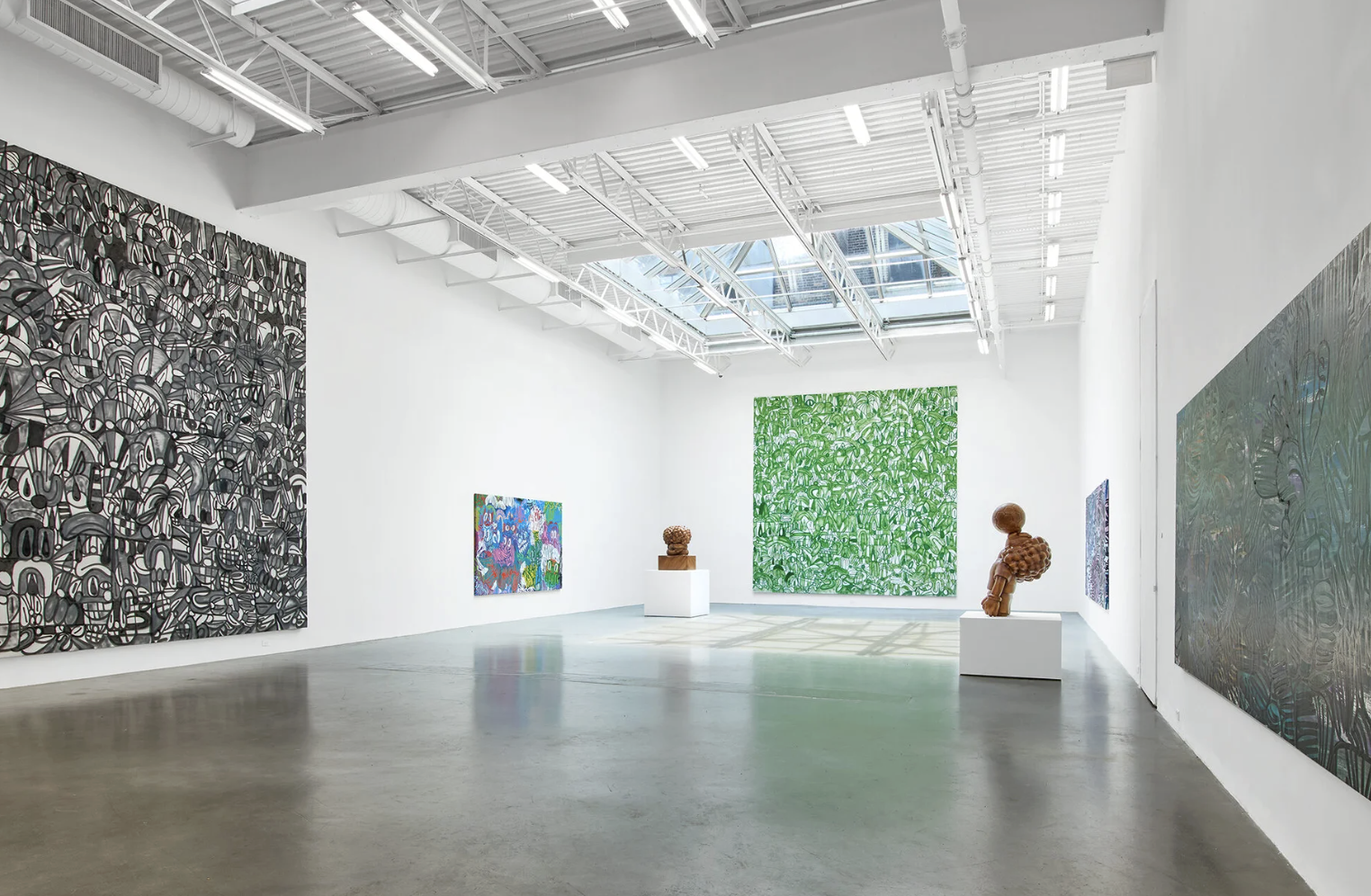
Slawn on W18th opened July 16, 2026 at 456 West 18th Street in Chelsea as the inaugural New York exhibition for Saatchi Yates, a London-based gallery founded in 2020. The audience in attendance was young and hypebeast-adjacent. The exhibition’s centerpiece works were three paintings, each roughly five meters square, in acid green, black-on-white, and charcoal greyscale. The surface of the greyscale painting was packed edge to edge with overlapping faces, some smiling, some frowning, all drawn with wide distorted lips and long, elongated eyes. In its all-over structure and rejection of pictorial subject, it recalls the early abstract expressionists, who rejected clear compositional objectives in favor of pure gesture that Slawn activates using spraypaint. The main room hosted his minstrelsy works at architectural scale, also featuring wooden bust sculptures of his signature minstrel character with afros. They were frozen in distinct gestures, one curled in on itself and another with its head tilted back, balancing a soccer ball on its large lips.
Halfway through the opening reception, performance artist Thelonious Stokes, covered head to toe in patchy black paint, stomped through the gallery screaming for people to "shut the fuck up." He blew what looked like a shofar, an instrument made from a ram’s horn, and pushed a gallery attendee in the face with it. As he traversed the gallery for a less than 30 minute performance, most of the influencer-esque crowd were recording it on their phones or ignoring it altogether, while a few even joked and laughed. Between the painted walls and the painted performer, the show delivered an immersive experience of imagery reminiscent of black subjugation.
The caricatural reduction of Black features, the exaggerated lips, bulging eyes, and the flattening of the Black face into a comic mask, was codified in the 19th century by white American entertainers performing in blackface. Key racist caricatures across American media: the Sambo, the Golliwog, and the Mammy, were tools of political and economic argument, deployed to justify slavery, segregation, and the exclusion of Black people from civic life. Their ubiquitous presence shaped how non-Black people learned to see Black people, and that visual grammar is still in usage today. Slawn's paintings depict it and Stokes performs it.
Another example of modern minstrelsy is the work of Andrew Byron Bachelor, known as King Bach online. He was the most-followed user on Vine, having over 16.2 million followers and 6.1 billion loops. His skits were based on stereotypical depictions of Blackness: watermelon and fried chicken, criminality, Jordans, and the absentee father, arranged to land a punchline in six seconds or less. Vine's short-form format shaped what TikTok and Instagram Reels are today: the Clip Economy. Audiences only see the viral sound bite from a larger podcast, show, or film, and use it to form an analysis of the work in its entirety. The Clip Economy has produced a category of artist who has rejected the white cube gallery to exhibit in-feed. Greater access to audiences is beneficial, but when the artist becomes more motivated by algorithmic performance than aesthetic inquiry, the work reverts to the mode of King Bach, whose ascent ran on uncritical depictions of anti-Blackness.
Referencing racist media in art is not inherently damaging. The tradition has been advanced by many contemporary Black artists, most influentially Jean-Michel Basquiat. In Rinso (1982), Basquiat paints a Black figure and inscribes above him the words "No suh No suh," referencing the language of address forced onto enslaved people by their enslavers. In the top right corner of the same canvas, he paints a second figure marked with the exaggerated red lips of the Sambo caricature. Critically, however, the words and the caricature share the frame, so that the viewer cannot separate the image from the language and structures of white power that weaponize it. Slawn depicts the caricature but alienates it from its origins, and in doing so, deploys the same inflammatory imagery while subverting nothing. Neither Slawn's paintings nor Stokes's performance accomplish an indictment of anti-Blackness. In both, the imagery is presented for shock and attention, both of which are useful for capital extraction in an algorithmic age.
Nike, seeking to capture value from this attention, added a Nike x Nigeria x Slawn Men’s Soccer Anthem pop-up shop to Saatchi Yates’s front entrance and sponsored the exhibition. This investment suggests that Nike identified, analyzed, and determined Slawn as “brand-safe” because his large, loyal, ostensibly "punk" and "anti-corporate" platform is devoid of the political substance that could disrupt the order Nike depends on. At best, Slawn’s work is rendered without understanding of the political and historical touchpoints he references, and at worst, it is a strategic and regressive grift to conjure memories of anti-Blackness.
The critical response to Slawn splits neatly. Outlets like The Guardian, which profiled him in September 2024 as "the most hyped artist of the moment," and This Is African Art, a digital art platform, which asked whether he is a "genius" or a "fraud" and declined to answer, have consistently produced coverage that observes his rise without interrogating his premise. That same month, London-based critic Sophie Nowakowska critiqued Slawn and Saatchi Yates’s marketing strategy, stating: “Well, it seems they’ve cracked the code—flooding Instagram with ads, getting the artist to churn out a thousand smaller pieces, each priced at £1000.” She continued by indicating, “The pieces didn’t move me.” Slawn responded by directing his followers to comment "SYM" (“suck your mum”) beneath her posts. His own defense of the caricature imagery, offered in a 2024 interview with Avant Arte, an editions publisher, was, "People say 'wow, this guy is painting racist caricatures,' [but] I'm not even painting 'coons,' I'm painting clowns."
Slawn's defense is disingenuous. Saying you are not doing something doesn't void it from being interpreted that way. Slawn speaks of his art the way he speaks of his artist label, denying it to protect himself from criticism and rigor. Whether reluctant because of his corporate sponsorships or incapable because of his technical inadequacy, Slawn does not use his medium to critique anti-Blackness the way Basquiat does with text in Rinso.
Instead, Slawn repackages American minstrelsy and sells it back to hemorrhaging multinational corporations, collapsing Western institutions, and eventually, to consumers. The result is a commercial spectacle, the same song and dance that would appall Basquiat, optimized for an algorithm that rewards polarization and controversy.