
The Next Designers: Dialective Class of 2026
Each year, Dialective, a nonprofit fashion collective, platforms the next generation of fashion designers with runway shows produced by students, for students. Bias Cut’s fashion editor Karalyn Hosier sits down with three stand-out graduates, Blue Achenbach, Devlin Ebisu, and Lia Skøien, to discuss impeccable craftsmanship, relentless determination, and what’s next in fashion.
Blue Achenbach
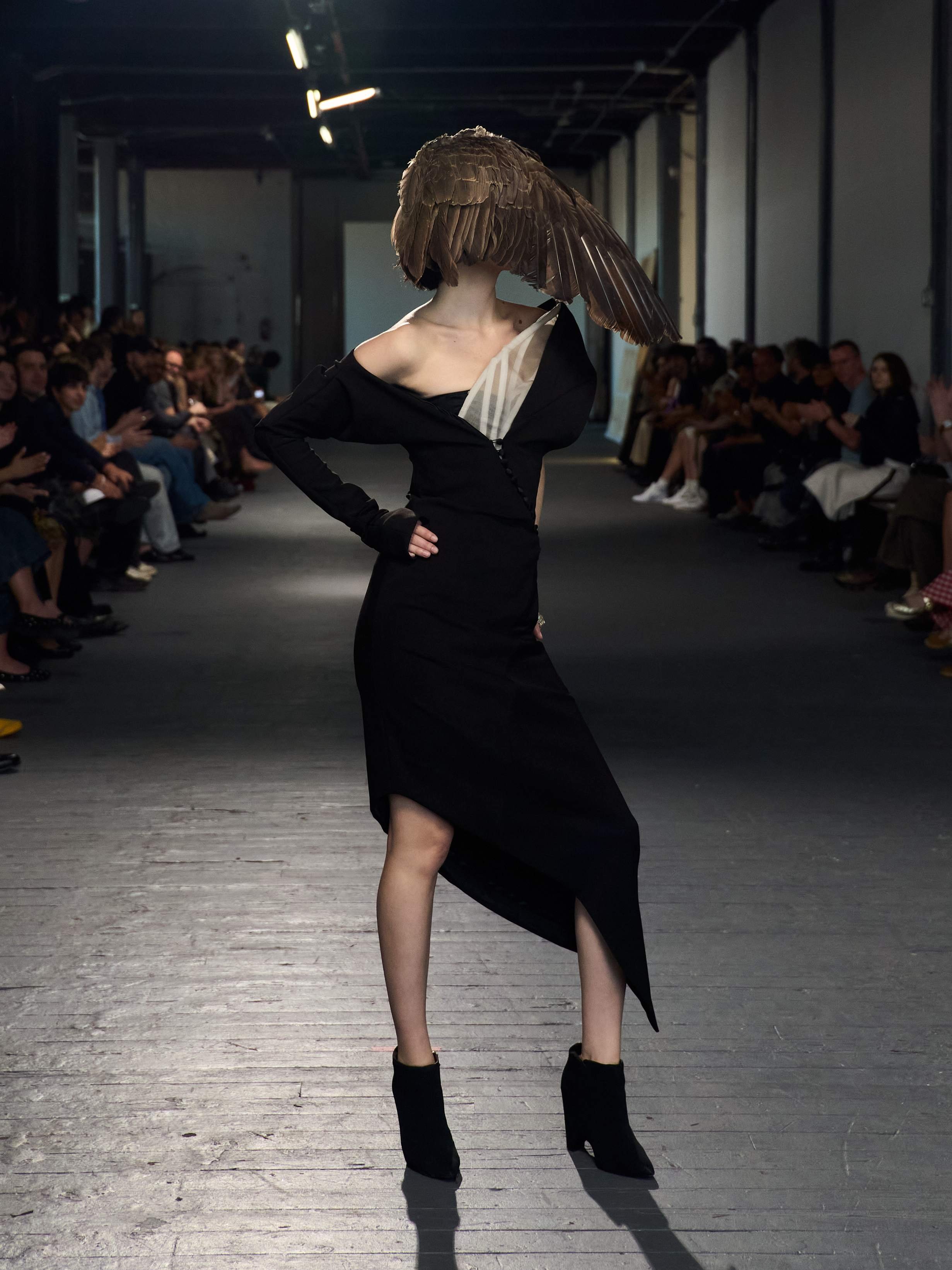
Photo by Thiha Min Zin
KARALYN HOSIER: Congratulations on graduating. How do you feel post-grad? Are you relieved?
BLUE ACHENBACH: It's a strange feeling, honestly. Obviously, I'm happy, and it is relieving—but I feel a little restless. When you're working that hard for so long, it's difficult to transition from 14-hour work days. I feel a little strange, I guess you could say, and eager to go on to the next thing. I definitely feel very happy with how [my thesis] came out. I feel very grateful.
KARALYN: I could imagine that it takes some time [to adjust]. Before we start talking about your collection, I'd love for you to just tell us a little bit about yourself.
BLUE: I'm from Los Angeles, California. Born and raised. A valley girl, unfortunately. I'm 21. I have a background in fine art, actually. My whole family are fine artists. I went to fine art middle and high schools, and around my sophomore and junior year of high school, I started to fall in love with fashion—specifically, the performance side of fashion. I was watching runway shows by [Thierry] Mugler, [John] Galliano, and Alexander McQueen. The immersive storytelling of it all, and the intense conceptualizing and world-building, was what really drew me in from the get-go. Since then, I've been designing and making, and I went to school for fashion, so it became my whole life. I obviously still have a lot of love for fine art. I'm a painter. But fashion overwhelmed everything else.
KARALYN: Coming from a fine art background, it checks out that you have a deep appreciation for conceptualization in fashion.
BLUE: I think that it's made me very detail-oriented. I was reviewing an interview with Galliano about his graduate collection, and it resonated with me because he spoke about how every detail matters while creating a story. He's really well known for completely immersing himself in the factors that create a collection. I definitely lean towards design more than construction, even though I have a lot of love for construction.
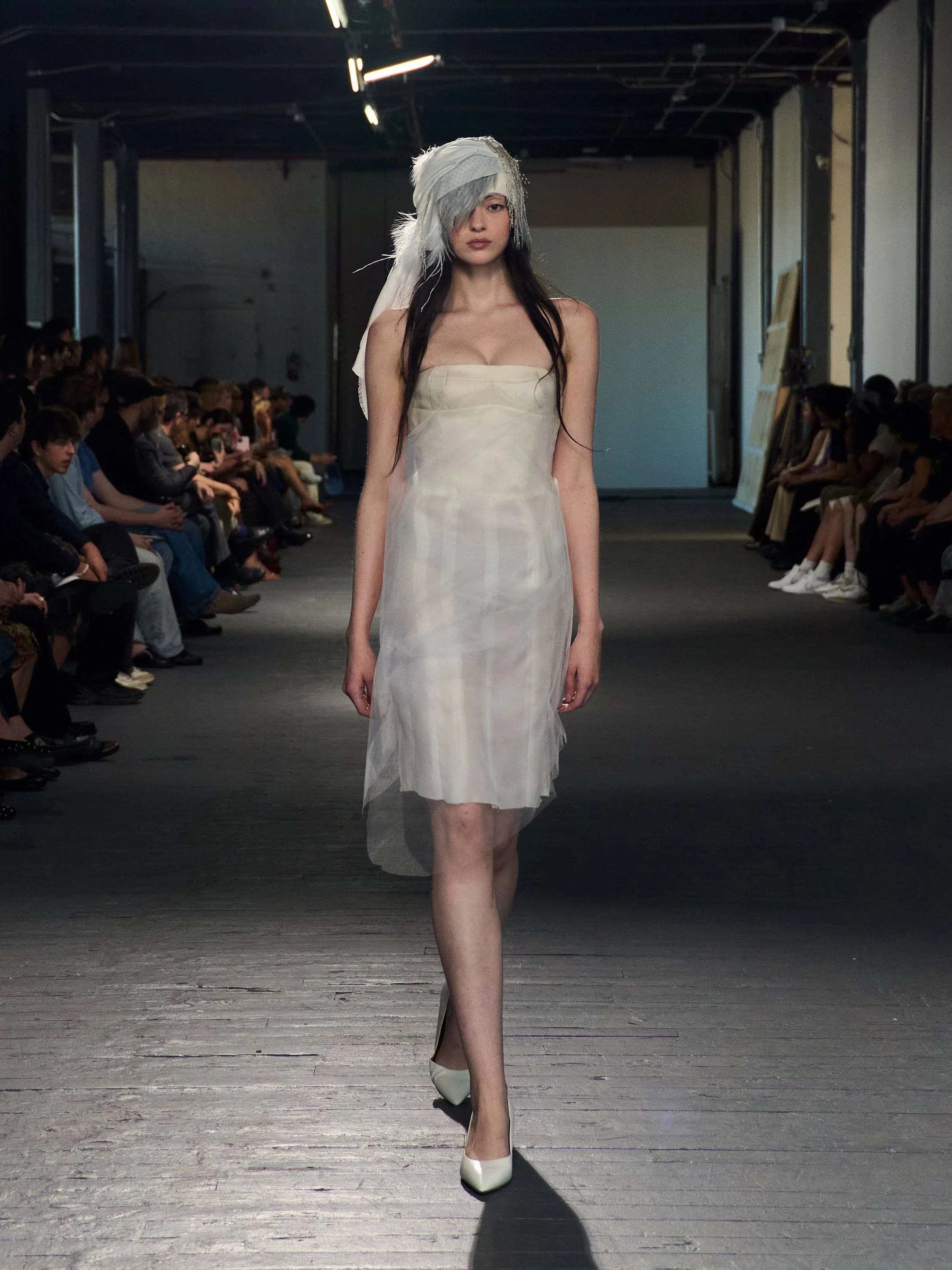
Photo by Thiha Min Zin
KARALYN: I would love to hear about your collection and the ideas, emotions, and experiences that shaped it.
BLUE: My collection is called Aperture/Refuge, and it builds upon the physical and conceptual nature of a nest. I take the nest, and I pull textural elements from it. I'm also examining how the nest is symbolic of home—moving beyond a nostalgic reflection of my own home, and towards an exploration of where I find safety. Hence, the word "refuge.” It's more focused on the bird leaving the nest, transition, and protective spaces, than childhood memories. It's kind of uncertain and uncomfortable. This collection really forced me to reflect on the places that I find the most comfort in, and the materials that represent that to me. It was a long and difficult journey. I have a somewhat tenuous relationship with home, and my collection created a therapeutic space for me to think about these vulnerable aspects of my identity and how they could translate into a garment. I imagine a bird being forced to meet transition, development, and growth, through the shedding of skins, feathers, and eventually, through flight, [represented by] my final look [with the goose wing].
KARALYN: Such a beautiful concept. You said you've been forced to reflect and meditate on this concept for the past year of your life. Do you feel like your ideas of home or your relationship to this concept have developed over time in a way that you weren't expecting?
BLUE: It's definitely an ongoing conversation. I think a lot of my work has manifested as a commentary more than a solution, and I think that's how a lot of my collections have manifested. Many designers work from really personal perspectives, obviously, when they're building their collections. I tend to be very vulnerable with my work as well as with my relationships to memory and safety because of my past experiences. I think of it as a conversation between me and my work, this kind of meditation through it all.
KARALYN: Is there a garment in your collection that feels especially personal to you?
BLUE: I definitely feel like my first, third, and fifth looks are the most personal. The fifth look, I think, resonates with everyone the most because the goose wing is the climax of this story. You start with the nest, and then the fifth look is the flight of leaving the nest. And I think that strikes an especially personal chord with me. The collection is meant to be left unanswered because I don't know exactly where that goes. My story isn't over yet.
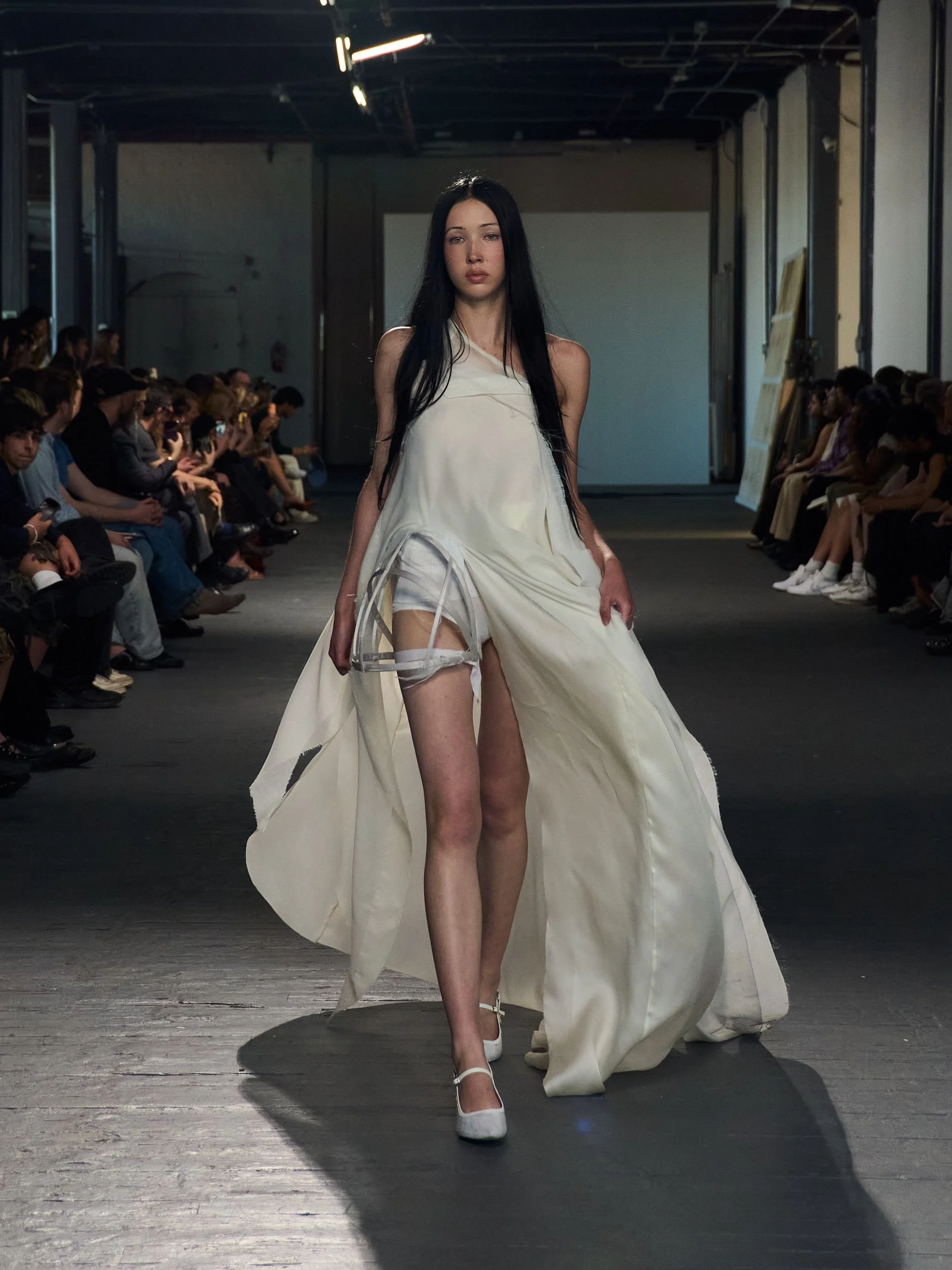
Photo by Thiha Min Zin
KARALYN: In what other ways did you use materiality and silhouette to tell the story?
BLUE: I was trying to create a juxtaposition between really lightweight, vulnerable materials—so lots of chiffons, organza, intensely delicate materials—and heavy, structural garments. Like a really delicate chiffon chemise next to heavy boning, wools, and knits. I thought of cages in particular; my caged bodice in look five is a literal manifestation of freeing yourself. The cages are representative of the things that held me down or created discomfort in me. But I also find comfort in these enclosed spaces, in the rigidity. It's a difficult relationship to describe, but the silhouettes that I used tried to convey vulnerability and the feeling of being caged or trapped.
KARALYN: I think—although certain feelings can be uncomfortable or make you feel trapped—if there's a familiarity in the rigidity, there’s a desire to return to these metaphorical cages.
BLUE: I was also considering circles for a lot of my research. There's something ritualistic about a circle, especially in my experience with spirituality. I saw the bird [represented in my pieces] as myself moving through a gap, which is why I chose the word “aperture.” It's not only a phrase for photography; the historical meaning is a gap or an opening or even a focus, which is how it became a photographic term. A lot of my patterning is based on circular, organic shapes because of that.
KARALYN: What did it feel like seeing your collection take on a life of its own and being shown on a runway, as opposed to just existing in a studio?
BLUE: Terrifying. It's so personal to me. The collection has such a potent, emotional aura to it. Exposing myself and putting myself out there felt very scary. Especially because I followed the collection and walked down the runway myself.
KARALYN: Yeah, like, “This is me, and this is how I feel, everyone.”
BLUE: “Bearing my soul to you all, and little do you know it.” But obviously very exciting. I struggle to really resonate with my excitement or my gratitude. As I said, I'm always on to the next thing. But there was definitely a feeling of elation. The whole runway turned out beautifully and I'm very grateful.
KARALYN: As you move beyond graduation, what are you hoping to build for yourself as a designer?
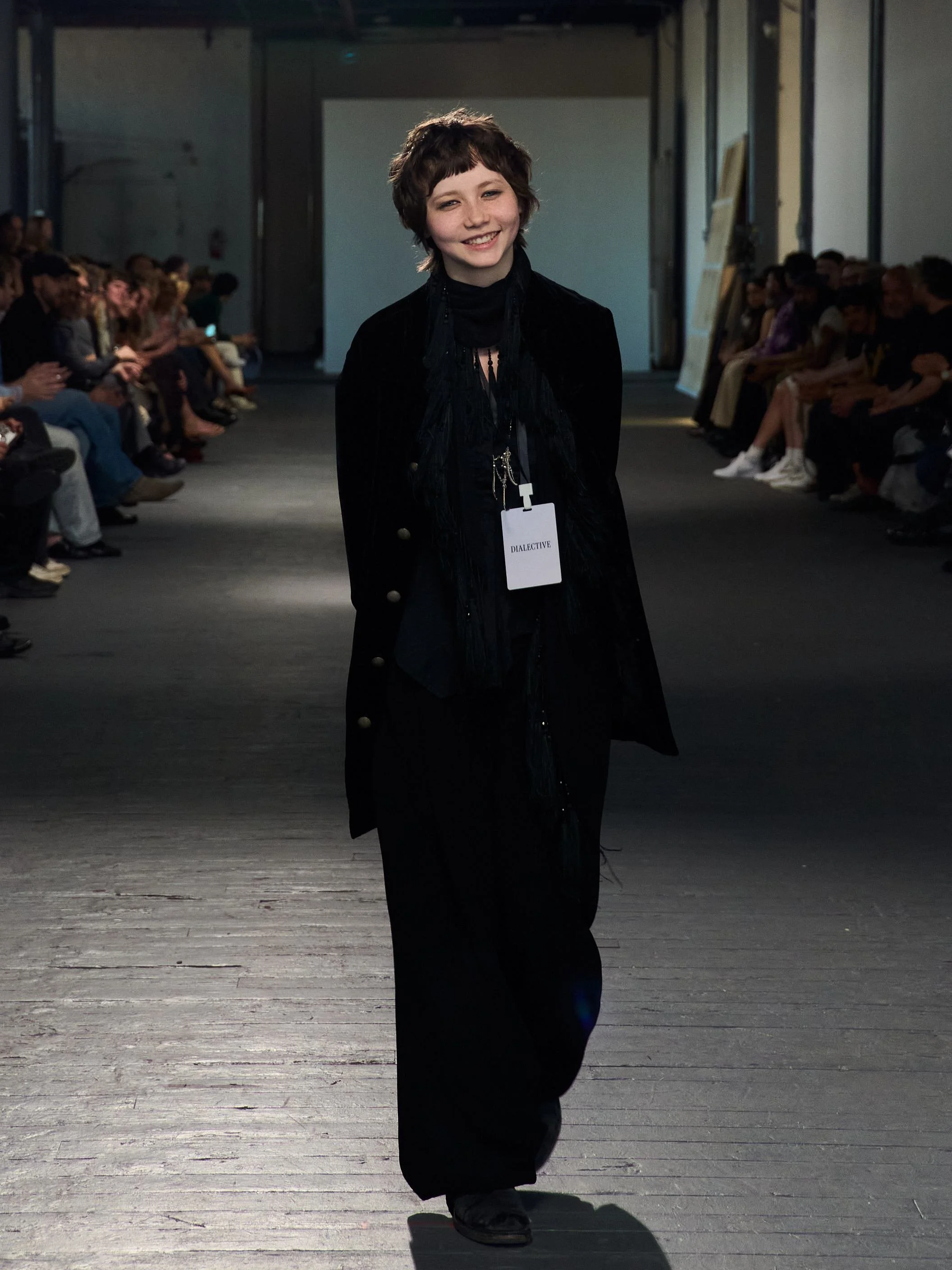
Photo by Thiha Min Zin
BLUE: As of right now, I'm trying to find a balance between pursuing the parts of the [fashion] industry that I feel most attracted to, and trying to survive. Coming out of graduation, I have quite a bit of debt, so I'm trying to find balance and a place for myself. I'm a very analog artist and designer. I bind all my own sketchbooks. I did a lot of my collaging by hand with hand sewing and hand finishes. I really want to find a place where I can apply those skills and hold on to something, especially amidst such a digital world. I have a couple of interviews in Europe. I'm hoping one works out and I can leave the United States.
KARALYN: You're going to spread your wings and fly! You're leaving the nest once and for all. Do you feel like you can fulfill that fine art compulsion with fashion design?
BLUE: I absolutely do. There’s an ongoing conversation in fashion over whether or not it can be defined as art. A lot of designers argue that fashion isn't art. And it's been a very strange journey finding a place for me in the industry when it's an inherently commercial world. Especially right now with fast fashion, there's a lot less appreciation for the construction of a collection, the research, and the quality of what you're making. But that's why I want to find a small atelier, which is more often found in Europe than in the States. They have those more traditional motivations for fashion. It's been a little bit difficult, though, because fashion has a different approach to making than fine art. But I feel like it's almost a good thing for me to have a different perspective than most. The most I can ask for is a reaction. It doesn't matter what the reaction is, as long as there’s a reaction. If I’ve built something worth a conversation, then I feel like I've succeeded.
Devlin Ebisu
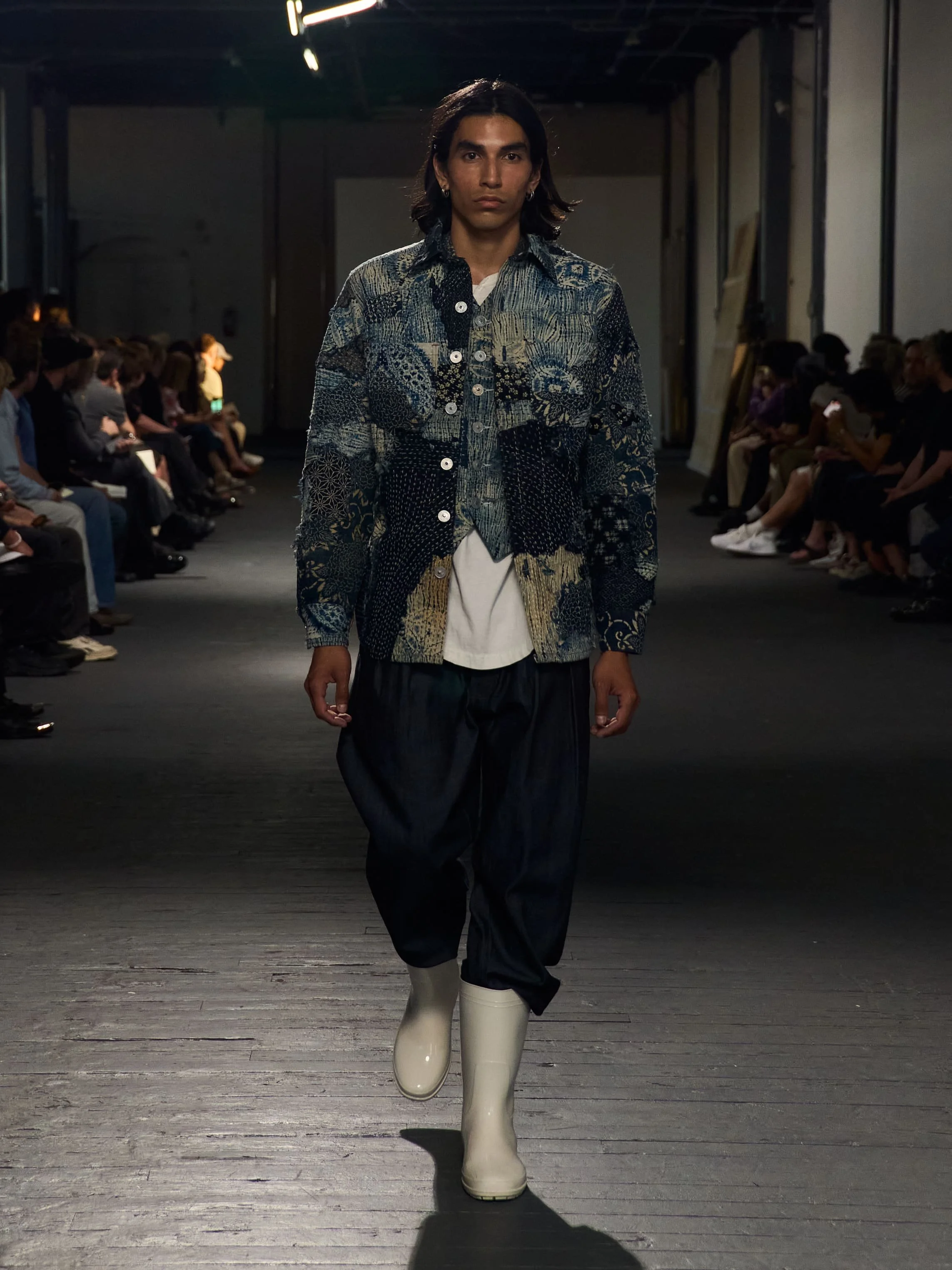
Photo by Thiha Min Zin
KARALYN: How do you feel after finishing your collection and graduating? Congratulations.
DEVLIN EBISU: Thank you. It feels surreal. It's finally hitting me now that it's over. I was able to put together a collection and see it go down the runway. A lot of people dream about that as children. I was actually able to do it, so it feels awesome.
KARALYN: Before we start talking about your collection, I would love to know where you're from, how old you are, and how long you've been designing.
DEVLIN: I am 22. I was born in New York. All of my family is from New York City. I moved to Florida when I was young, and I grew up there until high school. I've always been interested in art. Everybody in my family loves art so it's always been around me, and I think that really encouraged me to be a designer. I knew that I could do it—it wasn't a long shot or some insane, radical thing. It felt like something that was really true to me. Back in middle school I became really interested in fashion—particularly streetwear styles. Then clothes became too expensive so I started making my own stuff. I dabbled in sewing as a freshman in high school, and then I really locked into perfecting the craft. I've been proudly sewing and very invested in fashion for the past six years. I moved to New York to go to Parsons [School of Design].
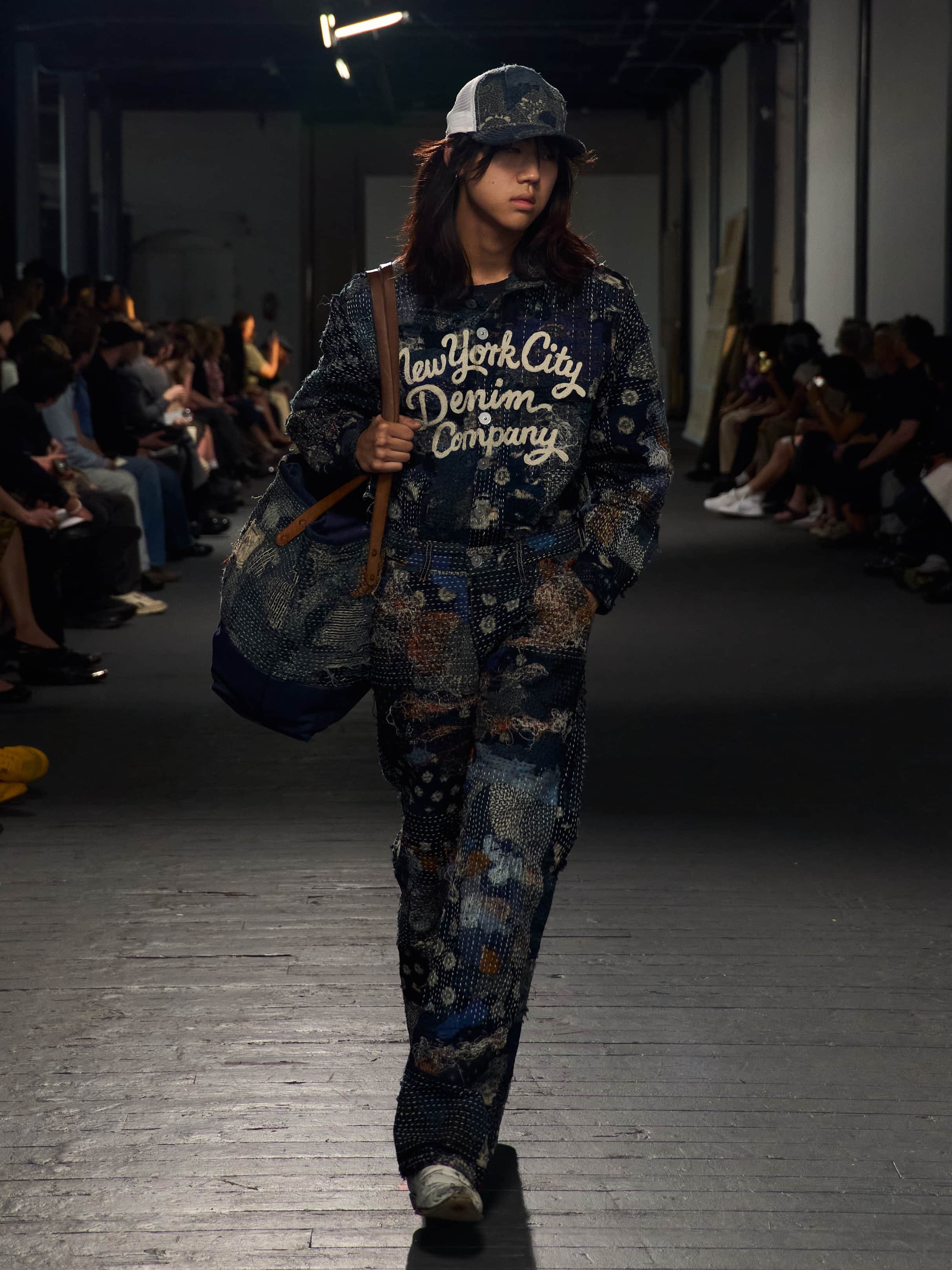
Photo by Thiha Min Zin
KARALYN: I’m so excited to hear about your collection. I would love for you to tell me about the ideas, emotions, and experiences that shaped it.
DEVLIN: For a long time, I designed to pursue high-quality techniques and craftsmanship. But for my thesis, I wanted to step away from that and create a collection that also felt personal. There was a real representation of myself in that collection, titled Heritage and Repair. It’s a combination and exploration of my family’s history of military service and my Japanese heritage.
On my dad’s side, my grandfather was a military man. He was stationed in Okinawa. That’s how he met my grandmother, and they moved to Texas. My mother's side of the family was also in the military. Fashion-wise, I really enjoy looking at military clothing, and the idea of incorporating that with Japanese textiles really interested me. The [denim patching] textile you can see [in the collection] is from Japanese references. I created a dialogue between these two cultures that I resonate with.
KARALYN: Do you have an interest in functionality in clothing—like why people wear denim when they're working, or why military garments are made out of certain materials? Was this something that you explored in your collection?
DEVLIN: Definitely. Denim is a part of my collection, but aside from that, I used duck canvas, which is traditionally utilized in military clothing. I find structured clothing and workwear to be such an interesting thing compared to high-end couture that you wear once and maybe never again. I'm all for wearing your clothes. Wear it, repair it, destroy it, fix it, you know? That's what creates actual stories in your jeans or in your jacket.
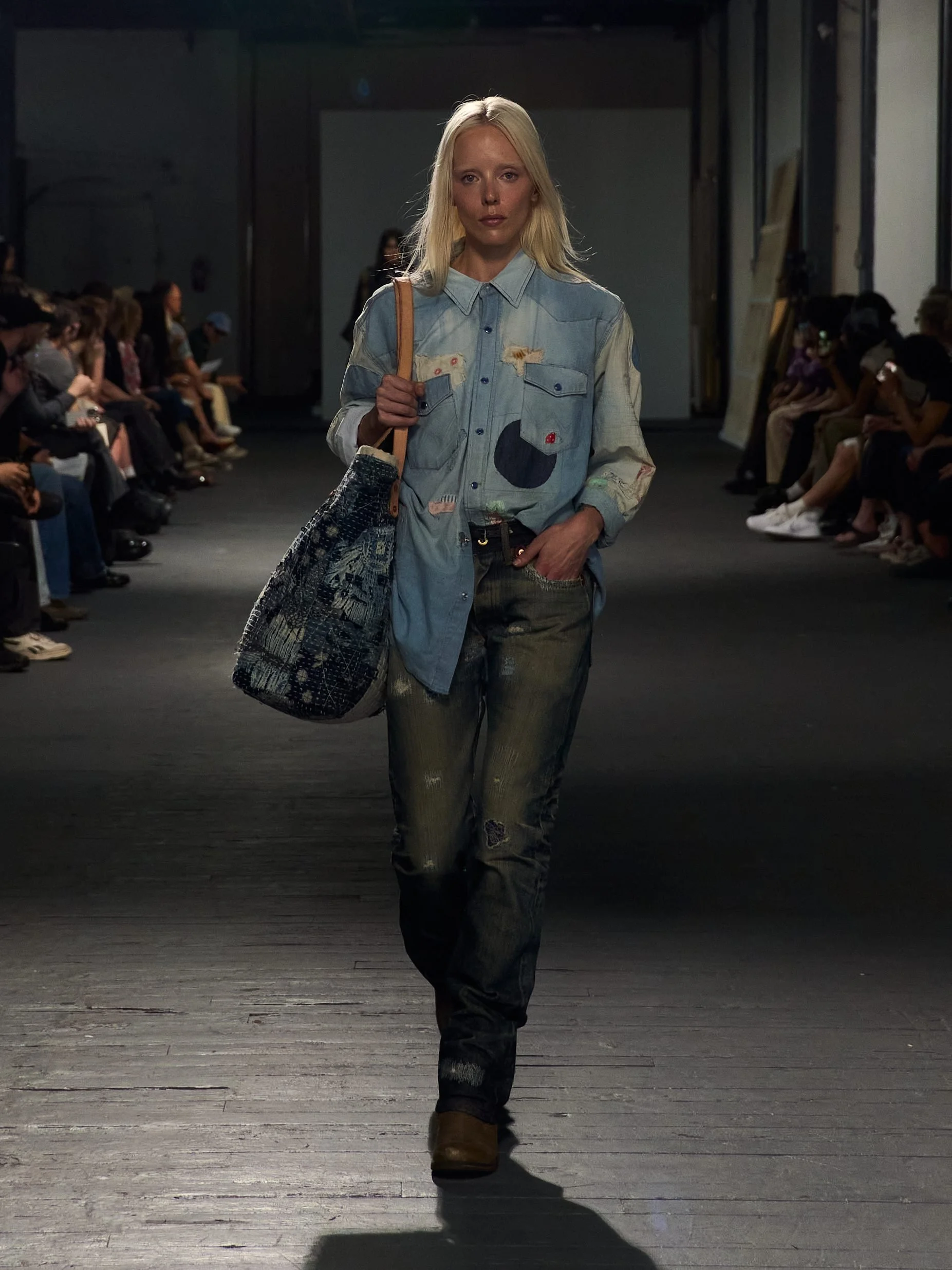
Photo by Thiha Min Zin
KARALYN: Can you explain your design process and how you developed these fabrics?
DEVLIN: I've been doing this boro technique for about three years now, since I was a sophomore in college. It’s a traditional mending technique that was used in the Edo period in Japan. I think that there's so much beauty in repair, so I really wanted to show that off. It's a ridiculously time-consuming process, very tedious and repetitive, but you get used to it after so many hours. For the jumpsuit in my collection—the one that has the New York City Denim Company chain-stitched across—just the textile development, excluding sewing, patterning, fitting, took like150 hours. You have to be insane to follow through with that. It's so rewarding at the end, but in the middle, you're like, “My hands hurt. What am I doing this for? Is this even worth it?”
KARALYN: The whole collection has these incredibly intricate details.
DEVLIN: It's basically tons of layering. I started off with the base fabric—lightweight denim. Then I distressed it and repaired it. On top of that, I had sourced tons of vintage Japanese and indigo textiles, applied them, hand-stitched them down, layered more, and stitched more. I’m simulating the wear, tear, and repair of garments.
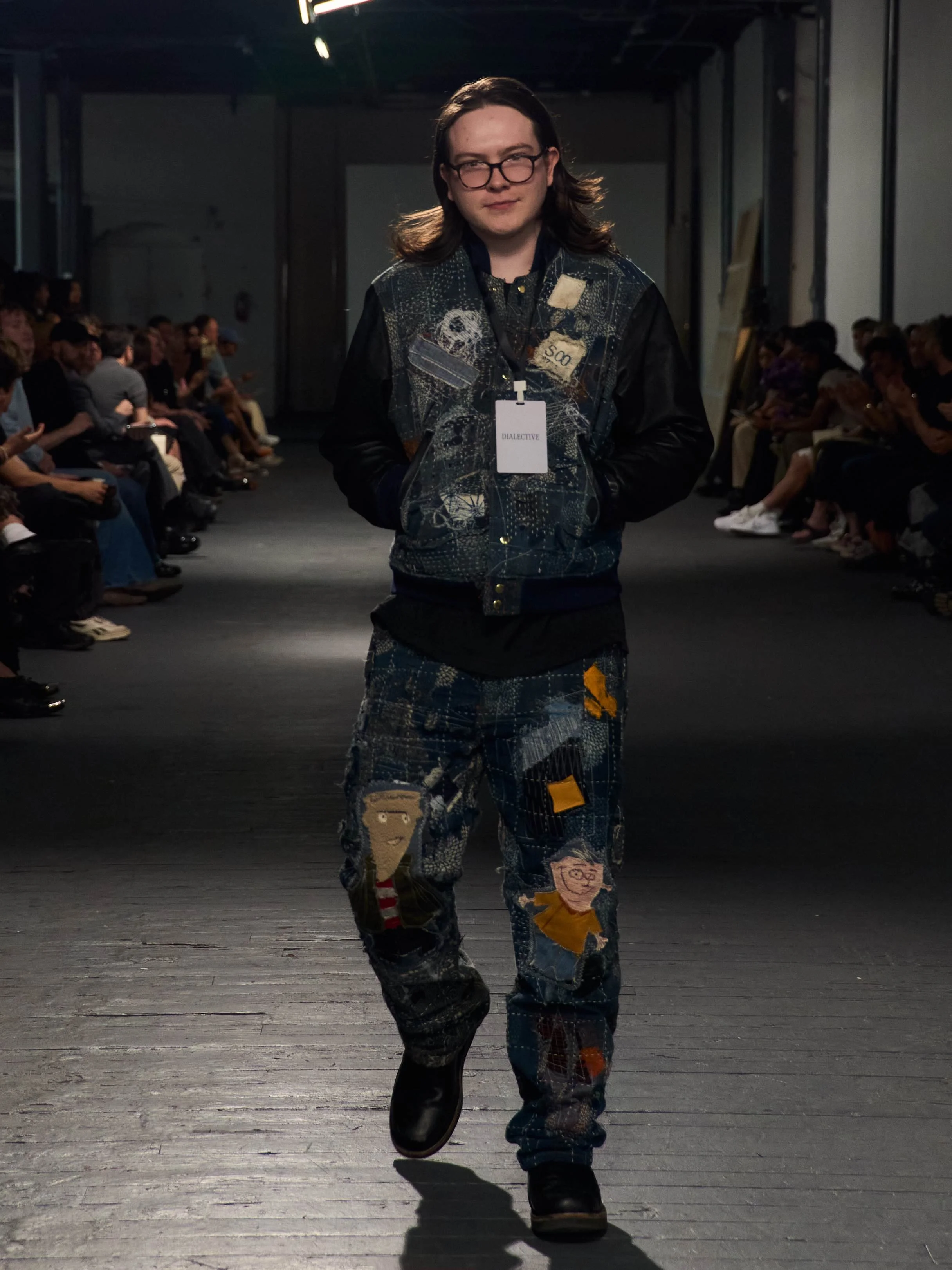
Photo by Thiha Min Zin
KARALYN: Are the garments heavy?
DEVLIN: I tried to use lightweight fabrics for the base, but the camouflage boro jacket weighs about six pounds. It's pretty heavy.
KARALYN: Did showing your collection feel vulnerable?
DEVLIN: I want to tell everybody that this is my heritage. This is my work. So I was very excited for people to see it, not afraid.
KARALYN: As you move beyond graduation, what are you hoping to build for yourself as a designer?
DEVLIN: Getting out of school is just the start. I'm ready to learn more, meet people, and have more experiences. I grew up looking up to people who were not the best role models. My end goal is to inspire the youth and be a good influence for the next generation of fashion designers.
KARALYN: And you'll continue designing?
DEVLIN: Totally. I don't plan to start my own label anytime soon. I feel that rushing into it right out of college will result in a lot of debt. For now, I can learn from people who have had a lot more time in the industry than I have.
Lia Skøien
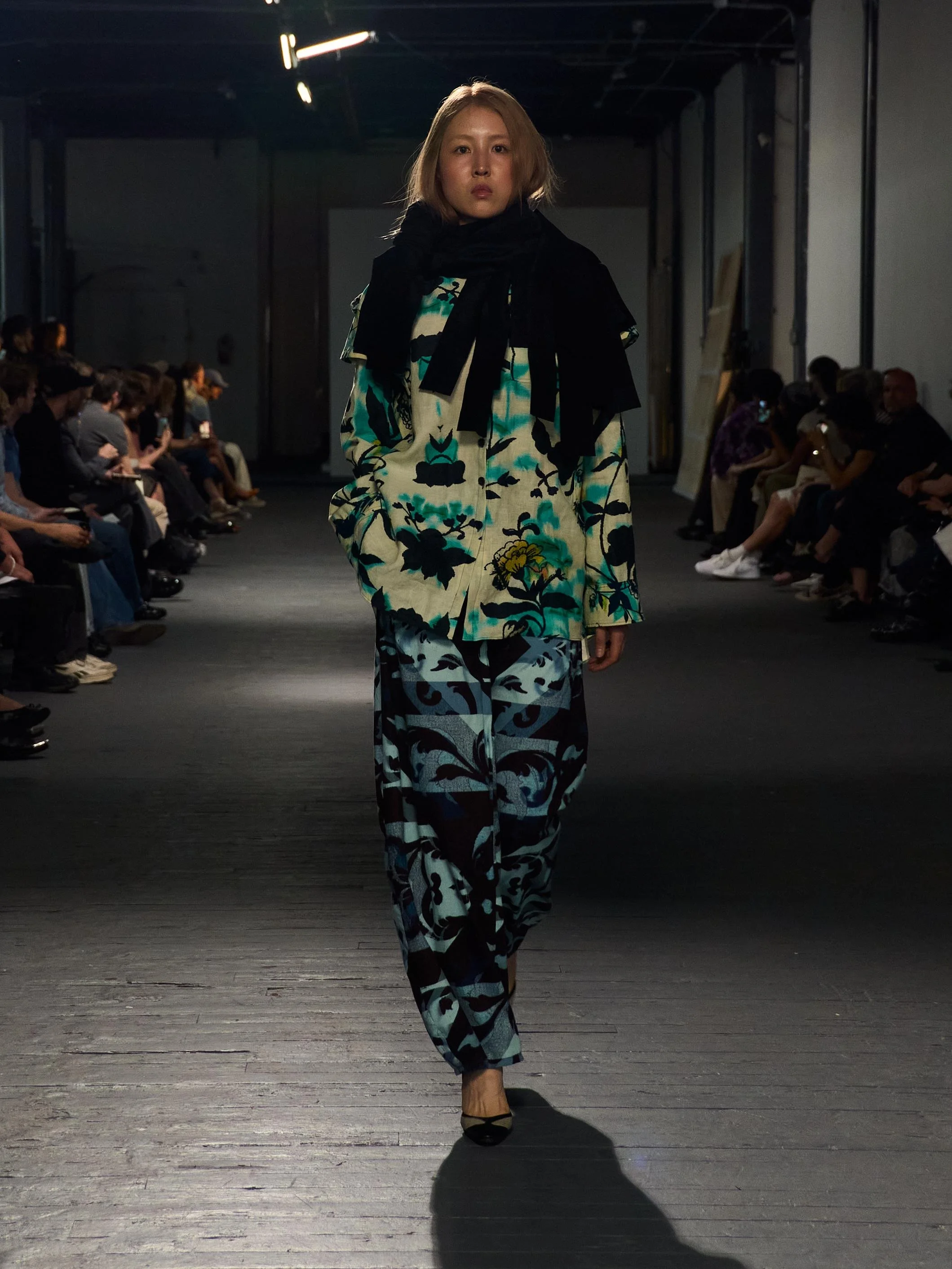
Photo by Thiha Min Zin
KARALYN HOSIER: Congratulations on finishing your collection and graduating. How do you feel about postgrad?
LIA SKØIEN: It's really confusing because creating my thesis was so fast-paced every single day, and then it all ended so quickly. Since then I've just been horizontal.
KARALYN: It’s a hard transition. Before we start talking about your collection, I would love to know a little more about you.
LIA: I am from Malmö, Sweden. It’s really close to Copenhagen. It was always so daunting to go there—everyone was so cool when I was young. I'm Danish, Swedish, and Norwegian. I'm 25, and I moved to New York in 2021. I didn't really like Parsons at first so I transferred to Pratt. I've been designing for six or seven years. I have a background in painting and drawing, but always had an interest in fashion because of growing up near Copenhagen. And then I kind of threw myself into fashion when I was applying to schools.
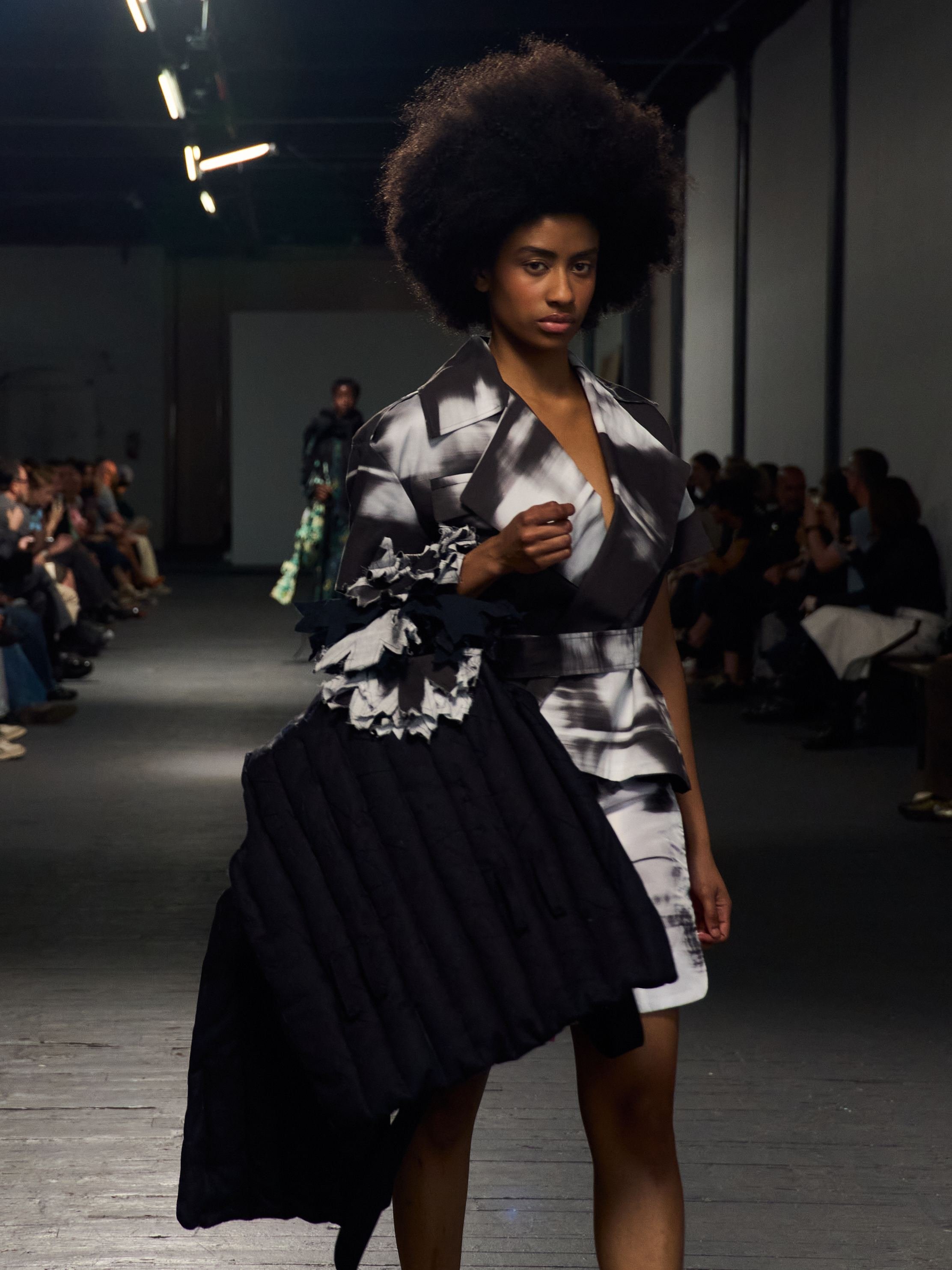
Photo by Thiha Min Zin
KARALYN: There's got to be something satisfying about being so physical when working with materials and textiles. It's completely different from painting or other art forms. Fashion is art. I know it's a bit of a polarizing topic, but I don't know how anyone could argue that fashion is not art.
LIA: I agree, especially as a maker.
KARALYN: I'm so excited to hear about your collection. I would love for you to share the ideas, emotions, and experiences that shaped it.
LIA: When I began to study fashion, I was not so drawn to creating a concept. I liked existing garments and materials that already had narratives. When I started school, I was drawn to Norwegian folk dress. It's a garment with so much history and heritage that is re-sewn, embellished, embroidered, and passed down through generations, and it says so much about you as a person. It represents how the self and identity evolve over time, both generationally and day-to-day.
For my thesis, I wanted to challenge the folk dress. I grew up in a family where everyone is connected to airplanes and pilots. My grandpa was a fighter jet pilot, my mom a stewardess, and my dad a pilot. Everyone wears a uniform. I was always fascinated watching my mom put on her little scarf, or my dad walk around in his suit. It felt like such a disconnect from who they were as people.
I wanted to combine folk dress and the pilot uniform by combining the shapes and structures from the uniform with the textiles and prints derived from folk dress, because they mean such different things. The folk dress is so personal; it’s your grandmother's stitching. The uniform is replaceable, and its purpose is to hide your identity, if that makes sense. They're so contradictory, so I thought that was a fun approach. That's the collection.
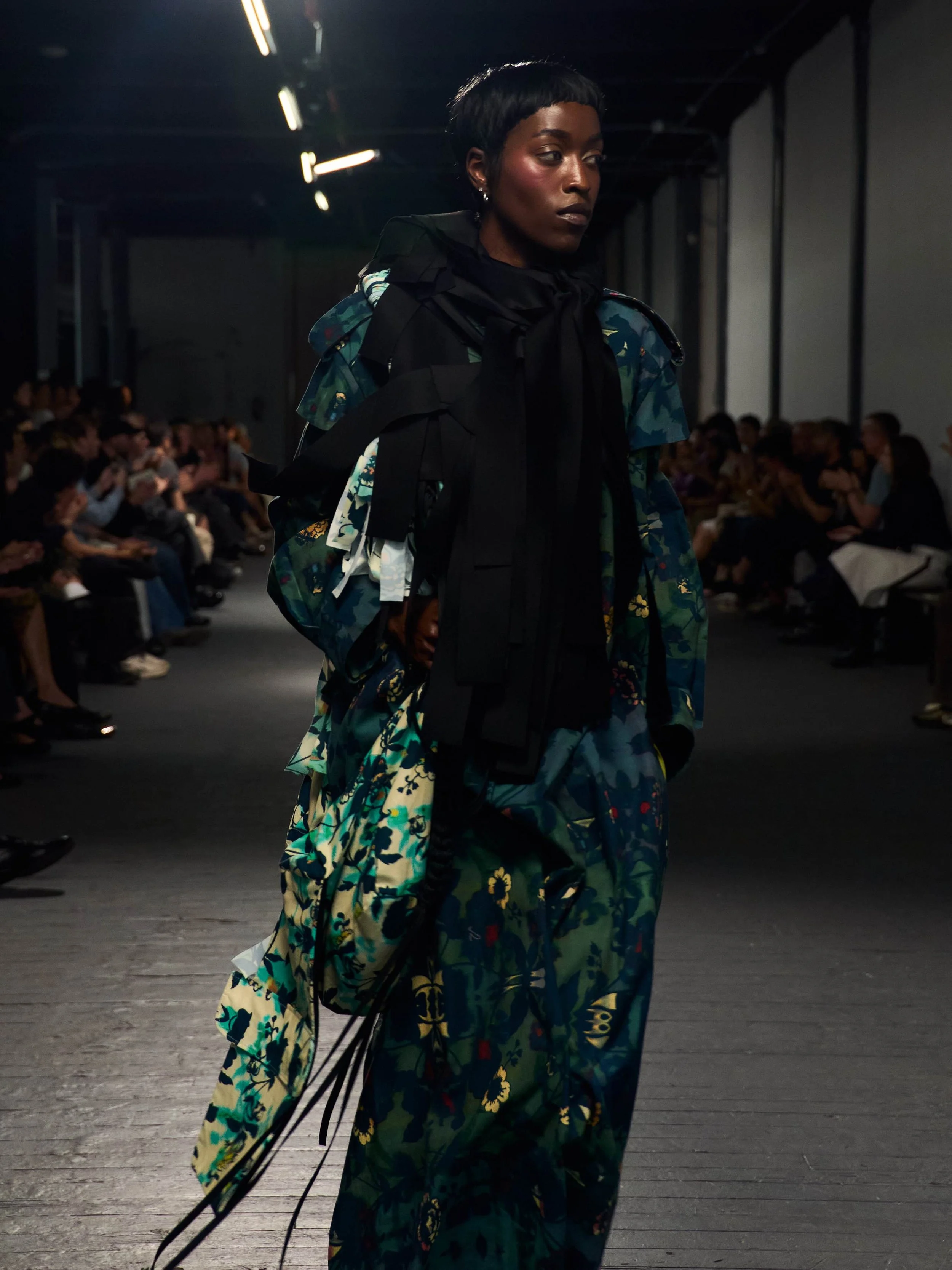
Photo by Thiha Min Zin
KARALYN: You've chosen this garment that has such a rich history, and are comparing it to the rigid uniforms that your family members have worn their whole lives. It's these two things in conversation with one another and complimenting each other. I don't know much about folk dress. Do you have one yourself?
LIA: Yes. You get a baby version when you're a really small child. My grandma still has mine. It's a little head scarf, an apron, and a wool dress. It's really cute. Over time, we add jewelry. It's supposed to protect you from evil spirits and bad things happening to you. My mom has my folk dress currently. I tried to get it back to New York when I was visiting Malmö over the summer. I don't have my dress with me. I wish I did.
KARALYN: Were the prints in your collection inspired by the folk dress?
LIA: They were. I started by sourcing a lot of fabrics back home in Sweden. There's this amazing Swedish, Danish, and Norwegian archive online, where you can find all kinds of different textiles. My print design came from scanning those textiles and reworking them, focusing on print distortion. I took the motifs, florals, and stripes, and made them not so “pretty.” Folk dress is a sacred thing. It's so special to the family. Some of the prints are scanned from my mom's dress as well, from the embroidery. That was such a fun part of the collection. My teacher said, “Stop bringing more prints.” I was like, “Okay,” and then I brought 20 more.
KARALYN: The idea of distorting the patterns really resonates with the concept of the folk dress, being that it’s sort of distorted over time from having to mend and rework the dress to keep it alive.
LIA: Yeah, that was kind of the approach. There was a lot of overlap in pilot [attire] and folk prints as well. I tried to combine the two—the pilot stripes with stripes in the folk dress. It was such an incredible part of the collection.
KARALYN: Is there a garment in your collection that you feel is especially personal to you?
LIA: There are two garments where I did a lot of shirting, like my apron shirt. That's something that I feel connects the dots between my mom's stewardess apron and the folk dress apron that I saw so many times growing up. I did a life jacket as well, but it doesn't functionally work. I wouldn't recommend going in the water with it. It's stuffed with fabric scraps. It reminds me of my dad, because it's… I don't know… him as a person. He's very all-over-the-place, which I love so much. So I’m fascinated when he puts on his suit and goes to work, flying 300 people around the world every day. So to make a life jacket that was non-functional was very heartwarming because it reminds me of him as a person. It's also embroidered with these Norwegian flowers. When you get married, you wear a folk dress with big floral appliques on the shoulder and fresh flowers. That's where it all came together for me.
KARALYN: Was there a moment during your creation of this collection when you questioned your direction?
LIA: I experienced so many ups and downs with this collection, as I’m sure any graduating designer does. It feels so monumental and larger than life. I had so many ideas, and I wanted everything to fit into the collection. I had hats, scarves, various accessories, and more and more prints. I was overworking myself a little bit. I think that's just being a designer.
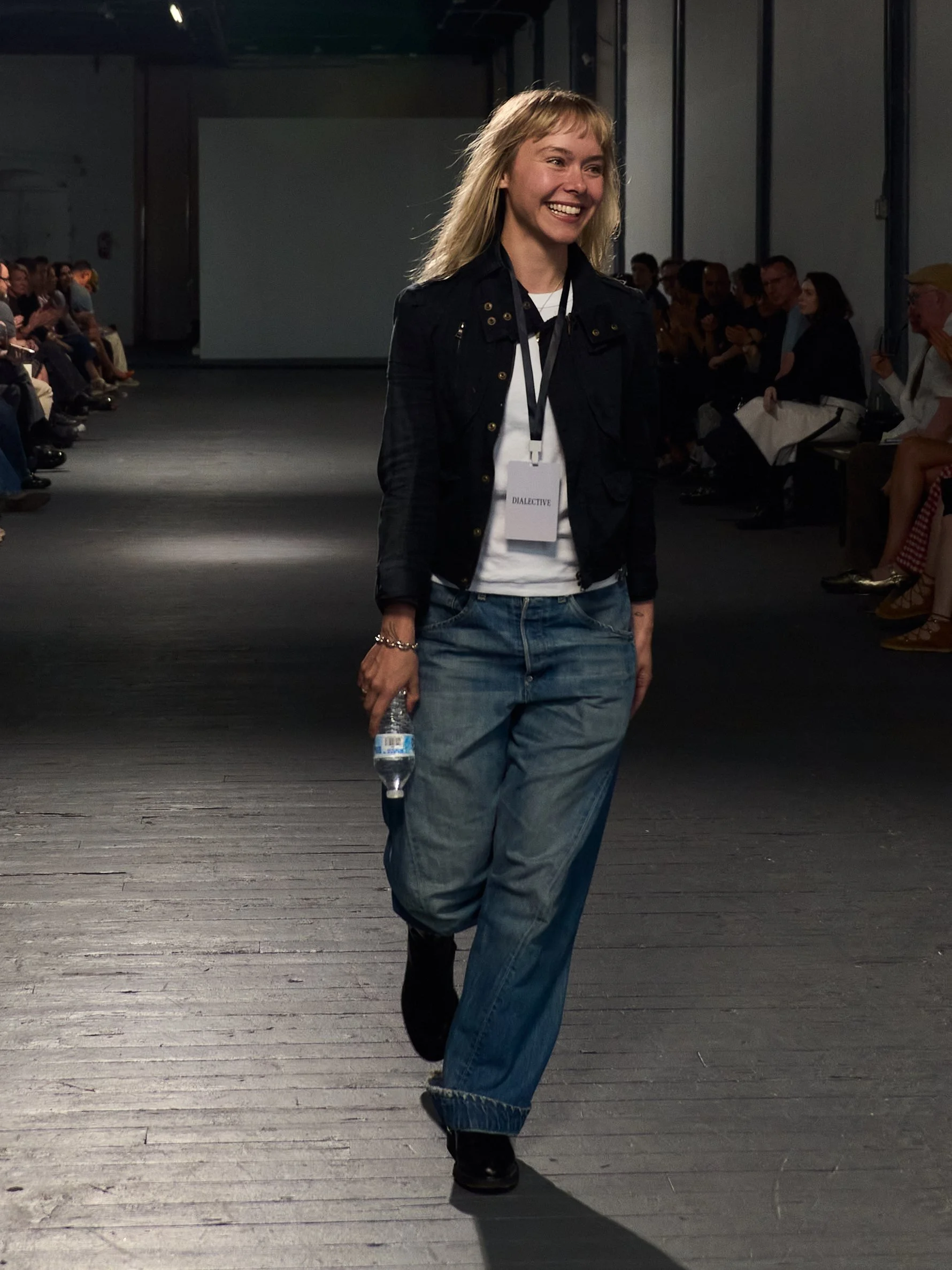
Photo by Thiha Min Zin
KARALYN: Was there a fear of it not translating the way you were hoping, or was your collection more for yourself than for others?
LIA: It’s what I've wanted to do my whole life—making a graduate collection. But I think it was the first time I realized I had no idea what I was doing. Still, I never gave up on it.
KARALYN: It’s got to be strange, having an idea so potent in your mind in the beginning stages, and then starting to lay it out in front of you and realizing it may not make sense.
LIA: I learned so much. I would do it again a hundred times.
KARALYN: Is there a part of the design process that you find the most rewarding?
LIA: I love pattern-making. Making the muslins is the most rewarding process because there are endless possibilities. We had fittings every week. Just getting through each week was a huge milestone, because it meant I was one step closer to what I wanted.
KARALYN: What was it like seeing your collection leave the studio and take on a life of its own on the runway?
LIA: It was so emotional. A lot of crying. It's like the baby that I birthed is leaving the nest for the first time. The deadline that I'd been so scared of for, like, a year finally passed. It was such a relief, but I immediately thought, “I want to keep making more. I don't want it to be over.” Seeing it on the runway was absolutely incredible. It was an out-of-body experience because I got to do it with so many of my friends.
KARALYN: Did it feel a bit vulnerable for you to present this collection to a crowd of people?
LIA: I think so. Until the show, my collection was confined to a hallway. Fashion is so small. Everybody knows each other. But opening up those doors and having all kinds of people see it was very daunting. We call it ice in the stomach in Sweden. I felt like I had ice in my stomach.
KARALYN: But you didn’t want it to end.
LIA: I need to touch some fabric very soon.
KARALYN: What are you hoping to build for yourself as a designer?
LIA: I cleaned out my studio two days ago. That was very emotional. It reminded me that this is something I can pursue for the rest of my life, whatever format that takes. The goal is making more.