
Sasha Brodsky paints the movement of bodies, the mood of rooms, and the feeling of cities, capturing the murky moments that make a place feel alive.
By JANE LEWIS
Photographer OLIVIA WEIN
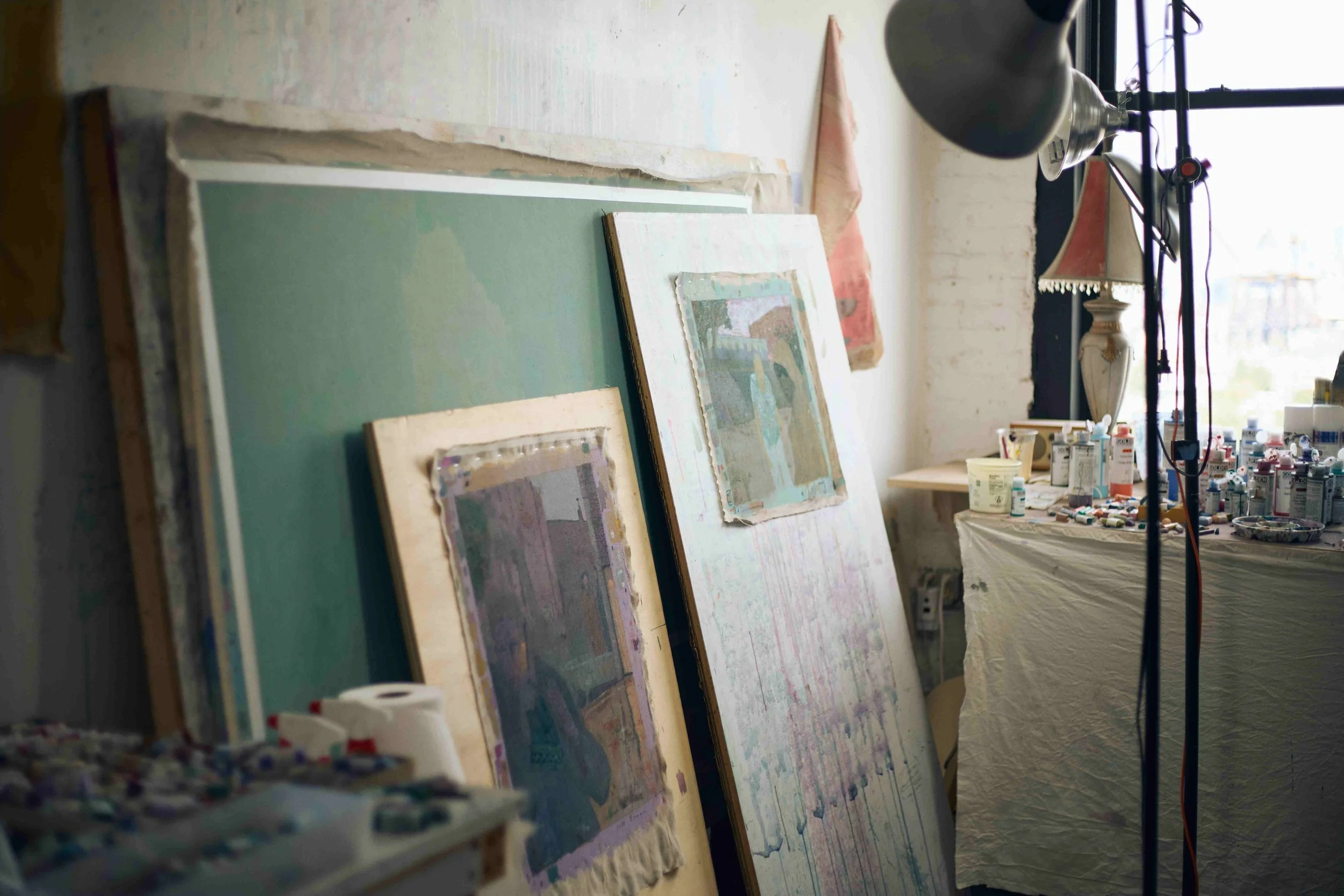
Sasha Brodsky considers himself a draftsman–not just an illustrator, or a painter, or a printmaker, or even just an artist, but someone who looks at a space, feels it, and stretches it into a painting. The 31-year-old Russian creates snapshots of urban scenes that, though ambiguous, feel strangely familiar. Always human, his figures are slumped and hunched, talking and reaching. Cityscapes and barren buildings serve as backdrops, and there is melancholy in his murky tones. Sasha resists theme and instead reaches for feeling.
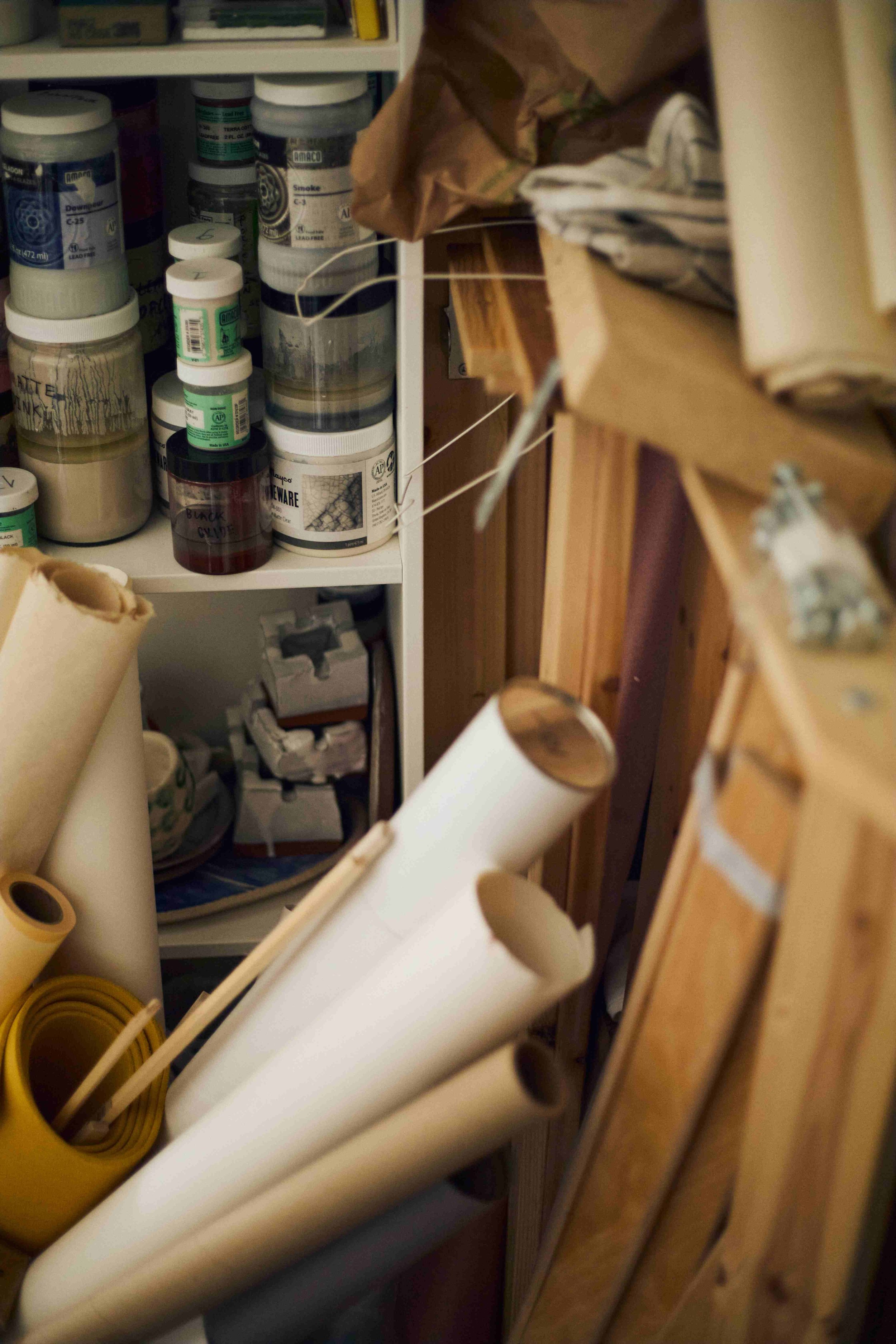
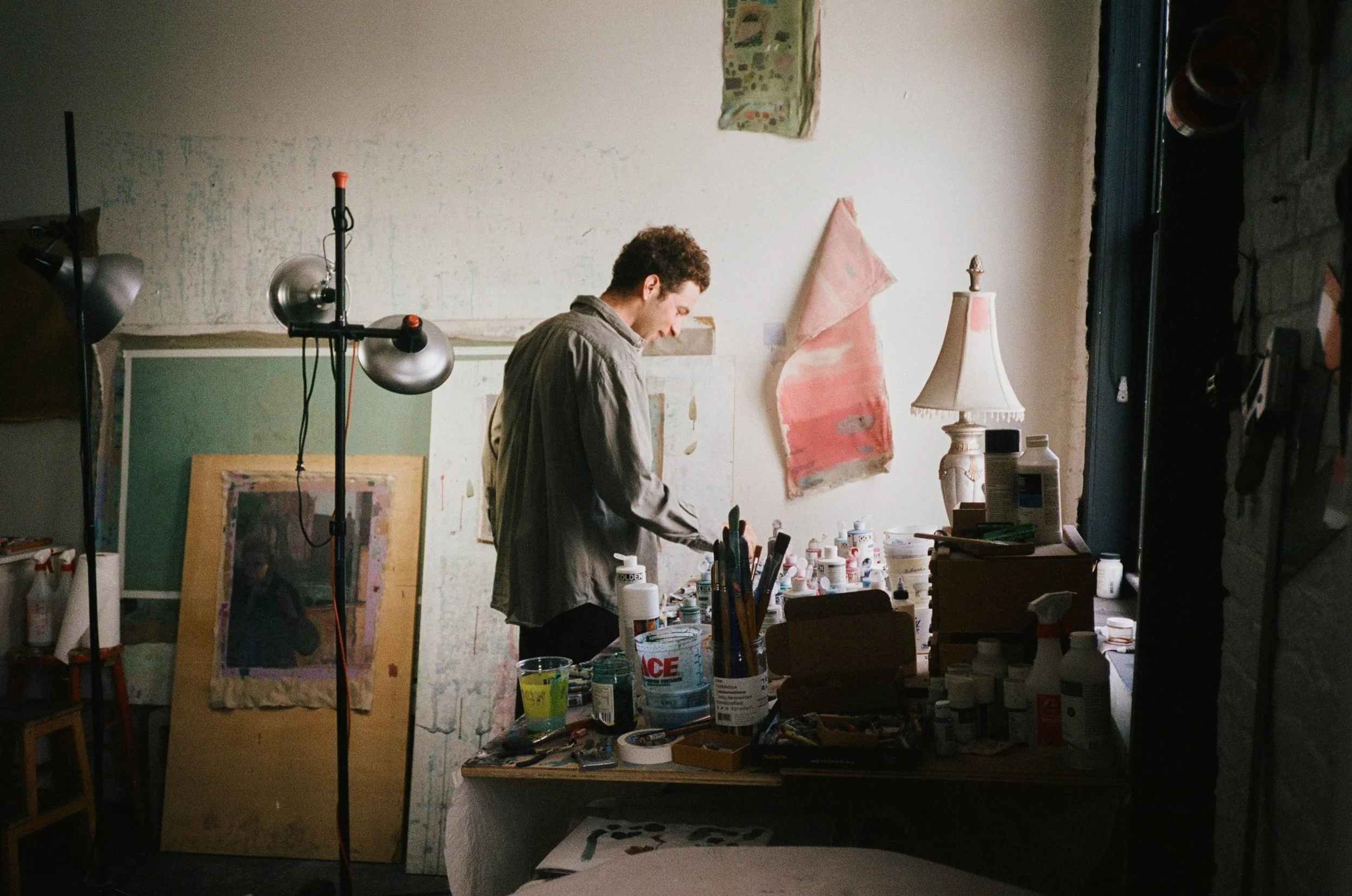
On a sunny day in August, I sat with the artist in his Brooklyn Navy Yard studio. His table, packed with acrylic paint, brushes, masking tape, and water cups, rests beneath one large window. Under the second window stands a kiln. Sasha’s partner, Marisha Falkovich, is a ceramicist and sculptor, and the two share their studio space in an almost even split. They have a large plywood desk littered with sketchbooks and stained with paint. Swaths of raw linen covered in geometric paint swatches drape the walls. Being inside an artist’s studio is like entering their brain. Sasha’s brain is brimming with muted chaos.
“I try to stay away from being too particular.”
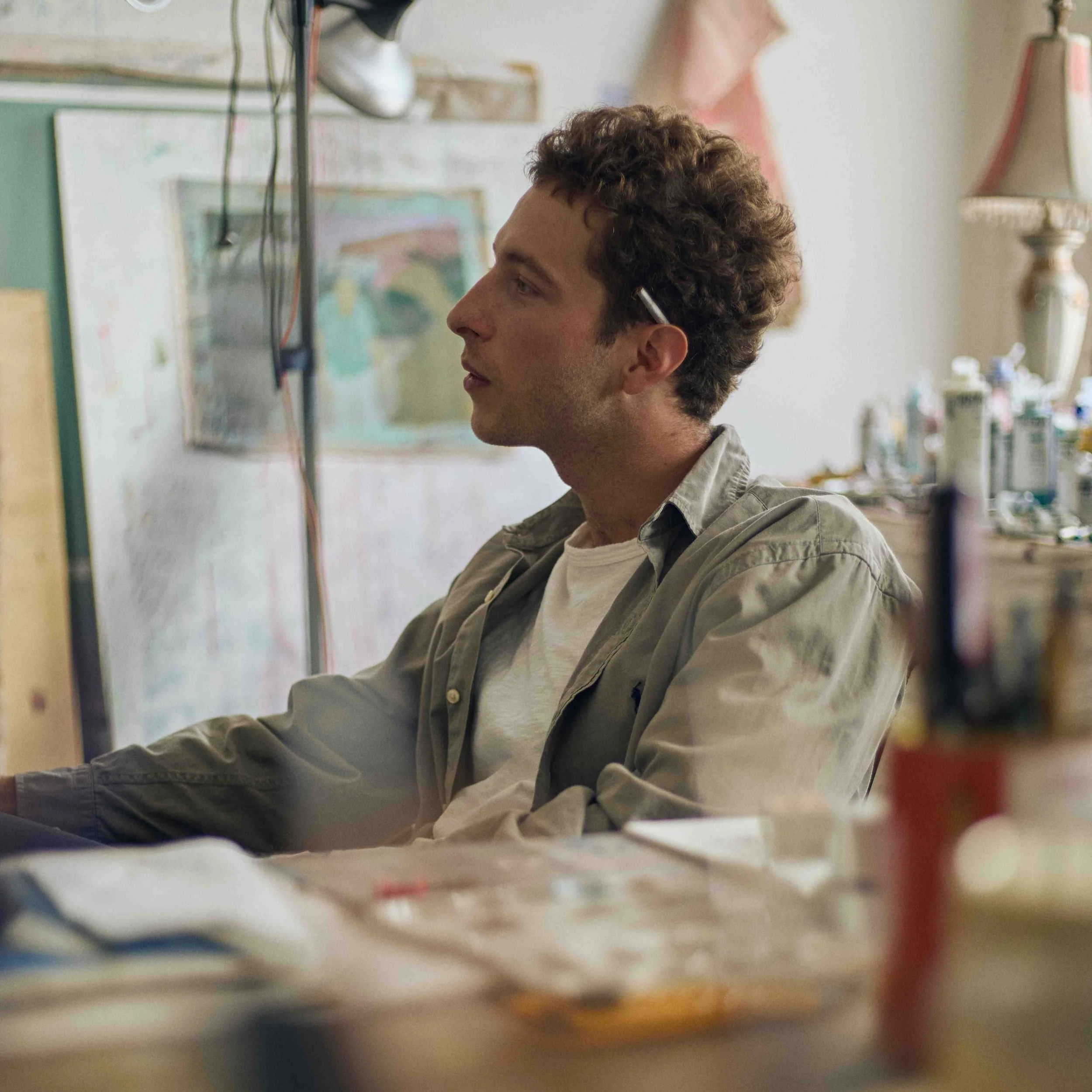
He was raised in Moscow, where his father, architect Alexander Brodsky, and mother, graphic designer Masha Brodsky, raised him to be relentlessly creative. Despite this, they remained wary of children’s art classes. “They're taking everyone and they're putting them into this meat grinder,” Sasha says, quoting his father’s disdain of traditional art education, which came from a belief that teaching a child how to make art defeats the purpose of the act. “It always stuck with me. I tried to never lose these [childlike] instincts,” he ponders. Art-making was always a family affair. Sasha grew up watching his dad work, and the whole family often pulled all-nighters before art openings to put finishing touches on an installation. In March 2024, Sasha and Alexander showed their work in tandem at the Fondazione Galleria Milano. Their exhibition, Nameless Square, featured an intricate clay sculpture by Alexander as Sasha’s etchings lined the walls. The whole family, including Marisha, was there to support.
I saw Sasha’s work for the first time at his Dwelling Place exhibition at Margot Samel gallery in Tribeca in June 2026. Every day on my walk to work, I stopped and stared through the gallery windows. Sasha’s canvases pulsed and moved. Orange, purple, blue, green, and orange again. They appeared like a collective migration, the subjects all paused mid-movement, yet the direction in which they moved remained undefined. The works were unusually displayed, with canvases stacked up the walls and hung in corners. “There are enough shows that are pristine—one painting in the middle of white wall. Super serious,” Sasha explains. “But there is a shortage of more humorous shows.” He speaks softly in a slight Russian accent and spins a pencil sharpener in his fingers. His father came to New York for the show and had a hand in the irregular placement of the paintings. “We had this idea that everyone thought was crazy: to put a few paintings in corners. You think it's really strange but it made the space feel wider,” he remembers. Sasha surrenders to the spaces that he encounters, allowing his inherited instinct to take the reins.
A taxi ride through Brooklyn or a walk from his home to his studio is all he needs to spark the next work. “Whenever I find myself in a part of town I haven't been before, it's like a little journey. I get a feeling,” he explains. “I never think of themes. It’s just a stream of pictures that kind of comes out [of me].” He begins with a rough pencil sketch on raw linen canvas. Next, using acrylic paint diluted with water, he layers and layers the thinned paint until it reaches his desired opacity. Then, he adds oil pastel, thickening the layers of purple, blue, green, and orange. He repeats this process over and over.
“To me, a good composition is one where there's some kind of tension and movement within the picture.”
Anonymity is a recurring idea in his work, as many of his human figures look down or hide parts of their faces; “I try to stay away from being very particular. Sometimes I finish a figure and think, ‘It's too specific or too realistic. I should make it a little less so.’” His backdrops are as ambiguous as his characters: skylines, sidewalks, and city squares that don’t belong to any particular zip code. Yet the New York undercurrent is strong. Sasha has lived in the city for nearly 12 years and calls it home. He hasn’t visited Russia since the war began in 2022, and his extended family predominantly lives in Georgia, a small country bordering Russia and Armenia. He grew up visiting New York with his family and later attended the School of Visual Arts, where he studied illustration. “It’s never been an alien place to me,” he reflects fondly.
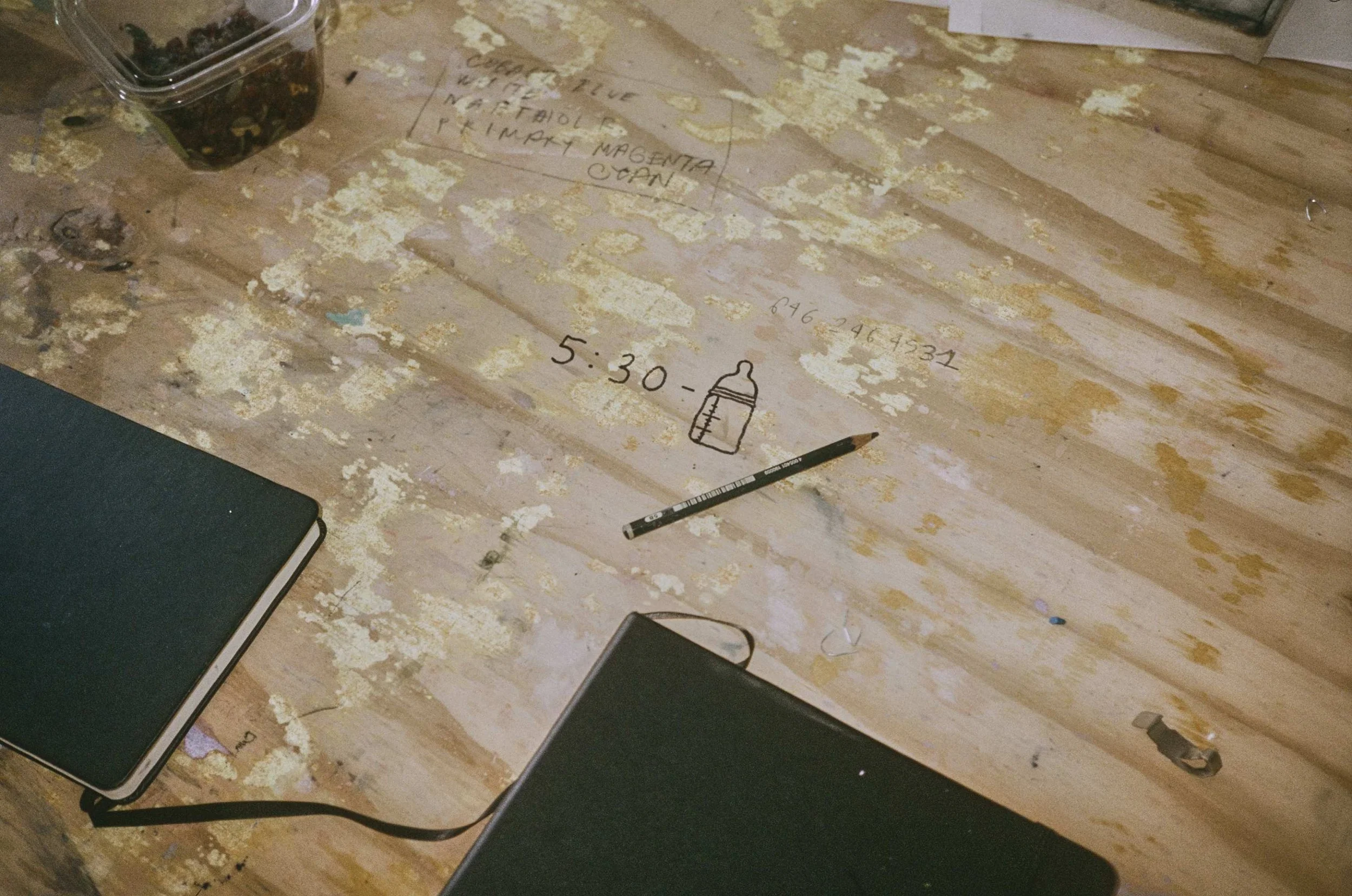
He and Marisha have been together for five years, and as I look around their studio, I’m struck by how closely their work coexists. I ask if the two of them have ever collaborated in their practices. “Well, we made a baby,” he laughs. The ultimate artistic feat. Their daughter is about to turn 1 and I glance behind me at the studio’s small couch, picturing the two artists laying together, soaking in their material and human creations. “Marisha is the first one to see anything I make,” he says. “Sometimes she criticizes, sometimes she looks up at me and says, ‘Stop! This is perfect.
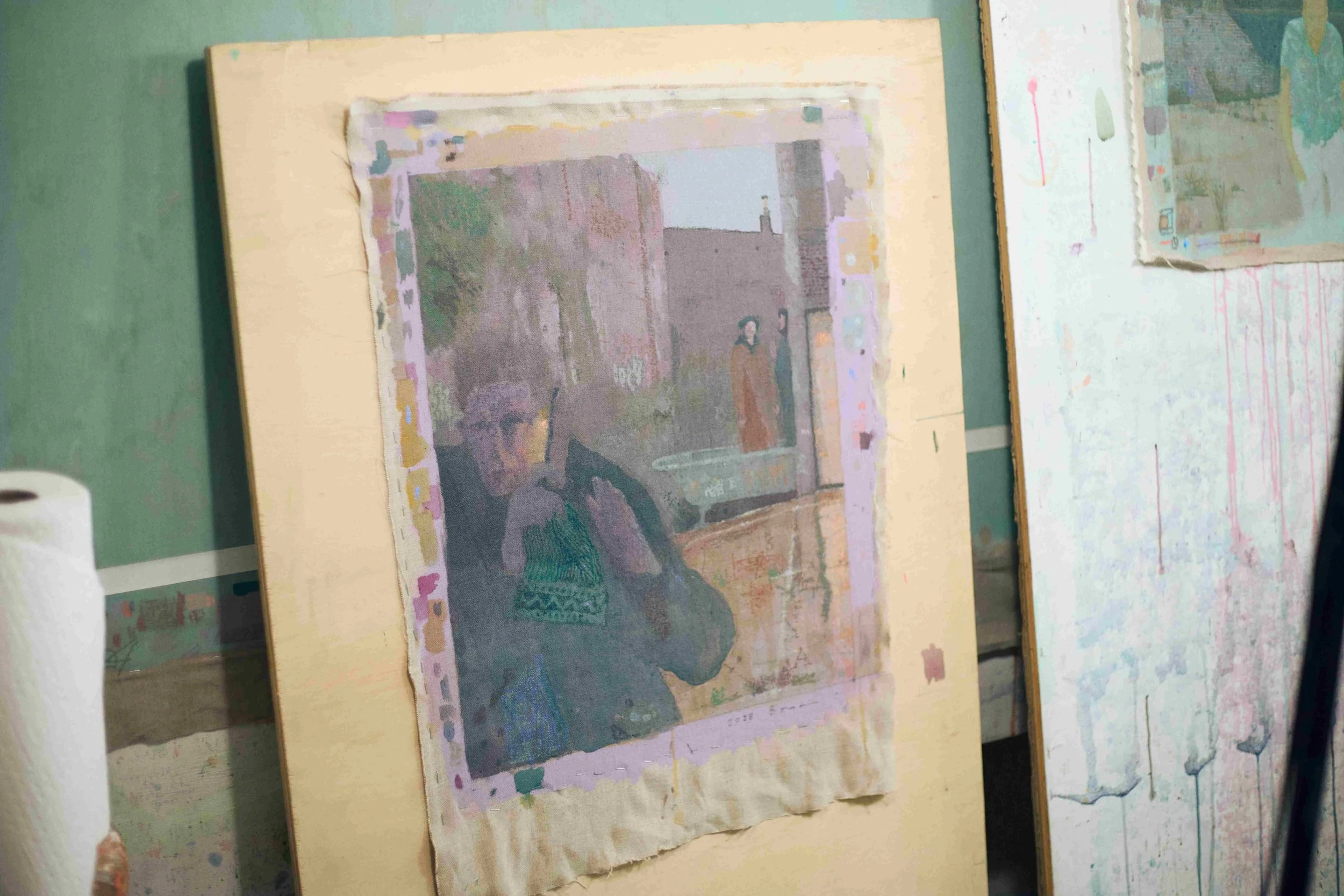
Sasha is fascinated by the way his daughter moves: how she turns her head, how her tiny fingers grasp one another. “Kids have their own very interesting way of moving and looking. It's especially interesting when you apply that to grown-up figures,” he explains. Abnormal movement is what makes his paintings come to life. Next to us, a nearly finished painting is stapled to a piece of plywood. In the background, two figures stand inside a bathtub surrounded by grungey lilac walls. A man stands in the foreground, reaching his right arm across his chest to hold a glowing phone up to his left ear, a green hat clutched in the same hand. “The phone is a part of body language now,” Sasha muses. “I saw this [scene] somewhere: a person was holding a phone and a hat with the same hand. It was such a strange pose.” Despite the phone, Sasha’s scenes don’t feel particularly modern or tied to an era. The subjects vary from work to work. What remains constant is a resistance to stagnancy. “To me, a good composition is one where there's some kind of tension and movement within the picture,” he states. “The space comes first. But sometimes it doesn’t feel right until I put down some kind of [human] figure that makes it more alive. The figures add movement into the static surroundings.” My instinct of sensing a migration in his works lands with him. There is a collective motion and activation in his scenes. “All these people are going somewhere,” he agrees, mulling over the concept in his head. “I’m capturing the feeling in space and people being a part of it.”
“I’m capturing the feeling in space and people being a part of it.”
This intangible feeling is something Sasha wrestles with, yet doesn’t feel the need to pin down. He turns to music. Raised on his dad’s cassettes of Tom Waits, Led Zeppelin, and The Beatles, he learned to play guitar. When he craved more than guitar, Sasha discovered GarageBand on his family computer, and quickly found himself fascinated with layering sounds over one another. “The sensation of recording a track and then recording another track on top of it was my first realization of, ‘Wow, I can make something on my own,’” he remembers. He and his friends started a high school band in his attic, eventually leading him to work with his former bandmate, Boris Krichevsky, who also attended the School of Visual Arts and studied film. The two of them run Csisterna, a music studio that creates scores for clients like Adidas, Chanel, Louis Vuitton, and Puma.
Sasha keeps art and music separate, but not very far apart. As our conversation comes to a close, he walks us out of the studio and in the direction of a neighboring building that houses his music studio. He confesses that he still dreams of being a famous musician, but when asked about whether he would play on stage in front of screaming fans, he responds, “I think not.” Sasha pulls out the cigarette from behind his ear, feeling it between his fingertips for a few seconds before raising it to his lips. He points out his favorite building across the street, admiring its bleak exterior against the blue sky and the weathered “United Talmudical Academy” sign. We stand for a few moments in silence, digesting the white noise, feeling the sun on our skin, and smelling the smoke. I feel the feeling that Sasha speaks of—the elusive sensation that hums in every corner of the city. “There's this feeling appearing in me,” he muses. “I’m just looking for this one, unifying color.”
This story was first published in print for Bias Cut 04: The Body Issue.